Erodium moschatum
(L.) L'Her ex Aiton
Musk Storksbill, Crowfoot, Musk-clover, White-stem filaree
(c) sihy, some rights reserved (CC BY-NC), uploaded by sihy

(c) Tom Chester, some rights reserved (CC BY-NC)

(c) Tom Chester, some rights reserved (CC BY-NC)
What to Eat
Edible parts: Leaves
Leaves can be eaten raw or cooked, added to salads or used as a potherb.
Where to Find It
It is a temperate and Mediterranean climate plant. It grows on cultivated and waste ground and along roadsides. Tasmania Herbarium.
Argentina, Australia, Chile, Europe, France, India, Italy, Korea, Mediterranean, New Zealand, Norfolk Island, North America, Portugal, Russia, Siberia, Sicily, Slovenia, South Africa, South America, Spain, Tasmania, Turkey, Türkiye, USA,
How to Identify
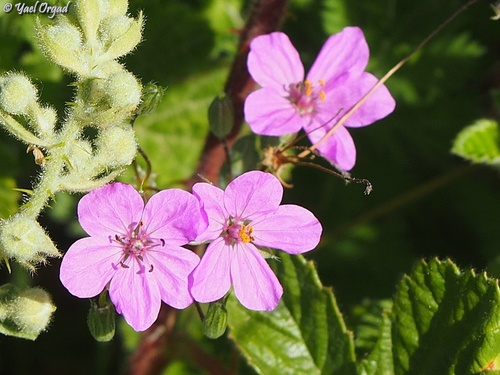
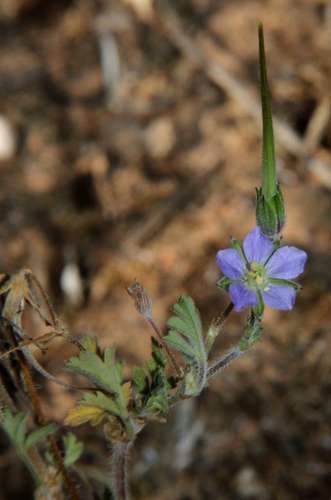
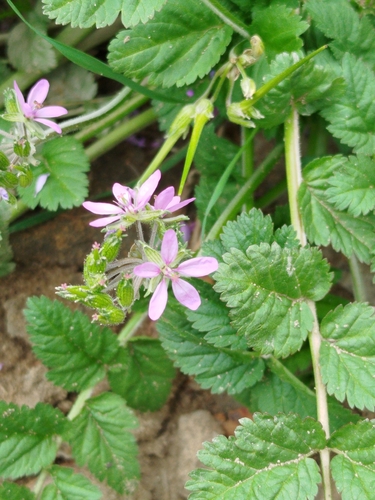
A herb which grows for one or two years. It can be erect or lie down. It grows to 50 cm high. The leaves are 10-30 cm long. The leaves are deeply dissected. This is almost to the midrib. There are 5-11 leaflets. These are 1-4 cm long by 0.5-3 cm wide. The leaf segments have teeth. The flowering stalks are in the axils of leaves. There are 6-10 or more flowers in a head. The stalks are 6-10 cm long. The petals are pink. The fruit has a beak 4-5 cm long. The beak on the seed is short. The plant smells of musk.
Nutrition Score: 22/100
| Part | Moisture | kJ | kcal | Protein | Vit A | Vit C | Iron | Zinc |
|---|---|---|---|---|---|---|---|---|
| Leaves | 88.9 | 139 | 33 | 2.5 | — | — | — | — |
How to Grow
Propagation: Sow seed in situ as soon as it is ripe in late summer, or alternatively in late spring. It usually germinates readily.
Medicinal Uses
The plant is febrifuge. A tincture of the plant is used in the treatment of dysentery.
Other Uses
A green dye can be obtained from the whole plant and requires no mordant.
Wikipedia
Source ↗Erodium moschatum is a species of flowering plant in the geranium family known by the common names musk stork's-bill and whitestem filaree. This is a weedy annual or biennial herb which is native to much of Eurasia and North Africa but can be found on most continents where it is an introduced species. In North America, it is found in most of the northeast United States and in Washington, Oregon, California, and Arizona, as well as the Canadian provices of Québec and Ontario.
Other Information
It is cultivated.
Notes
There are about 200 Erodium species.
Names & Synonyms
Ciyanotu, Donbaba, Ignelik, Kocakari ignesi, Kulunca, Muškatni čapljevec
References (28)
- Ahiskali, M., Ari, C. & Selvi, S., Edible wild plants and their consumption during winterin a rural village of Kazdagi (Mount Ida)
- W. Aiton, Hort. kew. 2:414. 1789
- Ambasta, S.P. (Ed.), 2000, The Useful Plants of India. CSIR India. p 202
- Beckstrom-Sternberg, Stephen M., and James A. Duke. "The Foodplant Database." http://probe.nalusda.gov:8300/cgi-bin/browse/foodplantdb.(ACEDB version 4.0 - data version July 1994)
- Biscotti, N. et al, 2018, The traditional food use of wild vegetables in Apulia (Italy) in the light of Italian ethnobotanical literature. Italian Botanist 5:1-24
- Blamey, M and Grey-Wilson, C., 2005, Wild flowers of the Mediterranean. A & C Black London. p 114
- Cordero, S. E., Abello, L. A., & Galvez, F. L., 2017, Plantas silvestres comestibles y medicinales de Chile y otras partes del mundo. CORMA p 172
- Curtis, W.M., 1956, The Students Flora of Tasmania Vol 1 p 93
- Dashorst, G.R.M., and Jessop, J.P., 1998, Plants of the Adelaide Plains & Hills. Botanic Gardens of Adelaide and State Herbarium. p 92
- Dogan, Y., 2012, Traditionally used wild edible greens in the Aegean Region of Turkey. Acta Societatis Botanicorum Poloniae 81(4): 329-342
- Ertug, F., 2004, Wild Edible Plants of the Bodrum Area. (Mugla, Turkey). Turk. J. Bot. 28 (2004): 161-174
- Ertug, F, Yenen Bitkiler. Resimli Türkiye Florası -I- Flora of Turkey - Ethnobotany supplement
- Flora of Australia Volume 49, Oceanic Islands 1, Australian Government Publishing Service, Canberra. (1994) p 257
- Food Composition Tables for the Near East. http://www/fao.org/docrep No. 419
- Gurdal, B. & Kultur, S., 2014, The edible and miscellaneous useful plants in Marmaris (Southwest Turkey). İstanbul Ecz. Fak. Derg. / J. Fac. Pharm. Istanbul 44(1) 2014 pp.69-78
- Hussey, B.M.J., Keighery, G.J., Cousens, R.D., Dodd, J., Lloyd, S.G., 1997, Western Weeds. A guide to the weeds of Western Australia. Plant Protection Society of Western Australia. p 166
- Hyde-Wyatt, B.H. & Morris D.I., 1975, Tasmanian Weed Handbook. Dept of Ag Tasmania. p 71
- Kayabasi, N. P., et al, 2018, Wild edible plants and their traditional use in the human nutrition in Manyas (Turkey). Indian Journal of Traditional Knowledge. Vol. 17(2), April 2018, pp 299-306
- Lamp, C & Collet F., 1989, Field Guide to Weeds in Australia. Inkata Press. p 120
- Lazarides, M. & Hince, B., 1993, Handbook of Economic Plants of Australia, CSIRO. p 95
- Licata, M., et al, 2016, A survey of wild plant species for food use in Sicily (Italy) – results of a 3-year study in four Regional Parks. Journal of Ethnobiology and Ethnomedicine 12:12
- Martin, F.W. & Ruberte, R.M., 1979, Edible Leaves of the Tropics. Antillian College Press, Mayaguez, Puerto Rico. p 193
- Paczkowska, G. & Chapman, A.R., 2000, The Western Australian Flora. A Descriptive Catalogue. Western Australian Herbarium. p 252
- Pasta, S., et al, 2020, An Updated Checklist of the Sicilian Native Edible Plants: Preserving the Traditional Ecological Knowledge of Century-Old Agro-Pastoral Landscapes. Frontiers in Plant Science. Volume 11|Article 388
- Plants for a Future database, The Field, Penpol, Lostwithiel, Cornwall, PL22 0NG, UK. http://www.scs.leeds.ac.uk/pfaf/
- Seidemann J., 2005, World Spice Plants. Economic Usage, Botany, Taxonomy. Springer. p 146
- Tasmanian Herbarium Vascular Plants list p 34
- Zeven, A. C. & de West, J. M. J., 1982, Dictionary of cultivated plants and their regions of diversity. Wageningen. p 108