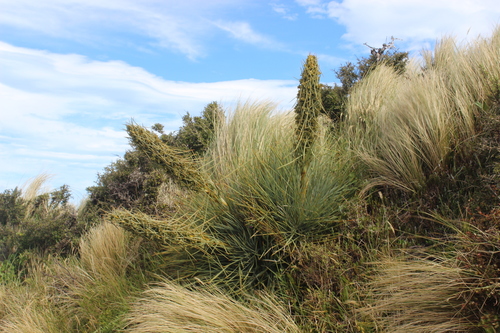
Azorella caespitosa
Cav.

GBIF

GBIF

GBIF
What to Eat
Edible parts: Root
Root - raw or cooked.
Where to Find It
Southern S. America - Argentina, Chile, Falkland Islands.
Coming Soon
How to Identify
Azorella caespitosa is an evergreen Perennial growing to 0.2 m (0ft 8in) by 0.6 m (2ft). It is in leaf all year. The species is hermaphrodite (has both male and female organs) and is pollinated by Insects. The plant is self-fertile. Suitable for: light (sandy) soils, prefers well-drained soil and can grow in nutritionally poor soil. Suitable pH: mildly acid, neutral and basic (mildly alkaline) soils. It cannot grow in the shade. It prefers dry or moist soil. The plant can tolerate maritime exposure.
How to Grow
We have very little information on this species and do not know if it will be hardy in Britain, though judging by its native range it should succeed outdoors in many parts of this country. It should also be very tolerant of maritime exposure. A mat forming plant, it can be up to 60cm in diameter. The following notes are based on the general needs of the genus. Requires a position in full sun in a well-drained gritty soil.
Propagation: Seed - we have no details for this species but suggest sowing the seed in late winter in a cold frame. Grow on for at least the first winter in a greenhouse or frame and plant out in late spring. Division.
Medicinal Uses
Hepatic Kidney. Hepatic. It is used in the treatment of liver and kidney problems.
Other Uses
ResinA resin is obtained from the plant. Its uses are not given in the report but are possibly connected to its medicinal properties.