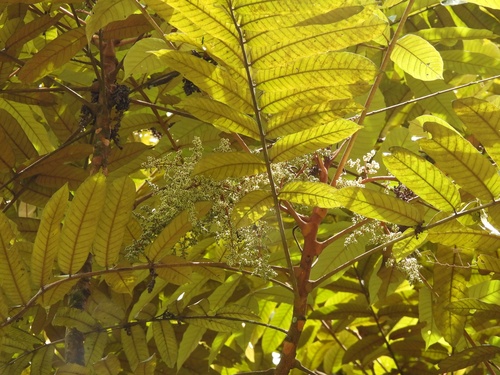
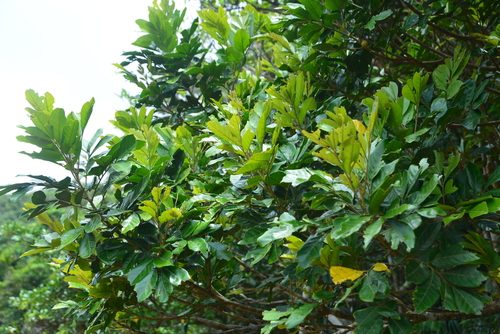
Aglaia odorata
Lour.
Chinese rice flower, Rice grain orchid

(c) multiplex, some rights reserved (CC BY-NC), uploaded by multiplex

(c) 106611639464075912591, some rights reserved (CC BY-NC-SA), uploaded by 106611639464075912591
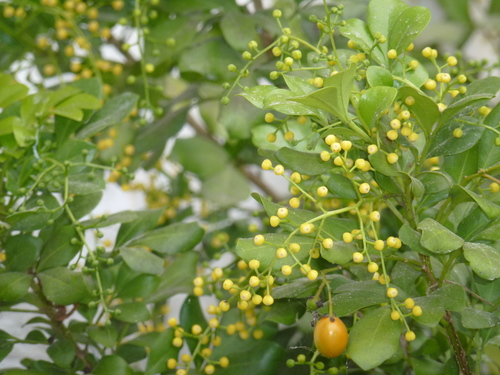
(c) Hungda, some rights reserved (CC BY-SA)
What to Eat
Edible parts: Flowers - flavouring, Leaves,Vegetable
The flowers are dried and used for scenting tea. The flowers are exquisitely scented, somewhat like vanilla but with spicy undertones. Tender young leaves - cooked and eaten as a vegetable.
Where to Find It
A tropical plant. It grows in rainforest. It needs a rich, fertile soil. It can grow in sun or light shade. It can grow in midly acidic or neutral soils. It needs a temperature above 15-18°C. In XTBG Yunnan. In Sichuan.
Asia, Cambodia, China, Hawaii, India, Indochina, Indonesia, Laos, Malaysia, Myanmar, Pacific, Philippines, SE Asia, Taiwan, Thailand, USA, Vietnam,
How to Identify
A small tree. It grows 5-8 m tall. The leaves have leaflets along the stalk. There are 3-7 leaflets opposite each other and these are 1-7 cm long by 1-4 cm wide. The flowers are golden yellow. They grow in clusters along the branches. They droop and have a scent. They smell like cymbidiums and look like rice grains which gives it its Chinese name. Trees are separately male and female.
How to Grow
Trees can be grown by air layering.
Propagation: Seed - Cuttings.
Medicinal Uses
Many parts of Aglaia odorata - roots, leaves, flowers and branches - can be used as medicine. The roots are boiled with water to make a drink to increase appetite. In the Philippines, the roots and leaves can be used as a tonic. The dried flowers are used to cure mouth ulcers and reduce fever. In China, the dried branches and leaves are boiled in water and used to reduce pain from rheumatic joints, injuries from falls, superficial infections and toxic swelling. According to research on branches by Yunnan Agricultural University and research on roots by Xishuangbanna Tropical Botanical Garden, Aglaia odorata has anti-cancer components: rocaglaol, molecular weight 434.48 g/mole and rocaglamide, molecular weight 505.55 g/mole. These components have significant cytotoxicity against blood cancer, liver cancer, lung cancer, breast cancer and colon cancer.
Other Uses
The genus 'Aglaia' is the only source of the group of about 50 known representatives of compounds that bear a unique cyclopenta[b]tetrahydrobenzofuran skeleton. These compounds are more commonly called rocaglate or rocaglamide derivatives, or flavaglines, and most have been found to have potent insecticidal properties, antifungal, antiviral, antibacterial or anthelmintic bioactivity. Several of them exhibit pronounced cytotoxic activity against a range of human cancers. Since the first representative in this group was only discovered in 1982, this is one of the few recent examples of a completely new class of plant secondary metabolites of biological promise (see B. G. Wang et al., Biochem. Syst. Ecol. 32: 1223-1226. 2004; L.W. Chaidir et al., J. Nat. Prod. 64: 1216-1220. 2001). The flowers are used to scent clothes, are added to potpourris and also used in making joss sticks. The dried flowers retain their perfume almost indefinitely. Flower pellets show potential as an organic herbicide for the control of barnyard grass weed. Organic extracts of the twigs and leaves yielded eight insecticidal cyclopentatetrahydrobenzofuran rocaglamide derivatives. The isolated rocaglamide derivatives exhibited strong insecticidal activity towards neonate larvae of the polyphagous pest insect Spodophera littoralis when incorporated into artificial diet. The wood is particularly good for turnery. A good, if slow growing, hedge plant. When trimmed regularly, the plant forms a dense, neat hedge. Very amenable to trimming, it is used for topiary in Asia.
Wikipedia
Source ↗Aglaia odorata is a species of flowering plant in the family Meliaceae. It is found in Cambodia, Southeast China, Hainan, Laos, Malaysia, Thailand, and Vietnam. It is occasionally sold as a house plant under the name "Chinese perfume plant." It can be grown outdoors in USDA zones 9 and 10.
Production
In China plants flower May to December and fruit July to March.
Other Information
It is cultivated.
Notes
Used as a medicine in Indonesia. There are about 104 Aglaia species. They occur in Asia and the Pacific.
Names & Synonyms
Hom klai, Kai thian, Ka sum nok, Juran, Mi zi lan, Mizilan, Mock lime, Pacar cina, Peppery orchid tree, Prayong, San-yeh-lan, Thanatka-wa, Thanathka-pan, Trayang, Tro yong
References (19)
- Ambasta S.P. (Ed.), 2000, The Useful Plants of India. CSIR India. p 21
- Biocyclopedia Edible Plant Species. biocyclopedia.org
- Bircher, A. G. & Bircher, W. H., 2000, Encyclopedia of Fruit Trees and Edible Flowering Plants in Egypt and the Subtropics. AUC Press. p 14
- Brouk, B., 1975, Plants Consumed by Man. Academic Press, London. p 330
- Brown, D., 2002, The Royal Horticultural Society encyclopedia of Herbs and their uses. DK Books. p 107
- Facciola, S., 1998, Cornucopia 2: a Source Book of Edible Plants. Kampong Publications, p 149
- Fl. cochinch. 1:173. 1790
- Hedrick, U.P., 1919, (Ed.), Sturtevant's edible plants of the world. p 30
- Hu, Shiu-ying, 2005, Food Plants of China. The Chinese University Press. p 507
- Liu, Yi-tao, & Long, Chun-Lin, 2002, Studies on Edible Flowers Consumed by Ethnic Groups in Yunnan. Acta Botanica Yunnanica. 24(1):41-56
- Marinelli, J. (Ed), 2004, Plant. DK. p 94
- McMakin, P.D., 2000, Flowering Plants of Thailand. A Field Guide. White Lotus. p 29
- Phon, P., 2000, Plants used in Cambodia. © Pauline Dy Phon, Phnom Penh, Cambodia. p 15
- Slik, F., www.asianplant.net
- Staples, G.W. and Herbst, D.R., 2005, A tropical Garden Flora. Bishop Museum Press, Honolulu, Hawaii. p 398 (Drawing)
- Valder, P., 1999, The Garden Plants of China. Florilegium. p 261
- Wijayakusuma, H.M.H., et al, 1996, Tanaman Berkhasiat Obat Di Indonesia. Pustaka Kartini. p 99
- Wongprasert, T. et al, 2011, A Synoptic Account of the Meliaceae of Thailand. Thai For. Bull. 39:210-266
- World Checklist of Useful Plant Species 2020. Royal Botanic Gardens, Kew