Euclea crispa
(Thunb.) Guerke
Blue guarri, Blue-leaved euclea

(c) Reuben Heydenrych, some rights reserved (CC BY-NC), uploaded by Reuben Heydenrych
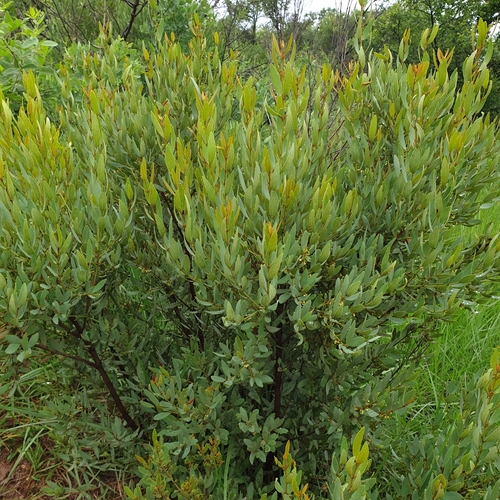
(c) Rouxne Botha, some rights reserved (CC BY-NC), uploaded by Rouxne Botha
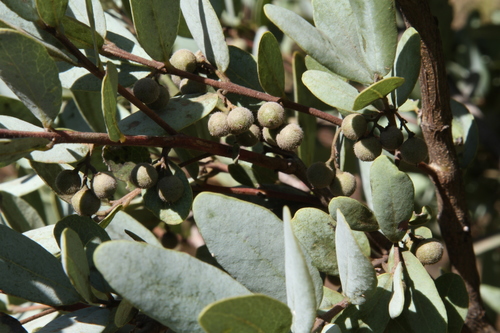
(c) fayne, some rights reserved (CC BY-NC), uploaded by fayne
What to Eat
Edible parts: Fruit, Leaves
The ripe fruit and leaves are edible. The leaves are eaten as an appetiser.
Known Hazards
Where to Find It
A tropical plant. It grows in open woodland among rocks and at the edge of forests. In Malawi it is mainly in scrub among rocks. It can grow in arid places. In Zimbabwe it grows between 1,100-2,300 m above sea level.
Africa, Angola, Botswana, Central Africa, Congo, East Africa, Eswatini, Lesotho, Malawi, Mozambique, Slovenia, South Africa, Southern Africa, Swaziland, Zambia, Zimbabwe,
How to Identify
A shrub. It grows 1-2 m high. It can be up to 8 m tall. The bark is grey and smooth. The leaves are sword shaped and 1.5-5 cm long by 0.5-1.5 cm wide. The colour of the green can vary but leaves are paler underneath. The flowers are very small and green to yellow. There are 3-10 flowers in sprays in the axils of leaves. The fruit is a round berry the size of a pea. It is red but becomes black when ripe. The fruit is edible. There is one seed.
Nutrition
| Part | Moisture | kJ | kcal | Protein | Vit A | Vit C | Iron | Zinc |
|---|---|---|---|---|---|---|---|---|
| Fruit | 81.2 | — | — | — | — | — | 2.1 | 0.2 |
How to Grow
Plants can be grown from seeds.
Medicinal Uses
The fruit are traditionally used as a purgative.
Wikipedia
Source ↗Euclea crispa, commonly known as the blue guarri, is an Afrotropical plant species of the family Ebenaceae. The hardy and evergreen plants may form a dense stand of shrubs, or grow to tree size. It is widespread and common in the interior regions of southern Africa, and occurs northward to the tropics. Though some are present near the South African south and east coasts, they generally occur at middle to high altitudes. It is readily recognizable from its much-branched structure and dull bluish foliage colour. Those bearing lanceolate leaves may however resemble the Wild olive, another common species of the interior plateaus.
Production
It is fairly slow growing.
Notes
There are 12-15 Euclea species. Euclea are restricted to Africa, Arabia, Comoros and Socotra.
Names & Synonyms
Bloughwarrie, Bosghwarrie, Guarri, Gwari-gwari, Idungamuzi, Inchitsamuti, Indodennyama, Indvodzemnyama, Iyeza-lokuxaxazisa, Madziyire, Mohlakolo, Mokgwelekgwele, Mokveretani, Motakola, Mothagola, Motlhakola, Motsetlele, Motsoetla, Mulala, Mulhangule, Musingaranguru, Mutangule, Mutangulenyele, Muvhinji, Myamatanemkhulu, Nhlangula, Sijele, Tshlangula, Umgwali, Umgwate, Umndlela, Umtjekezane
References (25)
- Facciola, S., 1998, Cornucopia 2: a Source Book of Edible Plants. Kampong Publications, p 92
- Fowler, D. G., 2007, Zambian Plants: Their Vernacular Names and Uses. Kew. p 24
- Fox, F. W. & Young, M. E. N., 1982, Food from the Veld. Delta Books. p 186
- Guillarmod, J., 1971,
- https://growwild.co.za Edible Indigenous plants
- INFOODS:FAO/INFOODS Databases
- Joffe, P., 2007, Creative Gardening with Indigenous Plants. A South African Guide. Briza. p 56
- Long, C., 2005, Swaziland's Flora - siSwati names and Uses http://www.sntc.org.sz/flora/
- Magwede, K., van Wyk, B.-E., & van Wyk, A. E., 2019, An inventory of Vhavenḓa useful plants. South African Journal of Botany 122 (2019) 57–89
- Maroyi, A., 2011, The Gathering and Consumption of Wild Edible Plants in Nhema Communal Area, Midlands Province, Zimbabwe. Ecology of Food and Nutrition 50:6, 506-525
- Mashile, S. P., et al, 2019, Indigenous fruit plants species of the Mapulana of Ehlanzeni district in Mpumalanga province, South Africa. South African Journal of Botany 122 (2019) 180–183
- Njuguna, P.M., 2005. Euclea divinorum Hiern. [Internet] Record from Protabase. Jansen, P.C.M. & Cardon, D. (Editors). PROTA (Plant Resources of Tropical Africa), Wageningen, Netherlands. < http://database.prota.org/search.htm>. Accessed 16 October 2009.
- Palgrave, K.C., 1996, Trees of Southern Africa. Struik Publishers. p 736
- Peters, C. R., O'Brien, E. M., and Drummond, R.B., 1992, Edible Wild plants of Sub-saharan Africa. Kew. p 106
- Royal Botanic Gardens, Kew (1999). Survey of Economic Plants for Arid and Semi-Arid Lands (SEPASAL) database. Published on the Internet; http://www.rbgkew.org.uk/ceb/sepasal/internet [Accessed 16th April 2011]
- Ruiters-Welcome, A. K., 2019, Food plants of southern Africa. Ph.D. thesis. Univ. of Johannesburg p 53
- Schmidt, E., Lotter, M., & McCleland, W., 2007, Trees and shrubs of Mpumalanga and Kruger National Park. Jacana Media p 520
- Swaziland's Flora Database http://www.sntc.org.sz/flora
- Tredgold, M.H., 1986, Food Plants of Zimbabwe. Mambo Press. p 67
- van Wyk, B, van Wyk, P, and van Wyk B., 2000, Photographic guide to Trees of Southern Africa. Briza. p 139
- Wehmeyer, A. S, 1986, Edible Wild Plants of Southern Africa. Data on the Nutrient Contents of over 300 species
- Welcome, A. K. & Van Wyk, B.-E., 2019, An inventory and analysis of the food plants of southern Africa. South African Journal of Botany 122 (2019) 136–179
- White, F., Dowsett-Lemaire, F. and Chapman, J. D., 2001, Evergreen Forest Flora of Malawi. Kew. p 227
- World Checklist of Useful Plant Species 2020. Royal Botanic Gardens, Kew
- www.zimbabweflora.co.zw 2011


