Euclea natalensis
A. DC.
Natal ebony, Large-leaved euclea, Hairyleaved guarri

(c) JMK, some rights reserved (CC BY-SA)
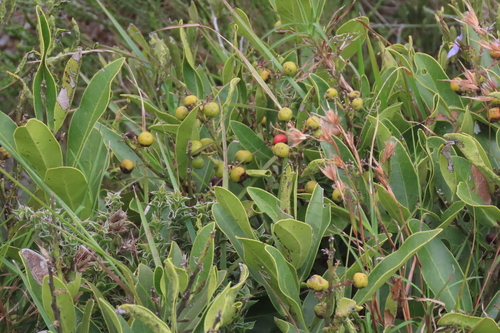
(c) Roland Morisse, some rights reserved (CC BY-NC), uploaded by Roland Morisse
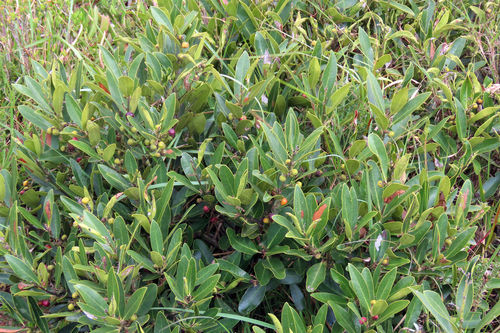
(c) Roland Morisse, some rights reserved (CC BY-NC), uploaded by Roland Morisse
What to Eat
Edible parts: Fruit, Caution
The fruit is edible.
Known Hazards
Where to Find It
It is a tropical and subtropical plant. It usually grows in coastal areas. It grows along river banks. It can grow from sea level to 1200 m altitude. Young plants need protecting from frost. It can grow in arid places. It suits hardiness zones 9-12. In Brisbane Botanical Garden.
Africa, Angola, Australia, Botswana, Central Africa, Congo, East Africa, Eswatini, Kenya, Malawi, Mozambique, South Africa, Southern Africa, Swaziland, Tanzania, Zambia, Zimbabwe,
How to Identify
A small tree. In dry areas it can be a stunted shrub 60 cm high but can grow to 12 m high. The trunk can be 46 cm across. The branches are spreading. The leaves are alternate. They are hard and leathery. They are dark green and shiny above and paler below. There can be thick velvety hairs. Leaves are 3-11 cm long and 0.8-5 cm wide. They are oblong and the base is narrowed. The flowers are small and bell-shaped. They are yellow and in many flowered sprays. These are 2.5-5 cm long and in the axils of leaves. Male and female flowers occur on separate trees. The fruit are round and 0.8-1.3 cm across. The fruit stalks are hairy. There is one seed inside. The fruit can be yellow, red or black. The fruit are edible.
How to Grow
A plant of tropical and subtropical areas, usually in drier regions at low to moderate elevations. At least one subspecies, E. Natalensis rotundifolia, is tolerant of salt spray. A very variable species, eight subspecies are recognised. A dioecious species, both male and female forms need to be grown if fruit and seeds are required.
Medicinal Uses
It is used in medicine.
Other Uses
A black dye is obtained from the bark of the roots. It is said to be a good floor stain, and is also used for dying mats. The roots are also chewed by women to impart a red colour to their mouths. Both the peeled twigs and unpeeled roots are used as chewing sticks in order to clean the teeth and maintain oral hygiene. The bark contains compounds with antimicrobial activity and is best left on the stem when chewing.
Wikipedia
Source ↗Euclea natalensis, the Natal guarri, is a dioecious African plant species of the family Ebenaceae. It occurs from Ethiopia and Somalia in the north, southwards to the Western Cape, South Africa. It has nectar and also contains pollen Its hirsute, leathery leaves have an opposite arrangement, and the flower sprays grow from the leaf axils. The spherical fruit appear from October to June.
Notes
It is used in medicine.
Names & Synonyms
Bergghwarrie, Inchitsamuzi, Indvodzemnyma, Kitana, Large-leaved guarri, Mcriparipa, Mulala, Mungulenyele, Mutangulethavha, Natal gwarri, Nkunzemnyama, Uchangula, Umchitamuzi
References (17)
- Etherington, K., & Imwold, D., (Eds), 2001, Botanica's Trees & Shrubs. The illustrated A-Z of over 8500 trees and shrubs. Random House, Australia. p 310
- Fowler, D. G., 2007, Zambian Plants: Their Vernacular Names and Uses. Kew. p 24
- INFOODS:FAO/INFOODS Databases
- Joffe, P., 2007, Creative Gardening with Indigenous Plants. A South African Guide. Briza. p 91
- Long, C., 2005, Swaziland's Flora - siSwati names and Uses http://www.sntc.org.sz/flora/
- Magwede, K., van Wyk, B.-E., & van Wyk, A. E., 2019, An inventory of Vhavenḓa useful plants. South African Journal of Botany 122 (2019) 57–89
- Palgrave, K.C., 1996, Trees of Southern Africa. Struik Publishers. p 739
- Palmer, E and Pitman, N., 1972, Trees of Southern Africa. Vol. 3. A.A. Balkema, Cape Town p 1773
- Peters, C. R., O'Brien, E. M., and Drummond, R.B., 1992, Edible Wild plants of Sub-saharan Africa. Kew. p 105
- Royal Botanic Gardens, Kew (1999). Survey of Economic Plants for Arid and Semi-Arid Lands (SEPASAL) database. Published on the Internet; http://www.rbgkew.org.uk/ceb/sepasal/internet [Accessed 16th April 2011]
- Ruiters-Welcome, A. K., 2019, Food plants of southern Africa. Ph.D. thesis. Univ. of Johannesburg p 53
- Schmidt, E., Lotter, M., & McCleland, W., 2007, Trees and shrubs of Mpumalanga and Kruger National Park. Jacana Media p 522
- Swaziland's Flora Database http://www.sntc.org.sz/flora
- Wehmeyer, A. S, 1986, Edible Wild Plants of Southern Africa. Data on the Nutrient Contents of over 300 species
- Welcome, A. K. & Van Wyk, B.-E., 2019, An inventory and analysis of the food plants of southern Africa. South African Journal of Botany 122 (2019) 136–179
- White, F., Dowsett-Lemaire, F. and Chapman, J. D., 2001, Evergreen Forest Flora of Malawi. Kew. p 229
- World Checklist of Useful Plant Species 2020. Royal Botanic Gardens, Kew


