Euclea undulata
Thunb.
Common guarri, Thicket euclea, Small-leaved guarri bush

(c) Gawie Malan, some rights reserved (CC BY-NC), uploaded by Gawie Malan

(c) Tony Rebelo, some rights reserved (CC BY-SA), uploaded by Tony Rebelo
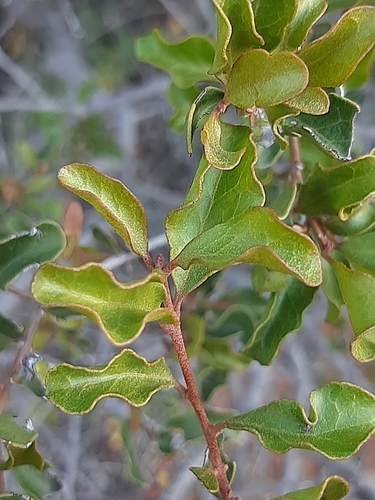
(c) Johan Eksteen, some rights reserved (CC BY-NC), uploaded by Johan Eksteen
What to Eat
Edible parts: Fruit
The fruit are eaten fresh and are commonly used in Namibia. The fruit are also bruised and fermented to make vinegar.
Where to Find It
A tropical plant. It grows on open rocky slopes. It can grow in arid places. It suits hardiness zones 8-10.
Africa, Botswana, East Africa, Eswatini, Mozambique, Namibia, South Africa, Southern Africa, Swaziland, Zimbabwe,
How to Identify
A small tree. The crown is round. They can be 6 m tall. There are many branches. The leaves are simple and small. They are 1.3-4 cm long by 6-15 mm wide. They are often clustered near the ends of branches. The flowers are small and white or yellow. They have a smell. Flowers occur in clusters in the axils of leaves. Trees are separately male and female. The fruit are small berries which turn red then black. They have one seed. The fruit are edible.
How to Grow
Tolerates low concentrations of copper in the soil. It is also locally dominant as dwarfed plants on soils with a high antimony and arsenic content. A dioecious species, both male and female forms need to be grown if fruit and seed are required.
Medicinal Uses
The bark is used for the treatment of headaches, toothaches and other pains. An infusion of the leaves is taken to treat diarrhoea and disorders of the stomach, and as a gargle to relieve tonsillitis. Root infusions are used as enemas, or as an ingredient of inembe (medication taken regularly during pregnancy to ensure a trouble-free confinement. The use of root preparations to induce emesis or purgation is also recorded. Several medically active compounds have been identified in the plant. The branches and leaves contain triterpenoids, tannins, saponins and reducing sugars. The fruits contain the napthoquinone isodiospyrin. The naphthoquinones 7-methyl-juglone (a) and diospyrin (b) have been isolated from the roots. The bark is reported to contain 3.26% of tannin. Aqueous extracts, prepared from dried leaf material at a concentration of 40mg/ml, have shown antimicrobial activity against Staphylococcus aureus. This result, together with the demonstrated presence of tannins in the leaves of this species, supports its use as an anti-diarrhoeal and for the relief of tonsillitis. As both anti-diarrhoeal and purgative actions are reported for this species, dosage and method of preparation require standardisation. Its use as an anti-diarrhoeal by pregnant women and children is not for the present recommended.
Other Uses
The twigs can be frayed and used as a toothbrush. The wood is brown, hard, close-grained, and fit for joiners' fancy work, veneering.
Other Information
The fruit are commonly used in Namibia.
Names & Synonyms
Gwarri, Santinyana, Umgwali
References (17)
- De Vynk, J. C., et al, 2016, Indigenous edible plant use by contemporary Khoe-San descendants of South Africa's Cape South Coast. South African Journal of Botany. 102 (2016) 60-69
- Etherington, K., & Imwold, D., (Eds), 2001, Botanica's Trees & Shrubs. The illustrated A-Z of over 8500 trees and shrubs. Random House, Australia. p 310
- Fox, F. W. & Young, M. E. N., 1982, Food from the Veld. Delta Books. p 187 (As var. myrtina)
- Hedrick, U.P., 1919, (Ed.), Sturtevant's edible plants of the world. p 295
- Long, C., 2005, Swaziland's Flora - siSwati names and Uses http://www.sntc.org.sz/flora/
- Mannheimer, C. A. & Curtis. B.A. (eds), 2009, Le Roux and Muller's Field Guide to the Trees and Shrubs of Namibia. Windhoek: Macmillan Education Namibia. p 386
- Palgrave, K.C., 1996, Trees of Southern Africa. Struik Publishers. p 741
- Palmer, E and Pitman, N., 1972, Trees of Southern Africa. Vol. 3. A.A. Balkema, Cape Town p 1781
- Peters, C. R., O'Brien, E. M., and Drummond, R.B., 1992, Edible Wild plants of Sub-saharan Africa. Kew. p 106
- Royal Botanic Gardens, Kew (1999). Survey of Economic Plants for Arid and Semi-Arid Lands (SEPASAL) database. Published on the Internet; http://www.rbgkew.org.uk/ceb/sepasal/internet [Accessed 16th April 2011]
- Ruiters-Welcome, A. K., 2019, Food plants of southern Africa. Ph.D. thesis. Univ. of Johannesburg p 53
- Schmidt, E., Lotter, M., & McCleland, W., 2007, Trees and shrubs of Mpumalanga and Kruger National Park. Jacana Media p 526 (As var. myrtina)
- Shava, S., 2000, The Use of Indigenous Plants as Food by a Rural Community in the Eastern Cape: an Educational Exploration. Masters Thesis Rhodes University. p 65
- Swaziland's Flora Database http://www.sntc.org.sz/flora
- van Wyk, B, van Wyk, P, and van Wyk B., 2000, Photographic guide to Trees of Southern Africa. Briza. p 142
- Welcome, A. K. & Van Wyk, B.-E., 2019, An inventory and analysis of the food plants of southern Africa. South African Journal of Botany 122 (2019) 136–179
- World Checklist of Useful Plant Species 2020. Royal Botanic Gardens, Kew


