Agrimonia eupatoria
L.
Agrimony, Salt and Pepper

(c) Mikko Lehikoinen, some rights reserved (CC BY-NC), uploaded by Mikko Lehikoinen

(c) Sarah Gregg, some rights reserved (CC BY-NC-SA), uploaded by Sarah Gregg
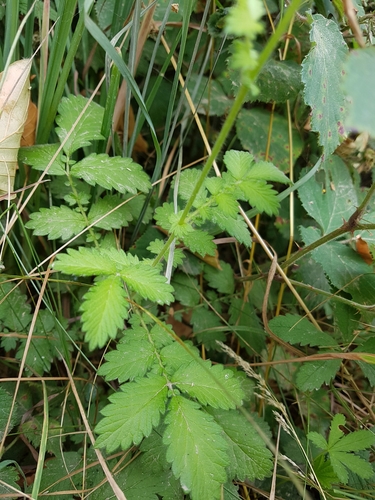
(c) mettetron, some rights reserved (CC BY-NC), uploaded by mettetron
What to Eat
Edible parts: Seeds, Leaves - tea, Vegetable
A refreshing tea can be brewed from the fresh or dried leaves, flowers, and stems, served hot or cold. It was once widely popular on its own or blended with China tea, prized for its delicate flavour and aroma. The seeds can also be dried and ground into a meal, though this is a famine food used only when other options are exhausted — note that this use may refer to A. pilosa Ledeb. rather than this species.
Known Hazards
Where to Find It
A temperate plant. It usually grows on alkaline soils and in sunny positions. It suits hardiness zones 6-10.
Africa, Albania, Andorra, Asia, Australia, Balkans, Bosnia, Britain, Canada, China, East Africa, Europe, France, Germany, Greece, Hungary, India, Iran, Iraq, Italy, Lesotho, Luxembourg, Macedonia, Mediterranean, Middle East, Myanmar, Netherlands, North America, Portugal, SE Asia, Serbia, Slovenia, Southern Africa, Spain, Switzerland, Turkey, Türkiye, Zimbabwe,
How to Identify
A perennial herb growing 60 cm high and 45 cm across. The leaves are 20 cm long. These have up to 14 pairs of leaflets. They have bristles underneath. The flowers occur in clusters. These are open flower heads. They are yellow. They are born on the stem.
How to Grow
Easily grown in most soils, preferring a calcareous soil. Thrives in a dry lightly shaded position, though it prefers full sun. Plants usually self-sow quite freely when growing in a suitable position. The seeds are contained in burrs that can easily attach themselves to clothing or animal's fur, thus transporting them to a new area where they can germinate and grow. The cultivar 'Sweet scented' is popular in France for making tea because the whole plant is sweet scented and the flowers have a spicy apricot-like fragrance.
Propagation: Seed can be sown in spring or autumn, either in pots in a cold frame or directly in situ. Germination typically takes 2–6 weeks at 13°C, though rates can be low — particularly with stored seed. Cold stratification improves germination but is not essential. When raising in pots, prick out seedlings once large enough to handle and plant out in late spring or early summer. Division in autumn is very easy; divisions can be planted straight into their permanent positions.
Medicinal Uses
The medicinal part used is the flowering plant, cut an inch or two above the ground and dried. Agrimony has a long history as a domestic herbal remedy. The whole plant is antiaphonic, astringent, a blood purifier, cholagogue, diuretic, tonic, and vulnerary, containing up to 5% tannin, which provides its strongly astringent character. Taken internally, an infusion is well regarded for treating jaundice and liver complaints, diarrhoea, and sore throats when used as a gargle. Externally, a strong decoction is applied to wounds, skin problems, and haemorrhoids. The plant is harvested in late spring to early summer and can be dried for later use. It also features in Bach flower remedies, prescribed under the keywords 'Mental torture' and 'Worry, concealed from others'. It is contraindicated in cases of hypersensitivity to plants in the rose family, and during pregnancy and lactation. The German Commission E Monographs approve it for diarrhoea, inflammation of the skin, and inflammation of the mouth and pharynx.
Other Uses
A yellow dye is obtained from the plant — sourced from the root, the whole plant, or the leaves depending on the account. Harvested in autumn, the yellow deepens the later in the season the plant is collected. The plant is also noted as a scented species.
Wikipedia
Source ↗Agrimonia eupatoria is a species of agrimony that is often referred to as common agrimony, church steeples or sticklewort. The whole plant is dark green with numerous soft hairs. The soft hairs aid in the plant's seed pods sticking to any animal or person coming in contact with the plant. The flower spikes have a spicy odor like apricots. In the language of flowers, agrimony means thankfulness or gratitude. Agrimonia eupatoria is a foodplant for the caterpillars of the snout moth Endotricha flammealis.
Notes
There are 15 Agrimonia species. They grow in the northern temperate zones. It is used in medicine.
Names & Synonyms
Agrimonia, Bojtorjan, Bojtorvan, Church Steeples, Cocklebur, Hemp agrimony, Liverwort, Navadni repik, Parlofu, Petrovac, Repcsik, Sticklewort, Tudofu
References (20)
- Abbet, C., et al, 2014, Ethnobotanical survey on wild alpine food plants in Lower and Central Valais (Switzerland). Journal of Ethnopharmacology 151 (2014) 624–634
- Ambasta S.P. (Ed.), 2000, The Useful Plants of India. CSIR India. p 22
- Blanco-Salas, J., et al, 2019, Wild Plants Potentially Used in Human Food in the Protected Area “Sierra Grande de Hornachos” of Extremadura (Spain). Sustainability 2019, 11, 456
- Bodkin, F., 1991, Encyclopedia Botanica. Cornstalk publishing, p 59
- Bonet, M. A. & Valles, J., 2002, Use of non-crop food vascular plants in Montseny biosphere reserve (Catalonia, Iberian Peninsula). International Journal of Food Sciences and Nutrition (2002) 53, 225–248
- Bremness, L., 1994, Herbs. Collins Eyewitness Handbooks. Harper Collins. p 139
- Brown, D., 2002, The Royal Horticultural Society encyclopedia of Herbs and their uses. DK Books. p 105
- Cundall, P., (ed.), 2004, Gardening Australia: flora: the gardener's bible. ABC Books. p 118
- Denes, A., et al, 2012, Wild plants used for food by Hungarian ethnic groups living inthe Carpathian Basin. Acta Societatis Botanicorum Poloniae 81 (4): 381-396
- Esperanca, M. J., 1988. Surviving in the wild. A glance at the wild plants and their uses. Vol. 1. p 24
- Facciola, S., 1998, Cornucopia 2: a Source Book of Edible Plants. Kampong Publications, p 192
- Hedrick, U.P., 1919, (Ed.), Sturtevant's edible plants of the world. p 30
- Janaćković, P. et al, 2019, Traditional knowledge on plant use from Negotin Krajina (Eastern Serbia): An ethnobotanical study. Indian Journal of Traditional Knowledge Vol 18 (1), pp 25-33
- Michael, P., 2007, Edible Wild Plants and Herbs. Grub Street. London. p 10
- Plants for a Future database, The Field, Penpol, Lostwithiel, Cornwall, PL22 0NG, UK. http://www.scs.leeds.ac.uk/pfaf/
- READ
- Redzic, S. J., 2006, Wild Edible Plants and their Traditional Use in the Human Nutrition in Bosnia-Herzegovina. Ecology of Food and Nutrition, 45:189-232
- Sp. pl. 1:448. 1753
- Vermeulen, N, 1998, The Complete Encyclopedia of Herbs. Rebo Publishers. p 29
- World Checklist of Useful Plant Species 2020. Royal Botanic Gardens, Kew
More from Rosaceae


