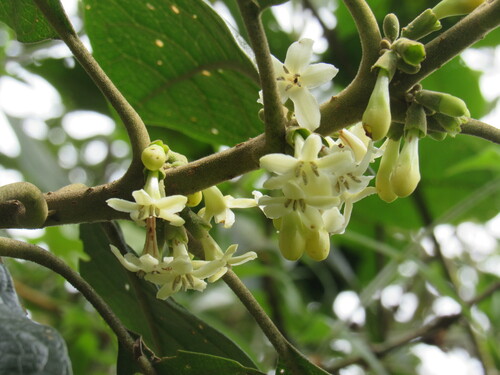
Monarda punctata
L.
Horse Mint, Spotted beebalm

(c) Mark Kluge, some rights reserved (CC BY-NC), uploaded by Mark Kluge

(c) dogtooth77, some rights reserved (CC BY-NC-SA)

(c) Tom Potterfield, some rights reserved (CC BY-NC-SA)
What to Eat
Tea. Leaves - raw or cooked. A strong aromatic taste, they are used as a flavouring in salads and cooked foods, and also as an aromatic tea.
Where to Find It
N. America - Louisiana and Florida, north to Long Island.
NORTHERN AMERICA: United States (Connecticut, Indiana, Massachusetts, Michigan, New Jersey, New York, Ohio, Pennsylvania (south), Vermont, Iowa, Kansas, Minnesota (southeast), Missouri, Illinois, Oklahoma, Wisconsin, Alabama, Arkansas, Florida, Georgia, Kentucky, Louisiana, Maryland, Mississippi, North Carolina, South Carolina, Tennessee, Virginia, New Mexico, Texas), Mexico (Tamaulipas)
How to Identify
Monarda punctata is a ANNUAL/PERENNIAL growing to 0.8 m (2ft 7in) by 0.4 m (1ft 4in). See above for USDA hardiness. It is hardy to UK zone 6. It is in flower from July to September. The species is hermaphrodite (has both male and female organs) and is pollinated by Bees. The plant is self-fertile. It is noted for attracting wildlife. Suitable for: light (sandy), medium (loamy) and heavy (clay) soils and can grow in heavy clay soil. Suitable pH: mildly acid, neutral and basic (mildly alkaline) soils. It can grow in semi-shade (light woodland) or no shade. It prefers dry or moist soil.
How to Grow
Easily grown in ordinary garden soil so long as it is not too dry. Requires a moist soil and a sunny position. This species prefers a light dry alkaline soil. Plants are hardy to about -10°c and should succeed outdoors in most parts of Britain. A polymorphic species. A good bee plant. Subject to mildew in dry summers.
Propagation: Seed - sow mid to late spring in a cold frame. Germination usually takes place within 10 - 40 days at 20°c. When large enough to handle, prick the seedlings out into individual pots and plant them out into their permanent positions in early summer. The seed can also be sown in situ in late summer in areas where the winters are not too severe and will produce larger plants. Cuttings of soft basal shoots in spring. Harvest the shoots with plenty of underground stem when they are about 8 - 10cm above the ground. Pot them up into individual pots and keep them in light shade in a cold frame or greenhouse until they are rooting well. Plant them out in the summer. Division in spring or autumn. Large divisions can be planted out direct into their permanent positions. We have found that it is better to pot up the smaller divisions and grow them on in light shade in a cold frame until they are well established before planting them out in late spring or early summer.
Medicinal Uses
Antiseptic Carminative Diaphoretic Diuretic Emmenagogue Rubefacient Stimulant Stomachic Vesicant. Horse mint was traditionally taken by several native North American Indian tribes to treat nausea and vomiting, and to encourage perspiration during colds. It was also applied externally as a poultice to treat swellings and rheumatic pains. Nowadays it is used primarily to treat digestive and upper respiratory tract problems. The leaves are carminative, diaphoretic, diuretic, emmenagogue, rubefacient, stimulant, stomachic and vesicant. An infusion of the leaves is used in the treatment of flatulence, nausea, indigestion, catarrh in the upper respiratory tract, and to induce sweating and promote urination. The herb is principally used externally as a rubefacient, applied as a poultice it helps to lessen the pain of arthritic joints by increasing the flow of blood in the area and thereby hastening the flushing out of toxins. The leaves can be harvested before the plant flowers, or they can be harvested with the flowering stems. They can be used fresh or dried. The plant is a rich source of the medicinal essential oil 'thymol', which is antiseptic. The plant has been commercially cultivated for its essential oil, though this is now produced synthetically. Thymol is also an effective hookworm remedy, but must be ingested in such large quantities that it can prove fatal to the patient.
Other Uses
Essential Incense. The plant has a pleasing aroma and has been hung in the house as an incense.