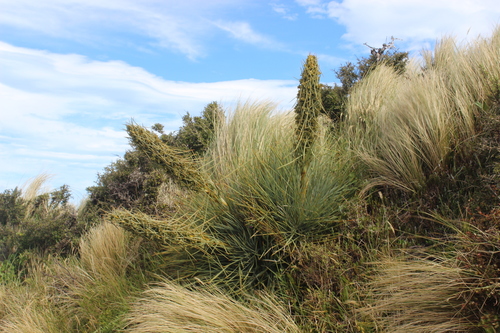
Ferula communis
L.
Common Giant Fennel, Giant anise fennel

(c) Mauricio Mercadante, some rights reserved (CC BY-NC-SA)
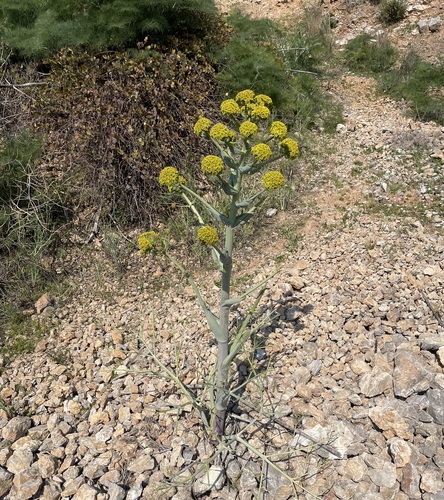
(c) Thomas Payne, some rights reserved (CC BY-NC)
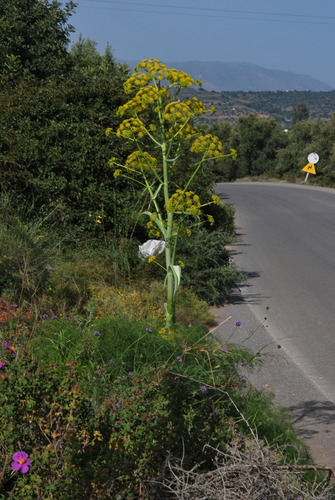
(c) Konrad and Roland Greinwald, some rights reserved (CC BY-NC)
What to Eat
Edible parts: Leaves, Vegetable, Flowers
The leaves are edible, though no further details are given.
Where to Find It
It is a Mediterranean plant. It grows in grassy and waste places. It can be in sandy places or on cliffs. Hobart Botanical Gardens.
Africa, Algeria, Australia, Cyprus, East Africa, Ethiopia, Europe, France, Greece, Italy, Mediterranean,* Morocco, North Africa, Portugal, Spain, Tasmania, Tunisia, Turkey, Türkiye,
How to Identify
A large herb which keeps growing from year to year. It grows 3 m high. It is very robust and has a pungent smell. The stems are stout and hollow. The leaves are divided 3-4 times. They have many bright green thread like lobes. These sheath the base. The upper leaves have smaller blades and larger sheaths. The flower umbels are large and rounded. They are bright yellow-green. The fruit are narrowly oval and flattened. They are 12-15 mm long. They have wings and resin canals.
How to Grow
Succeeds in most soils including dry ones according to one report whilst others say that it requires a deep moist fertile soil in a sunny position. Established plants are drought resistant. This species is hardy to about -10°c, possibly lower if the rootstock is mulched in the winter. A very ornamental plant, though the flowers have a most unpleasant rancid smell. Plants are often monoecious. Plants are intolerant of root disturbance due to their long taproot. They should be planted into their final positions as soon as possible. The sub-species brevifolia is the form used for its gum.
Propagation: Seed is best sown as soon as it is ripe in autumn in a greenhouse. Alternatively, sow in April in a greenhouse. Prick seedlings into individual pots as soon as they are large enough to handle, then plant out into permanent positions while still small, as the plants dislike root disturbance. Provide a protective mulch for at least the first winter outdoors. Division can be carried out in autumn, though this may be inadvisable given the plant's sensitivity to root disturbance.
Medicinal Uses
One report notes that the root yields a gum with medicinal properties, but no further details are given.
Other Uses
A gum known as 'Gum Ammoniac' is obtained by notching the root; it is used as an incense and also has medicinal value. The stems are used in furniture making. The dried pith serves as a tinder, burning very slowly inside the stem, which allows it to be carried alight from one place to another.
Wikipedia
Source ↗Ferula communis, the giant fennel, is a species of flowering plant in the carrot family Apiaceae. It is related to the common fennel (Foeniculum vulgare), which belongs to the same family. Ferula communis is a tall herbaceous perennial plant. It is found in Mediterranean and East African woodlands and shrublands. It was known in antiquity as laser or narthex.
Names & Synonyms
Boubal, Dog, Freula, Inslal, Nugusa
References (25)
- Addis, G., et al, 2005, Ethnobotanical Study of Edible Wild Plants in Some Selected Districts of Ethiopia. Human Ecology, Vol. 33, No. 1, pp. 83-118
- Alemneh, D., 2020, Ethnobotany of wild edible plants in Yilmana Densa and Quarit Districts of West Gojjam Zone, Amhara Region, Ethiopia. Ethnobotany Research & Applications. 20:47
- Asfaw, Z. and Tadesse, M., 2001, Prospects for Sustainable Use and Development of Wild Food Plants in Ethiopia. Economic Botany, Vol. 55, No. 1, pp. 47-62
- Biscotti, N. & Pieroni, A., 2015, The hidden Mediterranean diet: wild vegetables traditionally gathered and consumed in the Gargano area, Apulia, SE Italy. Acta Societatis Botanicorum Poloniae 84 (3): 327-338
- Biscotti, N. et al, 2018, The traditional food use of wild vegetables in Apulia (Italy) in the light of Italian ethnobotanical literature. Italian Botanist 5:1-24
- Blamey, M and Grey-Wilson, C., 2005, Wild flowers of the Mediterranean. A & C Black London. p 161
- Brickell, C. (Ed.), 1999, The Royal Horticultural Society A-Z Encyclopedia of Garden Plants. Convent Garden Books. p 438
- Ertug, F, Yenen Bitkiler. Resimli Türkiye Florası -I- Flora of Turkey - Ethnobotany supplement
- Facciola, S., 1998, Cornucopia 2: a Source Book of Edible Plants. Kampong Publications, 18
- Grubben, G. J. H. and Denton, O. A. (eds), 2004, Plant Resources of Tropical Africa 2. Vegetables. PROTA, Wageningen, Netherlands. p 561
- Hibbert, M., 2002, The Aussie Plant Finder 2002, Florilegium. p 101
- Jardin, C., 1970, List of Foods Used In Africa, FAO Nutrition Information Document Series No 2.p 78
- Lazarides, M. & Hince, B., 1993, Handbook of Economic Plants of Australia, CSIRO. p 113
- Lentini, F. and Venza, F., 2007, Wild food plants of popular use in Sicily. J Ethnobiol Ethnomedicine. 3: 15
- Lulekal, E., et al, 2011, Wild edible plants in Ethiopia: a review on their potential to combat food insecurity. Afrika Focus - Vol. 24, No 2. pp 71-121
- Martin, F.W. & Ruberte, R.M., 1979, Edible Leaves of the Tropics. Antillian College Press, Mayaguez, Puerto Rico. p 222
- Molla, A., Ethiopian Plant Names. http://www.ethiopic.com/aplants.htm (As Ferula abyssinica)
- Nassif, F., & Tanji, A., 2013, Gathered food plants in Morocco: The long forgotten species in Ethnobotanical Research. Life Science Leaflets 3:17-54
- Plants for a Future database, The Field, Penpol, Lostwithiel, Cornwall, PL22 0NG, UK. http://www.scs.leeds.ac.uk/pfaf/
- Rivera, D. et al, 2006, Gathered Mediterranean Food Plants - Ethnobotanical Investigations and Historical Development, in Heinrich M, Müller WE, Galli C (eds): Local Mediterranean Food Plants and Nutraceuticals. Forum Nutr. Basel, Karger, 2006, vol 59, pp 18–74
- Ryan, S., 2008, Dicksonia. Rare Plants Manual. Hyland House. p 103
- Sina, B. & Degu, H. D., 2015, Knowledge and use of Wild Edible Plants in the Hula District of the Sidama Zone. International Journal of Bio-resource and Stress Management 6(3):352-365
- Sinclair, V., 1992, The Floral Charm of Cyprus. Interworld Publications. p 142
- Sp. pl. 1:246. 1753
- World Checklist of Useful Plant Species 2020. Royal Botanic Gardens, Kew