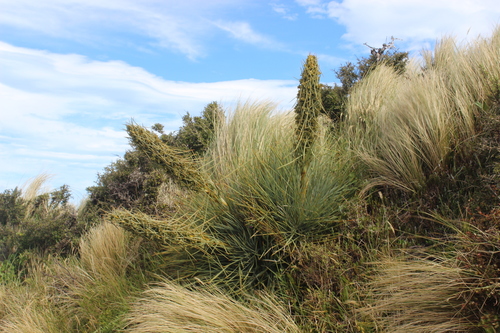
Ferula karelinii
Bunge

(c) vladimir_epiktetov, some rights reserved (CC BY-NC), uploaded by vladimir_epiktetov

(c) Alexey Zyryanov, some rights reserved (CC BY-NC)
What to Eat
Edible parts: Root
The root is edible, though no further details are available.
Where to Find It
It is a temperate plant.
Afghanistan, Asia, Central Asia, Central Asia, China, Iran, Kazakhstan, Middle East, Pakistan, Tibet, Turkmenistan, Uzbekistan,
How to Identify
A herb. It grows 40 cm tall. It has a thick tuberous root. The leaves are twice divided. The leaf segments are narrow and 8 cm long by 1 mm wide. The fruit are narrowly oval and hairy. They are 8-10 mm long.
How to Grow
We have almost no information on this species and do not know if it will be hardy in this country. Other members of the genus succeeds in most soils according to one report whilst other reports say that they require a deep fertile soil in a sunny position. Plants have a long taproot and are intolerant of root disturbance. They should be planted into their final positions as soon as possible.
Propagation: Sow seed as soon as it is ripe in a greenhouse in autumn, or alternatively in April in a greenhouse. Prick out seedlings into individual pots as soon as they are large enough to handle, then plant into permanent positions while still small, as the plants dislike root disturbance. Provide a protective mulch for at least the first winter outdoors. Division can be carried out in autumn, though this may be inadvisable given the plant's sensitivity to root disturbance.
Medicinal Uses
None known.
Other Uses
None known.
Wikipedia
A perennial herb growing to 0.6 m in height. Flowers June to July with seeds ripening June to July. Hermaphrodite flowers pollinated by insects with self-fertility. Thrives in light sandy, medium loamy, or heavy clay well-drained soils. Tolerates mildly acidic to mildly alkaline pH. Requires full sun and adapts to both dry and moist soil conditions.
Names & Synonyms
Ak-schair, Kesuk, Kumsabsi
References (6)
- Beitr. Fl. Russl. 130.; Mem. Acad. Imp. Sci. St.-Petersbourg Divers Savans 7:306. 1852 "karelini"
- Encyclopedia of Life
- Plants for a Future database, The Field, Penpol, Lostwithiel, Cornwall, PL22 0NG, UK. http://www.scs.leeds.ac.uk/pfaf/
- Ryabushkina, N., et al, 2008, Brief Review of Kazakhstan Flora and Use of its Wild Species. The Asian and Australasian Journal of Plant Science and Biotechnology
- USDA, ARS, National Genetic Resources Program. Germplasm Resources Information Network - (GRIN). [Online Database] National Germplasm Resources Laboratory, Beltsville, Maryland. Available: www.ars-grin.gov/cgi-bin/npgs/html/econ.pl (10 April 2000)
- World Checklist of Useful Plant Species 2020. Royal Botanic Gardens, Kew