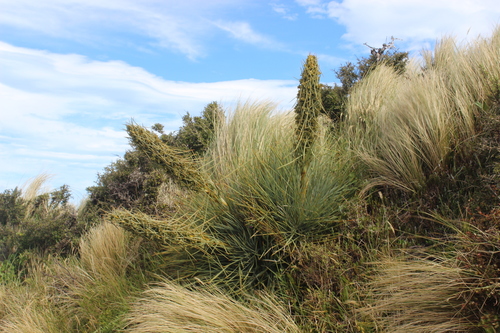
Ferula narthex
Boiss.
Stink fetida, Hing asafetida

Louis van Houtte (via Wikimedia Commons)

Wikimedia Commons (via Wikimedia Commons)
What to Eat
Edible parts: Leaves, Spice, Gum
Leaves and young shoots are eaten as a pot-herb. The gum obtained from the roots is used as a condiment.
Where to Find It
It is a subtropical plant. It grows in grassy slopes at about 3,600 m above sea level in Tibet. It suits hardiness zone 7-10.
Afghanistan, Asia, Central Asia, Himalayas, India, Pakistan, Tajikistan, Tibet,
How to Identify
A herb. It keeps growing from year to year. It grows 2.5 m tall. The roots are thick and the stem base is fibrous. The leaves are large and twice divided. The segments are oblong. The edges can be entire or have teeth. The flowers are in groups of up to 30. They are yellow.
How to Grow
Succeeds in most soils. Requires a deep fertile soil in a sunny position. This species is not hardy in the colder areas of Britain, it tolerates temperatures down to between -5 and -10°c. The whole plant is very strong-smelling. Plants have a long taproot and are intolerant of root disturbance. They should be planted into their final positions as soon as possible.
Propagation: Sow seed as soon as it is ripe in a greenhouse in autumn, or alternatively in April in a greenhouse. Prick out seedlings into individual pots as soon as they are large enough to handle, then plant into permanent positions while still small, as the plants dislike root disturbance. Provide a protective mulch for at least the first winter outdoors. Division can be carried out in autumn, though this may be inadvisable given the plant's sensitivity to root disturbance.
Medicinal Uses
The gum resin from the root is anthelmintic, antispasmodic, expectorant, and nervine. It is used to treat asthma, whooping cough, flatulent colic, and in cases of pneumonia and bronchitis in children. The leaves are carminative and diaphoretic. The plant has recently been investigated as a potential contraceptive.
Other Uses
The root is a source of the gum asafoetida, obtained by incising the roots. It is used both as a condiment and as a medicine.
Wikipedia
Source ↗Ferula narthex is a species of plant native to Afghanistan, Tajikistan, northern Pakistan and Kashmir. Hugh Falconer noted that this was the source of asafoetida in Central Asia. Although it is often listed as the source of asafoetida, one report stated that its essential oil lacked sulfur-containing compounds which are characteristic of asafoetida.
Names & Synonyms
Kama-i-gawi, Kama-i-anguza
References (10)
- Ambasta, S.P. (Ed.), 2000, The Useful Plants of India. CSIR India. p 220
- Fl. orient. 2:994. 1872-1873
- Hedrick, U.P., 1919, (Ed.), Sturtevant's edible plants of the world. p 307
- Peter, K. V. (Ed.), 2004, Handbook of Herbs and Spices Vol. 2 Woodhead Publishing and CRC Press. p
- Plants for a Future database, The Field, Penpol, Lostwithiel, Cornwall, PL22 0NG, UK. http://www.scs.leeds.ac.uk/pfaf/
- PROSEA handbook Volume 13 Spices. p 255
- Seidemann J., 2005, World Spice Plants. Economic Usage, Botany, Taxonomy. Springer. p 156
- van Wyk, B., 2005, Food Plants of the World. An illustrated guide. Timber press. p 194
- Wiersema, J. H. & Leon, B., 2013, World Economic Plants. A Standard Reference CRC Press. 2nd Ed. p 302
- World Checklist of Useful Plant Species 2020. Royal Botanic Gardens, Kew