Festuca ovina
L.
Sheep’s fescue
(c) Руслан Цвірко, some rights reserved (CC BY-NC), uploaded by Руслан Цвірко
(c) Hanna, some rights reserved (CC BY-NC), uploaded by Hanna

(c) Cheng-Tao Lin, some rights reserved (CC BY), uploaded by Cheng-Tao Lin
What to Eat
Edible parts: Seeds, Cereal
The seed is edible, though it is quite small and would be fiddly to collect and use in any quantity.
Where to Find It
It is a temperate plant. In China it grows in alpine meadows between 1,000-4,400 m above sea level. It suits hardiness zones 5-9. Tasmanian Herbarium. In Sichuan and Yunnan.
Asia, Australia, Balkans, Caucasus, China, Europe, Japan, Korea, Macedonia, Mongolia, North America, Russia, Slovenia, Taiwan, Tasmania, Tibet, USA,
How to Identify
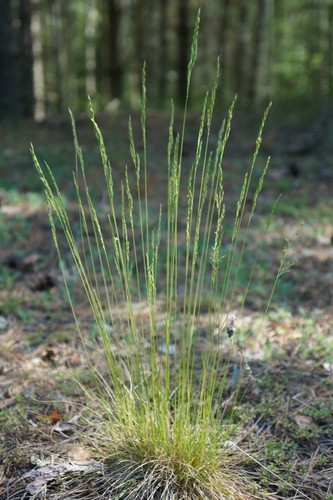
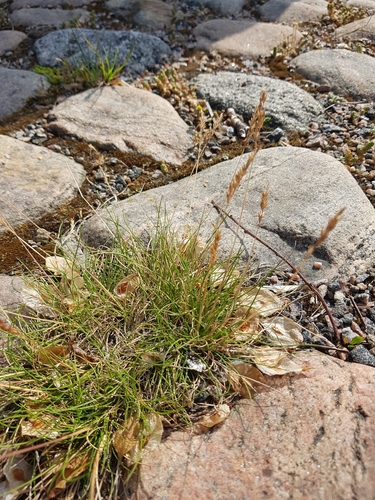
A tussock forming grass. It grows 60 cm high and spreads 40 cm wide. The leaves are fine and blue-green. The flowers are in panicles and are also blue-green. These are on tall wiry stems.
How to Grow
Prefers a light well-drained soil in full sun. A drought resistant plant once established, it succeeds on shallow chalky soils. Tolerant of constant cutting, this plant is often grown in lawns.
Propagation: Sow seed in spring directly in situ; it typically germinates within three weeks. Division in spring is very easy — clumps can be lifted and replanted directly into their permanent positions.
Medicinal Uses
None known.
Other Uses
None known.
Wikipedia
Source ↗Festuca ovina, sheep's fescue or sheep fescue, is a species of grass. It is sometimes confused with hard fescue (Festuca trachyphylla).
Notes
There are over 300 Festuca species.
Names & Synonyms
Ovčja bilnica
References (6)
- Beckstrom-Sternberg, Stephen M., and James A. Duke. "The Foodplant Database." http://probe.nalusda.gov:8300/cgi-bin/browse/foodplantdb.(ACEDB version 4.0 - data version July 1994)
- Cundall, P., (ed.), 2004, Gardening Australia: flora: the gardener's bible. ABC Books. p 601
- Heywood, V.H., Brummitt, R.K., Culham, A., and Seberg, O., 2007, Flowering Plant Families of the World. Royal Botanical Gardens, Kew. p 390
- Morley, B. & Everard, B., 1970, Wild Flowers of the World. Ebury press. Plate 7
- Plants for a Future database, The Field, Penpol, Lostwithiel, Cornwall, PL22 0NG, UK. http://www.scs.leeds.ac.uk/pfaf/
- Sp. pl. 1:73. 1753


