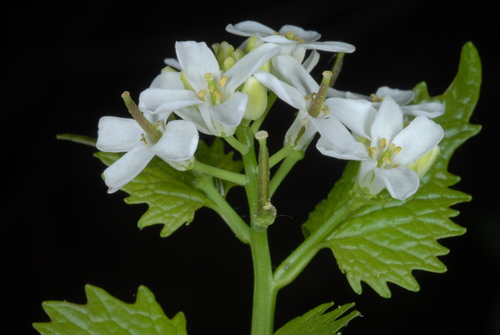
Fibigia clypeata
(L.) Medik.
Fibigia, Paper pumpkinseeds

(c) Uriah Resheff, some rights reserved (CC BY-NC), uploaded by Uriah Resheff

(c) אריאל שמיר, some rights reserved (CC BY-NC)

(c) אריאל שמיר, some rights reserved (CC BY-NC)
What to Eat
Edible parts: Leaves
Young leaves can be eaten raw and are used as a cress in salads.
Where to Find It
It is a Mediterraean climate plant. It grows in rocky and grassy places.
Balkans, Europe, Italy, Mediterranean, Middle East, Slovenia, Syria, Turkey, Türkiye,
How to Identify
A cabbage family herb. It is a short, dense, tufted plant. It is erect and keeps growing from year to year. The leaves are grey or green. The lower leaves are oblong and broadest above the middle. The flowers are yellow.
How to Grow
Propagation: Sow seed in early spring in a cold frame. Prick seedlings out into individual pots when large enough to handle and plant out in late spring. If sufficient seed is available, an outdoor sowing directly in situ can be made in mid-spring.
Medicinal Uses
None known.
Other Uses
None known.
Wikipedia
Source ↗Fibigia clypeata is an Asian species of flowering plant of the genus Fibigia in the family Brassicaceae. It is distributed throughout Greece, Iran, Jordan, Lebanon, Palestine, Syria and Turkey, where it flowers between February and April. This plant is found in abundance and is native to the Shouf Biosphere Reserve in Lebanon. Its common Arabic name is بتلة كالمرساة. Its common English name is False-gypsophila ankyropetalum. Its common French name is Ankyropetale fausse- gypsophylle. It is a drought-tolerant perennial suitable for xeriscaping.
Names & Synonyms
References (5)
- Blamey, M and Grey-Wilson, C., 2005, Wild flowers of the Mediterranean. A & C Black London. p 65
- Facciola, S., 1998, Cornucopia 2: a Source Book of Edible Plants. Kampong Publications, p 58
- Hedrick, U.P., 1919, (Ed.), Sturtevant's edible plants of the world. p 306 (As Farsetia clypeata)
- Pflanzeng. 1:90. 1792
- Plants for a Future database, The Field, Penpol, Lostwithiel, Cornwall, PL22 0NG, UK. http://www.scs.leeds.ac.uk/pfaf/