Laportea ovalifolia
(Schumach. & Thonn.) Chew

(c) Scamperdale, some rights reserved (CC BY-NC)
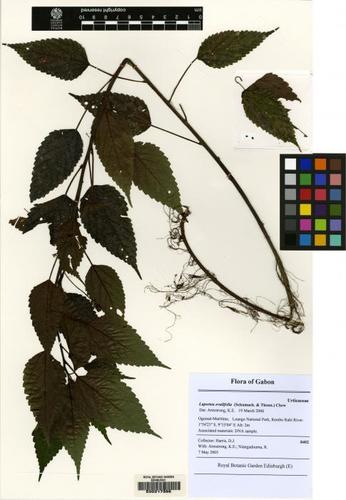
(c) Royal Botanic Garden Edinburgh, some rights reserved (CC BY-NC)
What to Eat
Edible parts: Leaves, Vegetable
The leaves are cooked as a vegetable, often mixed with other vegetables. It is a minor vegetable of local importance.
Known Hazards
Where to Find It
A tropical plant. It grows in forest and along streams. It grows from 900-2,000 m altitude.
Africa, Angola, Benin, Cameroon, Central Africa, Central African Republic, CAR, Congo DR, Côte d'Ivoire, East Africa, Equatorial-Guinea, Gabon, Ghana, Guinea, Guinée, Guinea-Bissau, Ivory Coast, Kenya, Liberia, Nigeria, Rwanda, Sao Tome and Principe, Sierra Leone, Southern Sudan, Sudan, Tanzania, Togo, Uganda, West Africa, Zimbabwe,
How to Identify
A herb. It keeps growing from year to year and has runners. It has scattered stinging hairs. The main stem usually lies along the ground and has erect shoots. It grows 2 m tall. The leaves are alternate and simple. The leaf stalk is 5-10 cm long and the leaf blade is 8-10 cm long by 4-6 cm wide. It is rounded at the base and tapers to the tip. There are rounded teeth along the edge. The flowers are of separate sexes. The male flowers are on fleshy pink erect stalks 50 cm long. These arise from the leaf axils of underground stems. They are in clusters 1 cm across. Female flowers are on stalks 5 cm tall. The fruit are 3 mm long.
How to Grow
The plant can become an invasive weed in farmland within its native range. It is considered a noxious weed in perennial crops such as cacao, oil palm and bananas.
Medicinal Uses
The leaves are anti-irritant, diuretic and haemostatic. They are used in the treatment of blennorrhoea and chest problems. The leaves are pounded, soaked in water and the infusion drunk to help in the delivery of the placenta after childbirth. The cooked leaves are eaten as a remedy for stomach-ache. The fresh leaves are used to relieve headaches. The leaves are used externally to treat cuts, wounds etc. The roots are boiled in water and the liquid drunk to prevent excessive menstrual bleeding. The fruit is used as an antidote to poisons.
Production
The leaves are collected in the rainy season.
Other Information
It is a minor vegetable of local importance.
Notes
There are about 22 Laportea species.
Names & Synonyms
Alumeme, Barumeme, Ishuwu, Lugeni, Mpupu, Nyaluvafya, Pupu, Umufuura
References (11)
- Bosch, C.H., 2004. Laportea ovalifolia (Schumach.) Chew. [Internet] Record from Protabase. Grubben, G.J.H. & Denton, O.A. (Editors). PROTA (Plant Resources of Tropical Africa), Wageningen, Netherlands. < http://database.prota.org/search.htm>. Accessed 16 October 2009.
- Burkill, H. M., 1985, The useful plants of west tropical Africa, Vol. 5. Kew.
- East African Herbarium records, 1981,
- Goode, P., 1989, Edible Plants of Uganda. FAO p 30 (As Fleurya ovalifolia)
- Grubben, G. J. H. and Denton, O. A. (eds), 2004, Plant Resources of Tropical Africa 2. Vegetables. PROTA, Wageningen, Netherlands. p 359
- Jardin, C., 1970, List of Foods Used In Africa, FAO Nutrition Information Document Series No 2.p 78
- Martin, F.W. & Ruberte, R.M., 1979, Edible Leaves of the Tropics. Antillian College Press, Mayaguez, Puerto Rico. p 223 (Also as Laportea podocarpa)
- Peters, C. R., O'Brien, E. M., and Drummond, R.B., 1992, Edible Wild plants of Sub-saharan Africa. Kew. p 196
- Ruffo, C. K., Birnie, A. & Tengnas, B., 2002, Edible Wild Plants of Tanzania. RELMA p 432
- Terashima, H., & Ichikawa, M., 2003, A comparative ethnobotany of the Mbuti and Efe hunter-gatherers in the Ituri Forest, Democratic Republic of Congo. African Study Monographs, 24 (1, 2): 1-168, March 2003
- World Checklist of Useful Plant Species 2020. Royal Botanic Gardens, Kew


