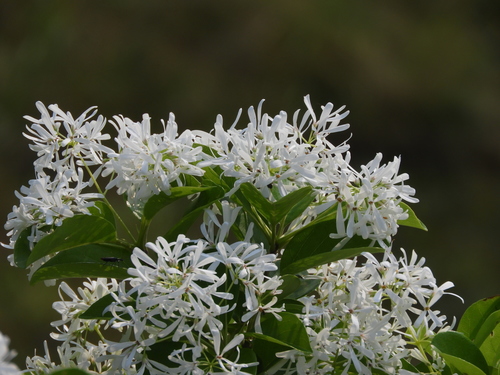
Forsythia suspensa
(Thunb.) Vahl.
Golden Bells, Weeping Forsythia

(c) Nemo's great uncle, some rights reserved (CC BY-NC-SA)
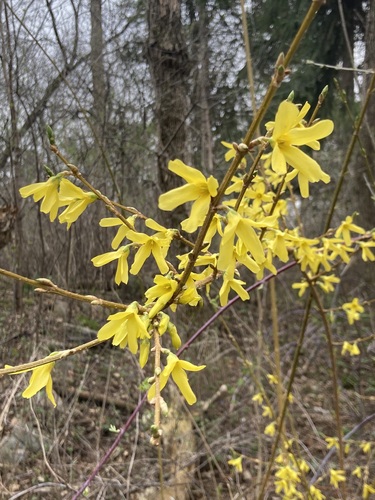
(c) Emily Hjalmarson, some rights reserved (CC BY-NC)

(c) Dr. Boli, some rights reserved (CC BY)
What to Eat
Edible parts: Leaves
Young leaves are edible when cooked, though some caution is advised due to the presence of a glycoside. The leaves are notably rich in rutin.
Where to Find It
It is a temperate plant. It grows in thickets or grassy areas on slopes between 300-2200 m altitude in China. It can grow in sun or part shade. It suits hardiness zones 4-9.
Asia, Australia, Britain, China*, Europe, Japan, Korea, Mongolia, Tasmania,
How to Identify
A lax shrub. It can grow to 3 m tall when trained on a wall. It loses its leaves during the year. The branches are slender and arching. They are yellow-brown. The internodes are hollow. The leaves are simple but can also have 3 divisions. The leaf stalk is 0.8-1.5 cm long. The leaf blade is oval and 2-10 cm long by 1.5-5 cm wide. There are teeth along the edge. There are one or sometimes 2 or more flowers in the axils of leaves. The flowers are golden. They have narrow petals. The flowers hang downwards. The fruit is a capsule which is oval and 1.2-2.5 cm long by 6-7 mm wide. The stalk is 0.7-1.5 cm long.
How to Grow
Plants can be grown by seed. The seed need 60 days of cold treatment. It can also be grown by greenwood cuttings.
Propagation: Sow seed in spring in a cold frame; it generally germinates within two months. Prick seedlings out into individual pots when large enough to handle and grow on in the greenhouse for at least the first winter before planting out in late spring or early summer after the last frosts. Half-ripe wood cuttings of 10–15cm taken at a node in July or August can be rooted in a frame and planted out in autumn or spring — success rates are very high, with rooting typically occurring within three weeks. Cuttings of mature wood in a sheltered outdoor bed also give a good percentage. Layering in spring or summer is another option, and plants often self-layer.
Medicinal Uses
Lian Qiao has been used in Chinese herbalism for over 4,000 years and is regarded as one of the 50 fundamental herbs. It is a bitter-tasting, pungent herb with an antiseptic action, chiefly used to treat boils, carbuncles, mumps, and infected neck glands. The fruit is a bitter astringent herb that stimulates the heart, nervous system, and gall bladder, and contains vitamin P, which strengthens capillaries. The fruit is also antidote, antiphlogistic, antitussive, diuretic, emmenagogue, febrifuge, laxative, and tonic. It is used internally for acute infectious diseases including mumps, as well as for tonsillitis, urinary tract infections, and allergic rashes. The fruit is harvested when fully ripe and dried for use in decoctions. The plant acts similarly to Lonicera japonica and is often combined with it for a stronger effect. The flowers have a broad-spectrum antibacterial action, inhibiting Staphylococcus aureus, Shigella dysenteriae, haemolytic streptococcus, Pneumococcus, Bacillus typhi, Mycobacterium tuberculi, and others. The plant is also vermifuge, though the specific part used is not recorded. The leaves are febrifuge and can be poulticed onto ulcerated glands and haemorrhoids. A decoction of the leaves and twigs is used to treat breast cancer. The root is used for cancer, colds, fever, and jaundice.
Other Uses
The sub-species F. suspensa sieboldii is a lax grower that roots freely where its branches touch the ground, making it a good tall ground cover when plants are spaced about 2.5 metres apart each way. It is also suited to use in borders, for erosion control, as an espalier, for massing, and as a screen.
Wikipedia
Source ↗Forsythia suspensa, commonly known as weeping forsythia or golden-bell, is a species of flowering plant in the family Oleaceae. It is native to China.
Notes
It is used in medicine. There are about 7-11 Forsythia species. There are also hybrids between species. The leaf contains a glucoside, phyllyrin.
Names & Synonyms
Lian Qiao
References (16)
- Bodkin, F., 1991, Encyclopedia Botanica. Cornstalk publishing, p 477
- Bremness, L., 1994, Herbs. Collins Eyewitness Handbooks. Harper Collins. p 103
- Brickell, C. (Ed.), 1999, The Royal Horticultural Society A-Z Encyclopedia of Garden Plants. Convent Garden Books. p 442
- Brown, D., 2002, The Royal Horticultural Society encyclopedia of Herbs and their uses. DK Books. p 213
- Chang Mei-chen, Qiu Lian-qing, Green, P.S., Oleaceae. Flora of China.
- Cundall, P., (ed.), 2004, Gardening Australia: flora: the gardener's bible. ABC Books. p 607
- Enum. pl. 1:39. 1804
- Etherington, K., & Imwold, D., (Eds), 2001, Botanica's Trees & Shrubs. The illustrated A-Z of over 8500 trees and shrubs. Random House, Australia. p 330
- Hibbert, M., 2002, The Aussie Plant Finder 2002, Florilegium. p 102
- Kremer, B.P., 1995, Shrubs in the Wild and in Gardens. Barrons. p 135
- Marinelli, J. (Ed), 2004, Plant. DK. p 107
- Plants for a Future database, The Field, Penpol, Lostwithiel, Cornwall, PL22 0NG, UK. http://www.scs.leeds.ac.uk/pfaf/
- READ,
- Ryan, S., 2008, Dicksonia. Rare Plants Manual. Hyland House. p 76
- Valder, P., 1999, The Garden Plants of China. Florilegium. p 287
- Young, J., (Ed.), 2001, Botanica's Pocket Trees and Shrubs. Random House. p 388