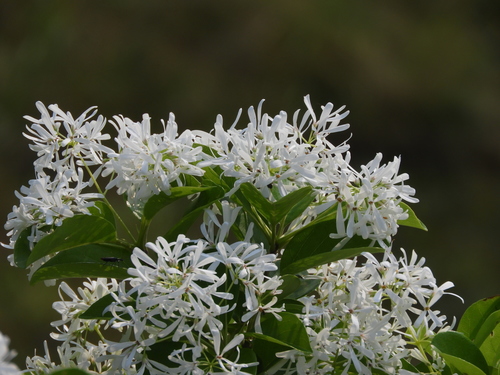
Fraxinus ornus
Linn.
Flowering ash, Manna Ash

(c) Dean Zagorac, some rights reserved (CC BY-NC), uploaded by Dean Zagorac
(c) secondariacervi, some rights reserved (CC BY-NC)
(c) Joost ., some rights reserved (CC BY-NC), uploaded by Joost .
What to Eat
Edible parts: Manna, Sap, Leaves - tea, Flowers
A sweet manna exudate is obtained from the stems by incision, with better quality material coming from the upper stems. It has a mild, sweet taste and is used as a gentle laxative, as a sweetener in sugar-free preparations, and as an anti-caking agent. The trunk must be at least 8cm in diameter before harvest can begin. A vertical series of oblique incisions are made in summer once the tree has largely stopped producing new leaves — one cut per day from July to the end of September. A whitish glutinous liquid exudes, hardens, and is then collected. Dry, warm weather is essential for a good harvest. The tree is harvested for 9 consecutive years, after which it is exhausted and cut down, leaving one shoot to regrow. That shoot takes 4–5 years to become productive again. Average yields are around 6 kilos per hectare of top-quality manna, plus 80 kilos of assorted manna.
Known Hazards
Where to Find It
It is native to S.W. Asia and S. Europe. Temperate. It likes a sunny position. It can tolerate dry conditions. It suits hardiness zones 6-10. Arboretum Tasmania.
Argentina, Australia, Balkans, Bosnia, Britain, Central Asia, Croatia, Europe, France, Greece, India, Italy, Lebanon, Macedonia, Mediterranean, Middle East, San Marino, Sicily, Slovenia, South America, Spain, Tajikistan, Tasmania, Turkey, Türkiye,
How to Identify
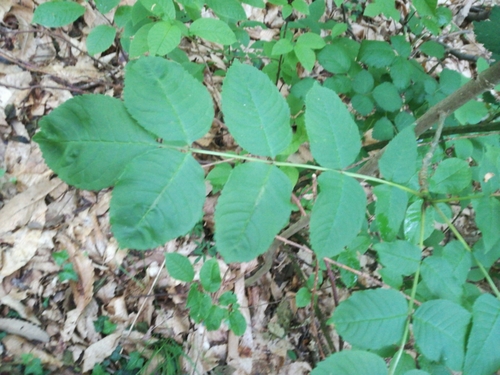
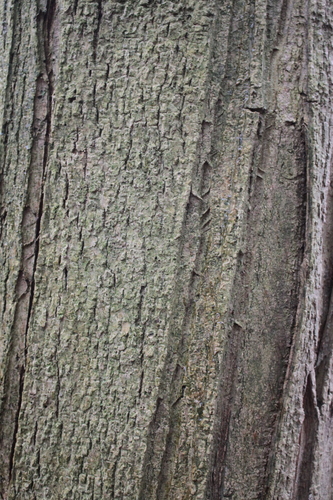
A tree which loses its leaves. It grows 10-15 m tall. It has a short fluted trunk. The bark is smooth and grey. It produces suckers. The leaves are dark green and divided along the stalk. There are 5-9 oval leaflets. They are downy underneath. They turn purple-red in autumn. The flowers are creamy-white and fluffy. They occur in clustered plumes. The flowers have a scent. The fruit are small and narrow. It is reddish-brown and has one seed.
How to Grow
Prefers a deep loamy soil, even if it is on the heavy side. Most members of this genus are gross feeders and require a rich soil. Succeeds in exposed positions and in alkaline soils. Requires a moist soil according to some reports whilst another says that it succeeds in drier soils. Plants are tolerant of atmospheric pollution. Although the dormant plant is very cold-hardy, the young growth in spring, even on mature plants, is frost-tender and so it is best to grow the plants in a position sheltered from the early morning sun. A very ornamental plant, the manna ash is cultivated for its edible manna in Sicily and Calabria. The flowers are sweetly scented. Trees have a very dense canopy. Dioecious. Male and female plants must be grown if seed is required.
Propagation: Seed is best harvested green — fully developed but not yet dried on the tree — and sown immediately in a cold frame, where it usually germinates in spring. Stored seed requires cold stratification and should be sown as soon as possible in a cold frame. Prick seedlings into individual pots when large enough and grow on in a cold frame through their first winter. Plant out into permanent positions or a nursery bed in late spring or early summer the following year. Where sufficient seed is available, sow directly into an outdoor seedbed in autumn and grow on for 2 years before transplanting.
Medicinal Uses
The manna from the trunk is a gentle laxative and tonic, particularly valued for use by children and pregnant women. Its action is normally mild, though it can sometimes cause flatulence and pain.
Other Uses
None known.
Wikipedia
Source ↗Fraxinus ornus, the manna ash or South European flowering ash, is a species of Fraxinus native to Southern Europe and Southwestern Asia, from Spain and Italy north to Austria and the Czech Republic, and east through the Balkans, Turkey, and western Syria to Lebanon and Armenia.
Production
The yield can be 5 kg of select manna and 70 kg of assorted manna per hectare. Trees older than 8 years and with a trunk over 7.5 cm across have a series of slanting cuts on alternate sides of the trunk and the sap collected in warm dry weather.
Other Information
It is cultivated.
Notes
There are about 65 Fraxinus species. The gum is used in medicine.
Names & Synonyms
Jasen, Mali jesen, Mena, Shirkhist
References (25)
- Ambasta, S.P. (Ed.), 2000, The Useful Plants of India. CSIR India. p 227
- Blamey, M and Grey-Wilson, C., 2005, Wild flowers of the Mediterranean. A & C Black London. p 174
- Bremness, L., 1994, Herbs. Collins Eyewitness Handbooks. Harper Collins. p 57
- Brouk, B., 1975, Plants Consumed by Man. Academic Press, London. p
- Brown, D., 2002, The Royal Horticultural Society encyclopedia of Herbs and their uses. DK Books. p 216
- Cerne, M., 1992, Wild Plants from Slovenia used as Vegetables. Acta Horticulturae 318
- Coombes, A.J., 2000, Trees. Dorling Kindersley Handbooks. p 230
- Cundall, P., (ed.), 2004, Gardening Australia: flora: the gardener's bible. ABC Books. p 611
- Dolina, K. & Luczaj, L., 2014, Wild food plants used on the Dubrovnik coast (south-eastern Croatia) Acta Soc Bot Pol 83(3):175–181
- Etherington, K., & Imwold, D., (Eds), 2001, Botanica's Trees & Shrubs. The illustrated A-Z of over 8500 trees and shrubs. Random House, Australia. p 334
- Facciola, S., 1998, Cornucopia 2: a Source Book of Edible Plants. Kampong Publications, p 163
- Harris, E & J., 1983, Field Guide to the Trees and Shrubs of Britain. Reader's Digest. p 165
- Hedrick, U.P., 1919, (Ed.), Sturtevant's edible plants of the world. p 320
- Hibbert, M., 2002, The Aussie Plant Finder 2002, Florilegium. p 103
- Lentini, F. and Venza, F., 2007, Wild food plants of popular use in Sicily. J Ethnobiol Ethnomedicine. 3: 15
- Lord, E.E., & Willis, J.H., 1999, Shrubs and Trees for Australian gardens. Lothian. p 56
- Pasta, S., et al, 2020, An Updated Checklist of the Sicilian Native Edible Plants: Preserving the Traditional Ecological Knowledge of Century-Old Agro-Pastoral Landscapes. Frontiers in Plant Science. Volume 11|Article 388
- Redzic, S. J., 2006, Wild Edible Plants and their Traditional Use in the Human Nutrition in Bosnia-Herzegovina. Ecology of Food and Nutrition, 45:189-232
- Redzic, S., 2010, Use of Wild and Semi-Wild Edible Plants in Nutrition and Survival of People in 1430 Days of Siege of Sarajevo during the War in Bosnia and Herzegovina (1992–1995). Coll. Antropol 34 (2010) 2:551-570
- Ryan, S., 2008, Dicksonia. Rare Plants Manual. Hyland House. p 28
- Schuler, S., (Ed.), 1977, Simon & Schuster's Guide to Trees. Simon & Schuster. No. 120
- Sfikas, G., 1984, Trees and shrubs of Greece. Efstathiadis Group. Athens. p 180
- Sp. pl. 2:1057. 1753
- Young, J., (Ed.), 2001, Botanica's Pocket Trees and Shrubs. Random House. p 394
- Zeven, A. C. & de West, J. M. J., 1982, Dictionary of cultivated plants and their regions of diversity. Wageningen. p 117