Alectryon coriaceus
(Benth.) Radlk.
Beach bird’s eye, Soap Berry, Beach Alectryon

(c) Tony Rodd, some rights reserved (CC BY-NC-SA)
Poyt448 Peter Woodard, no known copyright restrictions (public domain)
What to Eat
Edible parts: Fruit aril
The seed arils (the fleshy covering) are edible.
Where to Find It
It grows in tropical, subtropical and warm temperate locations. It suits moist well drained soils and can grow on dry soils. It can grow in full sun or light shade. It is sensitive to drought and frost. Adelaide Botanical Gardens.
Asia, Australia*, Indonesia, SE Asia,
How to Identify
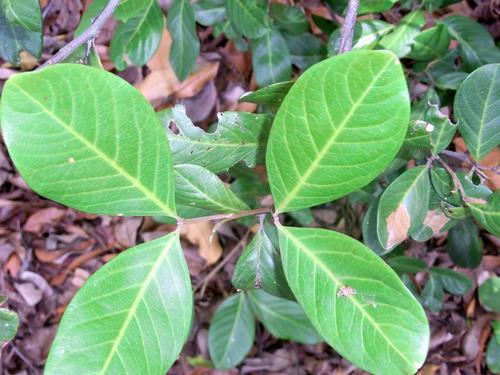
A small to large shrub. It grows 2-6 m tall and spreads 2-5 m across. The small branches are often hairy. The leaves are oval and leathery. The new leaves are shiny and coppery bronze. They are 4-15 cm long and 2-4 cm wide. The flowers are small. They are in groups 5-20 cm long. The fruit is a 3 lobed capsule 5-7 mm long by 5-12 mm wide. The red and green seeds are edible.
How to Grow
Plants can be grown from fresh seed or from cuttings.
Wikipedia
Source ↗Alectryon coriaceus, known as the beach bird's eye, or beach alectryon is a rainforest tree of the soapberry family found in eastern Australia. The specific epithet coriaceus refers to the leathery thick leaves. Leaflets are 4 to 12 cm long, and 2 to 7 cm wide. A small tree up to 11 metres in height. Only found growing near the sea from as far south as Newcastle, New South Wales to Maryborough, Queensland. Greenish yellow flowers have tiny petals, and form in December. This tree features typical red and black fruit of this genus, maturing from March to July.
Notes
There are 15-34 Electryon species.
Names & Synonyms
Alektrion pantai, Semak mata burung
References (9)
- Actes Congr. Int. Bot., Amsterdam 1877:118. 1879
- Bodkin, F., 1991, Encyclopedia Botanica. Cornstalk publishing, p 63
- Cherikoff V. & Isaacs, J., The Bush Food Handbook. How to gather, grow, process and cook Australian Wild Foods. Ti Tree Press, Australia p 146, 198
- Elliot, W.R., & Jones, D.L., 1982, Encyclopedia of Australian Plants suitable for cultivation. Vol 2. Lothian. p 172
- Jones D, L, 1986, Ornamental Rainforest Plants in Australia, Reed Books, p 120
- Lamberton, K (Ed.), 2004, The Australian gardening encyclodepia. Murdoch Books, NSW Australia. p 156
- Nicholson, N & H., 1996, Australian Rainforest Plants, Terania Rainforest Publishing. NSW. p 6
- Sukarya, D. G., (Ed.) 2013, 3,500 Plant Species of the Botanic Gardens of Indonesia. LIPI p 579
- Williams, J.B., Harden, G.J., and McDonald, W.J.F., 1984, Trees and shrubs in rainforests of New South Wales and Southern Queensland. Univ. of New England, Armidale. p 22