Gaertnera paniculata
Benth.
(c) Carel Jongkind, some rights reserved (CC BY-NC), uploaded by Carel Jongkind
(c) Carel Jongkind, some rights reserved (CC BY-NC), uploaded by Carel Jongkind
(c) Carel Jongkind, some rights reserved (CC BY-NC), uploaded by Carel Jongkind
What to Eat
Edible parts: Roots, Leaves, Vegetable
The young tender shoots and roots are eaten.
Where to Find It
A tropical plant. It grows in moist deciduous forests in West Africa. It grows between 1,200-1,450 m altitude.
Africa, Angola, Burkina Faso, Cameroon, Central Africa, Congo DR, East Africa, Gabon, Guinea, Guinée, Liberia, Niger, Nigeria, Sahel, Sao Tome and Principe, Sierra Leone, West Africa, Zambia,
How to Identify
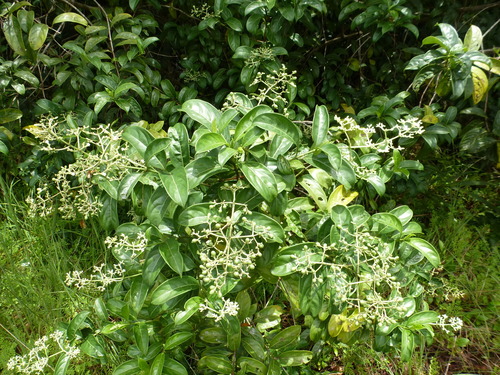
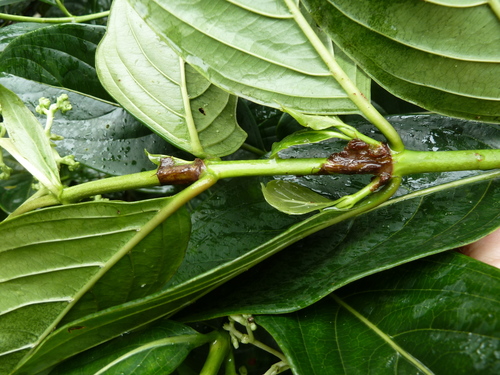
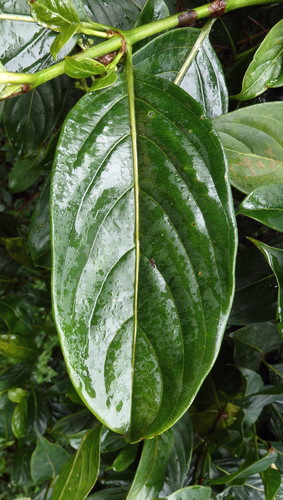
A straggling shrub or small tree. It grows 8-18 m high. It has branches low down. The stems are slightly hairy when young. The leaves are 8-18 cm long by 3-8 cm wide. They are narrowly oval and taper to the tip. They are thinly leathery. The flowers are greenish white. They are in large loose groups 7-30 cm long. They have a sweet scent. The fruit is juicy and purple or blue coloured. They are 9 mm long by 6 mm wide.
How to Grow
Plants are grown from seed. Seed need to be sown while fresh.
Medicinal Uses
Roots and leaves are used as a vegetable.
Notes
There are about 30-70 Gaertnera species.
Names & Synonyms
Gboli-wulo, Kimbodia, Kimbodi, Kurumbe, Ng obai
References (8)
- Burkill, H. M., 1985, The useful plants of west tropical Africa, Vol. 4. Kew.
- Chapman, J. D. & Chapman, H. M., 2001, The Forest Flora of Taraba and Andamawa States, Nigeria. WWF & University of Canterbury. p 197
- Flora Zambesiaca. http://apps.kew.org/efloras
- Grubben, G. J. H. and Denton, O. A. (eds), 2004, Plant Resources of Tropical Africa 2. Vegetables. PROTA, Wageningen, Netherlands. p 562
- Jardin, C., 1970, List of Foods Used In Africa, FAO Nutrition Information Document Series No 2.p 79
- Latham, P., 2004, Useful Plants of Bas-Congo province. Salvation Army & DFID p 133
- Schatz, G.E., 2001, Generic Tree Flora of Madagascar. Royal Botanical Gardens, Kew and Missouri Botanical Garden. p 330 (Genus)
- World Checklist of Useful Plant Species 2020. Royal Botanic Gardens, Kew


