Galium boreale
L.
Northern bedstraw
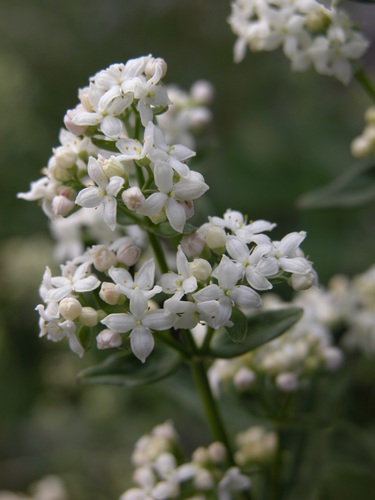
(c) Елена Шубницина, some rights reserved (CC BY-NC), uploaded by Елена Шубницина
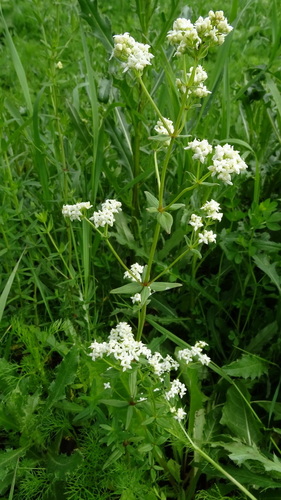
(c) Zdeňka Nováková, some rights reserved (CC BY-NC), uploaded by Zdeňka Nováková

(c) Douglas Goldman, some rights reserved (CC BY-SA), uploaded by Douglas Goldman
What to Eat
Edible parts: Leaves, Seeds - coffee
The leaves can be eaten raw or cooked. A tea is made from the flowering stems.
Where to Find It
It is a temperate plant. It grows on open, dry hillsides in the Rocky Mountains. In Sichuan and Yunnan.
Afghanistan, Asia, Canada, Caucasus, Central Asia, China, Europe, India, Iran, Japan, Kazakhstan, Korea, Luxembourg, Middle East, Mongolia, North America, Norway, Pakistan, Russia, Scandinavia, Siberia, Slovenia, Tibet, USA,
How to Identify
A herb. It keeps growing from year to year. The stems are leafy and often in clusters. The base is woody. The leafy stems are 70 cm high. The leaves do not have stalks. The leaves are narrow and in rings of four. They are 2.5-7 cm long. The flowers are small and in many flowered clusters at the ends of the stems.
How to Grow
Prefers a loose moist leafy soil in some shade. Tolerates dry soils but the leaves quickly become scorched when growing in full sun. This species does not thrive in a hot climate.
Propagation: Seed is best sown in situ as soon as it is ripe in late summer, though spring sowing is possible and germination may be very slow. The plant reproduces readily without assistance. Divide in spring or throughout the growing season, keeping divisions well watered. Larger clumps can be replanted directly into permanent positions; smaller clumps are best potted and grown on in a cold frame until rooting well before planting out in spring.
Medicinal Uses
The plant is diaphoretic and diuretic. A decoction has been used as a contraceptive. Both Asperuloside (a terpenoid) and Coumarin (a benzopyrone) occur in some species of Galium. Asperuloside can be converted into prostaglandins, which stimulate the uterus and affect blood vessels, making the genus of significant interest to the pharmaceutical industry.
Other Uses
A red dye is obtained from the root. The plant is also used as a stuffing material for mattresses.
Wikipedia
Source ↗Galium boreale or northern bedstraw is a species of perennial flowering plant in the family Rubiaceae. It is widespread over the temperate and subarctic regions of Europe, Asia and North America including most of Canada and the northern United States.
Notes
There are about 300 Galium species. There are 60 species in tropical America.
Names & Synonyms
Cleavers, Kvitmaure, Severna lakota
References (11)
- Cormack, R. G. H., 1967, Wild Flowers of Alberta. Commercial Printers Edmonton, Canada. p 322
- Elias, T.S. & Dykeman P.A., 1990, Edible Wild Plants. A North American Field guide. Sterling, New York p 86
- Esperanca, M. J., 1988. Surviving in the wild. A glance at the wild plants and their uses. Vol. 2. p 112
- Flora of Pakistan. www.eFloras.org
- Girard, N. J., 2020, Sustainable Foraging of Wild Edible Plants in Norway. A Biocultural Approach. M. Sc. thesis Norwegian University. p 135
- MacKinnon, A., et al, 2009, Edible & Medicinal Plants of Canada. Lone Pine. p 269
- Plants for a Future database, The Field, Penpol, Lostwithiel, Cornwall, PL22 0NG, UK. http://www.scs.leeds.ac.uk/pfaf/
- Porsild, A.E., 1974, Rocky Mountain Wild Flowers. Natural History Series No. 2 National Museums of Canada. p 364
- Sp. pl. 1:108. 1753
- Stubbs, R. D., 1966, An investigation of the Edible and Medicinal Plants used by the Flathead Indians. MA thesis University of Montana. p 64
- Urgamal, M., Oyuntsetseg, B., Nyambayar, D. & Dulamsuren, Ch. 2014. Conspectus of the vascular plants of Mongolia. (Editors: Sanchir, Ch. & Jamsran, Ts.). Ulaanbaatar, Mongolia. “Admon“ Press. 334pp. (p. 79-90).


