Galium odoratum
(L.) Scop.
Sweet woodruff

no rights reserved, uploaded by Peter de Lange

(c) Joy, some rights reserved (CC BY-NC)
(c) Gabriel Campbell-Martinez, some rights reserved (CC BY), uploaded by Gabriel Campbell-Martinez
What to Eat
Edible parts: Flowers, Leaves - tea, Herb, Spice
The leaves can be eaten raw or cooked. They carry a coumarin scent similar to freshly mown hay and are used as a flavouring in cooling drinks and added to fruit salads. Soaking the leaves in white wine produces 'Maitrank', an aromatic tonic drink made in Alsace. A fragrant and delicious tea can be made from the green-dried leaves and flowers — slightly wilted leaves are used, giving a fresh, grassy flavour. The sweet-scented flowers can be eaten or used as a garnish.
Known Hazards
Where to Find It
It is a temperate plant. In China it grows in mountain forests between 1,500-2,800 m above sea level. It suits hardiness zones 3-9. In Hobart Botanical gardens.
Africa, Asia, Australia, Austria, Balkans, Bosnia, Britain, Canada, Caucasus, China, Czech Republic, Europe, Germany, Hungary, Iran, Ireland, Japan, Korea, Luxembourg, Middle East, Netherlands, North Africa, North America, Norway, Russia, Scandinavia, Siberia, Slovenia, Spain, Sweden, Switzerland, Tasmania, Turkey,Türkiye, USA,
How to Identify
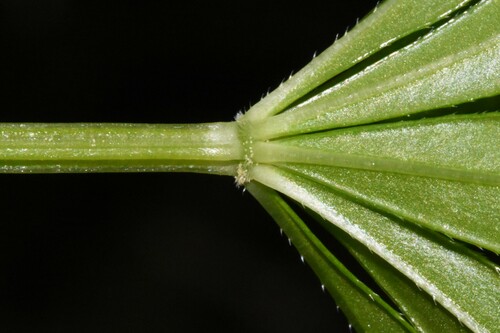
A small plant which keeps growing from year to year. It grows 45 cm high and spreads 90 cm wide. The stems are square in cross section. All parts of the plant have an odour. The leaves are narrow and stiff. They are slightly prickly. They are 5 cm long. They occur in neat rings of 6 to 8. The flowers are small and white. They are 35 mm across. They have a sweet scent.
How to Grow
Plants can be grown from seed.
Propagation: Seed is best sown in situ as soon as it is ripe in late summer, though spring sowing is possible and may be very slow to germinate. A period of cold stratification helps reduce germination time, and incorporating plenty of leafmould into the soil along with tree shade also improves germination rates. Divide in spring, or throughout the growing season if divisions are kept moist until established. Larger clumps can go directly into permanent positions; smaller clumps are best potted and grown on in a cold frame before planting out in spring. Softwood cuttings can be taken after flowering and rooted in a frame.
Medicinal Uses
Sweet woodruff was widely used during the Middle Ages as an external application to wounds and cuts and internally for digestive and liver problems. Today it is valued mainly for its tonic, diuretic, and anti-inflammatory properties. The leaves are antispasmodic, cardiac, diaphoretic, diuretic, and sedative. An infusion treats insomnia, nervous tension, varicose veins, biliary obstruction, hepatitis, and jaundice. The plant is harvested just before or as it comes into flower and can be dried for later use. One report advises caution in use while another considers it entirely safe. Excessive doses can cause dizziness and symptoms of poisoning. The dried plant contains coumarins that prevent blood clotting, though in excessive doses this can lead to internal bleeding. The plant is grown commercially as a source of coumarin for producing an anticoagulant drug. Do not use this remedy if taking conventional medicine for circulatory problems or if pregnant. Both Asperuloside (a terpenoid) and Coumarin (a benzopyrone) occur in some species of Galium. Asperuloside can be converted into prostaglandins, which stimulate the uterus and affect blood vessels, making the genus of significant interest to the pharmaceutical industry. A homeopathic remedy made from the plant is used for inflammation of the uterus.
Other Uses
A red dye is obtained from the root. Soft-tan and grey-green dyes are obtained from the stems and leaves. The plant makes good ground cover on woodland edges or in cool shade under shrubs, spreading rapidly at the roots and serving as an ideal carpeting plant for bulbs to grow through. Although the fresh plant has little aroma, it becomes very fragrant as it dries, developing the scent of newly mown grass and retaining it for years. It is used in linen cupboards to protect against moths and was formerly used as a strewing herb and as an ingredient in pot-pourri. Bunches were also hung in the home to keep rooms cool and fragrant in summer.
Wikipedia
Source ↗Galium odoratum, the sweet woodruff or sweetscented bedstraw, is a flowering perennial plant in the family Rubiaceae, native to much of Europe. It is widely cultivated for its flowers and its sweet-smelling foliage.
Notes
There are about 300 Galium species. There are 60 species in tropical America.
Names & Synonyms
Dišeča lakota, Lazarkinja, Lievevrouwebedstro, Myske, Szagos muge, Waldmeister
References (30)
- Bircher, A. G. & Bircher, W. H., 2000, Encyclopedia of Fruit Trees and Edible Flowering Plants in Egypt and the Subtropics. AUC Press. p 45 (As Asperula odorata)
- Bodkin, F., 1991, Encyclopedia Botanica. Cornstalk publishing, p 484
- Bodkin, F., 1991, Encyclopedia Botanica. Cornstalk publishing, p 109 (As Asperula odorata)
- Bremness, L., 1994, Herbs. Collins Eyewitness Handbooks. Harper Collins. p 173
- Brickell, C. (Ed.), 1999, The Royal Horticultural Society A-Z Encyclopedia of Garden Plants. Convent Garden Books. p 456
- Brouk, B., 1975, Plants Consumed by Man. Academic Press, London. p 355 (As Asperula odorata)
- Brown, D., 2002, The Royal Horticultural Society encyclopedia of Herbs and their uses. DK Books. p 219
- Cundall, P., (ed.), 2004, Gardening Australia: flora: the gardener's bible. ABC Books. p 624
- Denes, A., et al, 2012, Wild plants used for food by Hungarian ethnic groups living in the Carpathian Basin. Acta Societatis Botanicorum Poloniae 81 (4): 381-396 (As Asperula odorata)
- Facciola, S., 1998, Cornucopia 2: a Source Book of Edible Plants. Kampong Publications, p 212
- Fl. carniol. ed. 2, 1:105. 1771
- Girard, N. J., 2020, Sustainable Foraging of Wild Edible Plants in Norway. A Biocultural Approach. M. Sc. thesis Norwegian University. p 135
- Hedrick, U.P., 1919, (Ed.), Sturtevant's edible plants of the world. p 82 (As Asperula odorata)
- Hibbert, M., 2002, The Aussie Plant Finder 2002, Florilegium. p 34 (As Asperula odorata), 108
- http://nordicfood lab/org/blog/2102/9/wild-edible-plants-an-overview
- Irving, M., 2009, The Forager Handbook, A Guide to the Edible Plants of Britain. Ebury Press p 52
- Jackes, D. A., Edible Forest Gardens
- Kiple, K.F. & Ornelas, K.C., (eds), 2000, The Cambridge World History of Food. CUP p 434, 1883 (As Asperula odorata)
- Luczaj, L. et al, 2012, Wild food plant use in 21st century Europe: the disappearance of old traditions and the search for new cuisines involving wild edibles. Acta Soc Bot Pol 81(4):359–370
- Mabey, R., 1973, Food for Free. A Guide to the edible wild plants of Britain, Collins. p 137
- Michael, P., 2007, Edible Wild Plants and Herbs. Grub Street. London. p 248
- Plants for a Future database, The Field, Penpol, Lostwithiel, Cornwall, PL22 0NG, UK. http://www.scs.leeds.ac.uk/pfaf/
- Redzic, S. J., 2006, Wild Edible Plants and their Traditional Use in the Human Nutrition in Bosnia-Herzegovina. Ecology of Food and Nutrition, 45:189-232
- Schunko, C., et al, 2010, Organic farmers use of wild food plants and fungi in a hilly area in Styria (Austria). Journal of Ethnobiology and Ethnomedicine 6:17
- Seidemann J., 2005, World Spice Plants. Economic Usage, Botany, Taxonomy. Springer. p 161
- Simkova, K. et al, 2014, Ethnobotanical review of wild edible plants used in the Czech Republic. Journal of Applied Botany and Food Quality 88, 49-67
- Vorstenbosch, T., et al, 2017, Famine food of vegetal origin consumed in the Netherlands during World War II. Journal of Ethnobiology and Ethnomedicine (2017) 13:63
- Wiersema, J. H. & Leon, B., 2013, World Economic Plants. A Standard Reference CRC Press. 2nd Ed. p 316
- Williams, D., 2017, Ainu Ethnobiology. Contributions in Ethnobiology. Society of Ethnobiology.
- World Checklist of Useful Plant Species 2020. Royal Botanic Gardens, Kew


