Alectryon oleifolius
(Desf.) S.T. Reynolds
Bullocky bush, Boonaree, Rosewood, Western Rosewood, Boonery
(c) cinclosoma, some rights reserved (CC BY-NC), uploaded by cinclosoma
(c) Wayne Martin, some rights reserved (CC BY-NC)
(c) cinclosoma, some rights reserved (CC BY-NC), uploaded by cinclosoma
What to Eat
Edible parts: Buds, Gum, Fruit
The fruit, buds, and gum are edible.
Known Hazards
Where to Find It
It is a subtropical plant. It grows in sandy soils. It suits dry areas. In tropical Queensland it grows between 225-725 m altitude. It can grow in arid places. It suits hardiness zones 8-10.
Australia*,
How to Identify
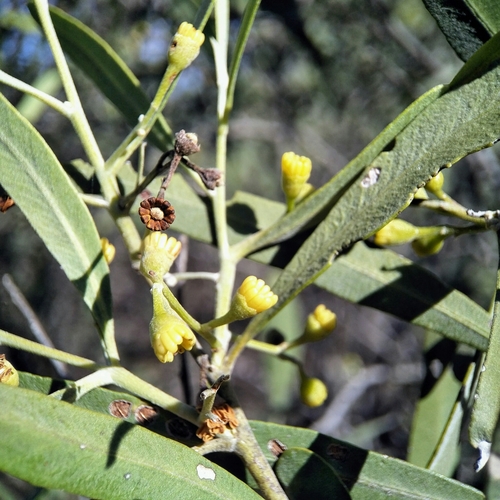
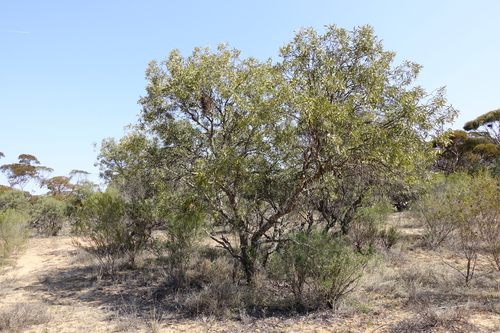
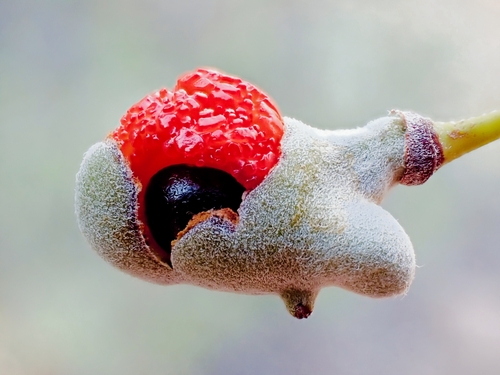
A small to medium sized tree. It grows to 9 m high. The bark is rough. The leaves are alternate and grey-green. They have prominent veins. The leaves have smooth edges. The flowers are small. They are cream and clustered at the ends of stems. The fruit has one shiny black seed. There is red flesh around the seed. The fruit is edible.
How to Grow
It can be grown from root suckers. Seeds germinate under extreme temperatures.
Wikipedia
Source ↗Alectryon oleifolius, commonly known as boonaree, inland rosewood or bullock bush (South Australia), is a species of small tree of the soapberry family Sapindaceae, native to Australia.
Notes
There are 15-34 Electryon species.
References (9)
- Austrobaileya 2(4):335. 1987
- Cooper, W. and Cooper, W., 2004, Fruits of the Australian Tropical Rainforest. Nokomis Editions, Victoria, Australia. p 476
- Etherington, K., & Imwold, D., (Eds), 2001, Botanica's Trees & Shrubs. The illustrated A-Z of over 8500 trees and shrubs. Random House, Australia. p 84
- Hunter, J.T., 2017, Is there a relationship between contemporary high Aboriginal plant resource locations and mapped vegetation communities? Cunninghamia 17:27-34. The Royal Botanic Garden Sydney. ISSN 2200 - 405X
- Latz, P.K., 1996, Bushfires and Bushtucker: Aboriginal plant use in Central Australia. IAD Press Alice Springs p 122
- Milson, J., 2000, Trees and Shrubs of north-west Queensland. DPI p 284
- Paczkowska, G . & Chapman, A.R., 2000, The Western Australian Flora. A Descriptive Catalogue. Western Australian Herbarium. p 527
- Steenbeeke, Greg as part of the Plants Directory project. List of plant species from northern NSW that may be used as food plants p 3
- Williams, K.A.W., 1999, Native Plants of Queensland Volume 4. Keith A.W. Williams North Ipswich, Australia. p 46