Ganophyllum falcatum
Blume
Termite tree, Scaly Ash, Daintree hickory

(c) Graham Bell, some rights reserved (CC BY-NC), uploaded by Graham Bell

(c) Russell Cumming, some rights reserved (CC BY-NC), uploaded by Russell Cumming

(c) kerrycoleman, some rights reserved (CC BY-NC), uploaded by kerrycoleman
What to Eat
Edible parts: Fruit
The fruit is eaten raw, specifically the aril (the layer around the seed). The fruit is smooth, oval, and fleshy, turning orange-red when ripe.
Where to Find It
A tropical and subtropical plant. Trees grow naturally in coastal monsoon vine forest. They are often on coastal sand dunes and near freshwater streams. Plants need to be in well drained soil. It needs plenty of moisture. Plants are sensitive to cold. In Indonesia is grow in forests up to 1200 m altitude.
Andamans, Asia, Australia, India, Indonesia, Malaysia, Nicobar, Pacific, Papua New Guinea, PNG, Philippines, SE Asia, Solomon Islands, West Africa,
How to Identify
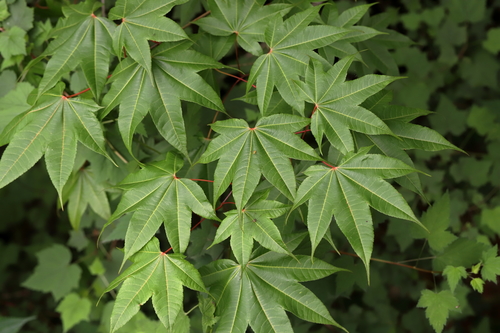
A medium sized tree. It grows 10-25 m high. It has a dense spreading crown. The young branches secrete resin and are scaly. The bark is smooth, light grey and slightly flaky. The leaves are alternate, smooth and divided along their length. The whole leaf is 15-35 cm long divided into 5-10-20 alternate leaflets. The leaflets are 3-10 cm long by 1.5-5 cm wide. The leaflets are curved and are not the same shape on either side of the midrib. They are shiny dark green on top and paler underneath. The leaflets have a pointed tip. The leaf stalk is 4.5-6.5 cm long. The flowers are very small and greenish-white. They are 0.2-0.5 cm across and many flowers occur together in a large panicle which is 10-30 cm long. These are produced in the axils of the upper leaves. Male and female flowers occur on separate branches. The fruit is smooth and oval and fleshy. It has one stone inside. The fruit is 1-1.5 cm long by 0.6-0.8 cm wide. It is orange red when ripe with a pointed tip. There are one or two seeds inside. The seeds are 8 mm long by 12 mm wide.
How to Grow
Plants can be grown from seed. The seed should be sown while fresh. They are best if soaked for 24 hours.
Medicinal Uses
Traditionally used by local peoples (FPI).
Other Uses
The seeds are the source of an oil called 'Arangan oil'. A solid fat at room temperature, it is used for illumination. The wood is very strong and durable. It is used for bridges, house construction etc.
Wikipedia
Source ↗Ganophyllum falcatum, commonly known as the scaly ash, is an evergreen rainforest tree. It grows up to 32 metres high and has rough, flaky bark. The species was described by German-Dutch botanist Carl Ludwig Blume in 1851 based on plant material collected from the coast of New Guinea.It is native to Africa, the Andaman Islands, Asia, Malesia and northern Australia. The ovoid fruits are consumed by fruit pigeons and cassowaries.
Production
Plants can be fast growing. In Australia, trees flower from October to January and fruit occur from December to February. (Plants flower at the beginning of the wet season.)
Notes
There are 2 Ganophyllum species.
Names & Synonyms
Pohon kayu madu, Pohon mangir
References (25)
- Ambasta, S.P. (Ed.), 2000, The Useful Plants of India. CSIR India. p 229
- Argent, G et al, nd, Manual of the Larger and More important non Dipterocarp Trees of Central Kalimantan Indonesia. Volume 2 Forest Research Institute, Samarinda, Indonesia. p 556
- Brock, J., 1993, Native Plants of Northern Australia, Reed. p 193
- Burkill, I.H., 1966, A Dictionary of the Economic Products of the Malay Peninsula. Ministry of Agriculture and Cooperatives, Kuala Lumpur, Malaysia. Vol 1 (A-H) p 1061
- Calvert, G., 2010, The Burdekin Delta Tree Guide. Lower Burdekin Landcare Association., Inc., Ayr p 91
- Cooper, W & Cooper, W T, 1994, Fruits of the Rain Forest. RD Press p 146
- Cooper, W. and Cooper, W., 2004, Fruits of the Australian Tropical Rainforest. Nokomis Editions, Victoria, Australia. p 490
- Cherikoff, V. & Isaacs, J., The Bush Food Handbook. How to gather, grow, process and cook Australian Wild Foods. Ti Tree Press, Australia p 147, 200
- Cribb, A.B. & J.W., 1976, Wild Food in Australia, Fontana. p 75
- Elliot, W.R., & Jones, D.L., 1992, Encyclopedia of Australian Plants suitable for cultivation. Vol 4. Lothian. p 330
- Foreman, D. B., 1971, A checklist of the Vascular Plants of Bougainville with Descriptions of some Common Forest Trees. Botany Bulletin No. 5. Department of Botany. p 122
- French, B.R., 2010, Food Plants of Solomon Islands. A Compendium. Food Plants International Inc. p 331
- Havel, J.J., 1975, Forest Botany, Volume 3 Part 2 Botanical taxonomy. Papua New Guinea Department of Forests, p 165
- Hibbert, M., 2002, The Aussie Plant Finder 2002, Florilegium. p 108
- Jackes, B.R., 2001, Plants of the Tropics. Rainforest to Heath. An Identification Guide. James Cook University. p 80
- Jones D, L, 1986, Ornamental Rainforest Plants in Australia, Reed Books, p 126
- Lazarides, M. & Hince, B., 1993, Handbook of Economic Plants of Australia, CSIRO. p 118
- Morley, B.D., & Toelken, H.R., (Eds), 1983, Flowering Plants in Australia. Rigby. p 204
- Paczkowska, G . & Chapman, A.R., 2000, The Western Australian Flora. A Descriptive Calatogue. Western Australian Herbarium. p 530
- Radke, P & A, Sankowsky, G & N., 1993, Growing Australian Tropical Plants. Frith & Frith, Australia. p 40
- Sukarya, D. G., (Ed.) 2013, 3,500 Plant Species of the Botanic Gardens of Indonesia. LIPI p 298
- Townsend, K., 1994, Across the Top. Gardening with Australian Plants in the tropics. Society for Growing Australian Plants, Townsville Branch Inc. p 220
- Wheeler, J.R.(ed.), 1992, Flora of the Kimberley Region. CALM, Western Australian Herbarium, p 654
- World Checklist of Useful Plant Species 2020. Royal Botanic Gardens, Kew
- Yunupinu Banjgul, Laklak Yunupinu-Marika, et al. 1995, Rirratjinu Ethnobotany: Aboriginal Plant Use from Yirrkala, Arnhem Land, Australia. Northern Territory Botanical Bulletin No 21. Parks and Wildlife Commission of the Northern Territory. p 43.