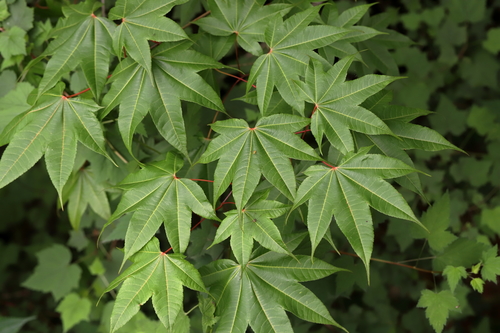
Alectryon tomentosus
(F. Muell.) Radlk.
Woolly rambutan, Red Jacket, Hairy Bird's eye

(c) Greg Tasney, some rights reserved (CC BY-SA), uploaded by Greg Tasney

(c) Tatters ❀, some rights reserved (CC BY)

(c) Tatters ❀, some rights reserved (CC BY-NC-SA)
What to Eat
Edible parts: Fruit aril
The fruit aril (fleshy layer surrounding the seed) is eaten.
Where to Find It
It is frost hardy once established. In tropical Queensland it grows from sea level to 950 m altitude. It needs rich, moist soil. It suits hardiness zones 9-10. Mt Cootha Botanical Gardens.
Australia*, Papua New Guinea, PNG,
How to Identify
A medium sized bushy tree. It grows 8-12 m high. The leaves have leaflets along the stalk. Leaves are 12 cm long and there are 2-4 pairs of leaflets. Each leaflet is 14 cm long by 6 cm wide. They are hairy all over. The edges are toothed. The pair of leaflets at the end are larger. New growth is pinkish. The flowers are small and cream. They are about 0.4 cm across. They occur in small panicles. The fruit have 1-3 hairy lobes. They are 1.5 cm across. Each lobe contains a large black seed in a red fleshy fruit. The fruit is edible.
How to Grow
Plants can be grown from fresh seed or cuttings.
Wikipedia
Source ↗Alectryon tomentosus, commonly known as the hairy birds eye, red jacket or woolly rambutan, is a rainforest tree of the family Sapindaceae found in eastern Australia. The specific epithet tomentosus refers to the hairy leaves and hairy young shoots. It grows in many different types of rainforest on a variety of soil types. Seen as far south as the Hunter River, New South Wales and growing to the most far north eastern point of the Australian continent. In its natural habitat it may reach 15 metres (50 ft) tall and a stem diameter of 30 cm (12 in). It is generally a lot smaller in cultivation. The average normal flower and fruit drop are 40% and 90% respectively. The endosperm development is ab initio nuclear and cell formation commences at the micropylar end, proceeding towards the chalaza. The outer layers of the outer integument differentiate into the edible flesh of the fruit. Alectryon tomentosus is an attractive tree, featuring jagged edged leaves, pink flowers and red fruit. The trunk is grey and smooth. It is often planted in gardens, parks or as a street tree. Green catbirds have been noticed eating the fruit. First described in 1857 by Ferdinand von Mueller as Nephelium tomentosum from a collection on the Brisbane River, it gained its current binomial name when reclassified by Ludwig Adolph Timotheus Radlkofer.
Notes
There are 15-34 Electryon species.
References (17)
- Actes Congr. Int. Bot., Amsterdam 1877:116. 1879
- Anon., 2003, Native Plants for the Fitzroy basin. Society for Growing Australian Plants Inc. (Rockhampton Branch)
- Bircher, A. G. & Bircher, W. H., 2000, Encyclopedia of Fruit Trees and Edible Flowering Plants in Egypt and the Subtropics. AUC Press. p 17
- Bodkin, F., 1991, Encyclopedia Botanica. Cornstalk publishing, p 64
- Cherikoff V. & Isaacs, J., The Bush Food Handbook. How to gather, grow, process and cook Australian Wild Foods. Ti Tree Press, Australia p 146, 198
- Cooper, W. and Cooper, W., 2004, Fruits of the Australian Tropical Rainforest. Nokomis Editions, Victoria, Australia. p 476
- Cribb, A.B. & J.W., 1976, Wild Food in Australia, Fontana. p 21
- Elliot, W.R., & Jones, D.L., 1982, Encyclopedia of Australian Plants suitable for cultivation. Vol 2. Lothian. p 173
- Etherington, K., & Imwold, D., (Eds), 2001, Botanica's Trees & Shrubs. The illustrated A-Z of over 8500 trees and shrubs. Random House, Australia. p 85
- Jackes, B.R., 2001, Plants of the Tropics. Rainforest to Heath. An Identification Guide. James Cook University. p 80
- Jones D, L, 1986, Ornamental Rainforest Plants in Australia, Reed Books, p 120
- Lamberton, K (Ed.), 2004, The Australian gardening encyclodepia. Murdoch Books, NSW Australia. p 156
- Low, T., 1992, Bush Tucker. Australia’s Wild Food Harvest. Angus & Robertson. p 60
- Melzer, R. & Plumb, J., 2011, Plants of Capricornia. Belgamba, Rockhampton. p 320
- Nicholson, N & H., 2000, Australian Rainforest Plants, V. Terania Rainforest Publishing. NSW. p 8
- Townsend, K., 1994, Across the Top. Gardening with Australian Plants in the tropics. Society for Growing Australian Plants, Townsville Branch Inc. p 74
- Williams, J.B., Harden, G.J., and McDonald, W.J.F., 1984, Trees and shrubs in rainforests of New South Wales and Southern Queensland. Univ. of New England, Armidale. p 46