Garcinia dioica
Blume
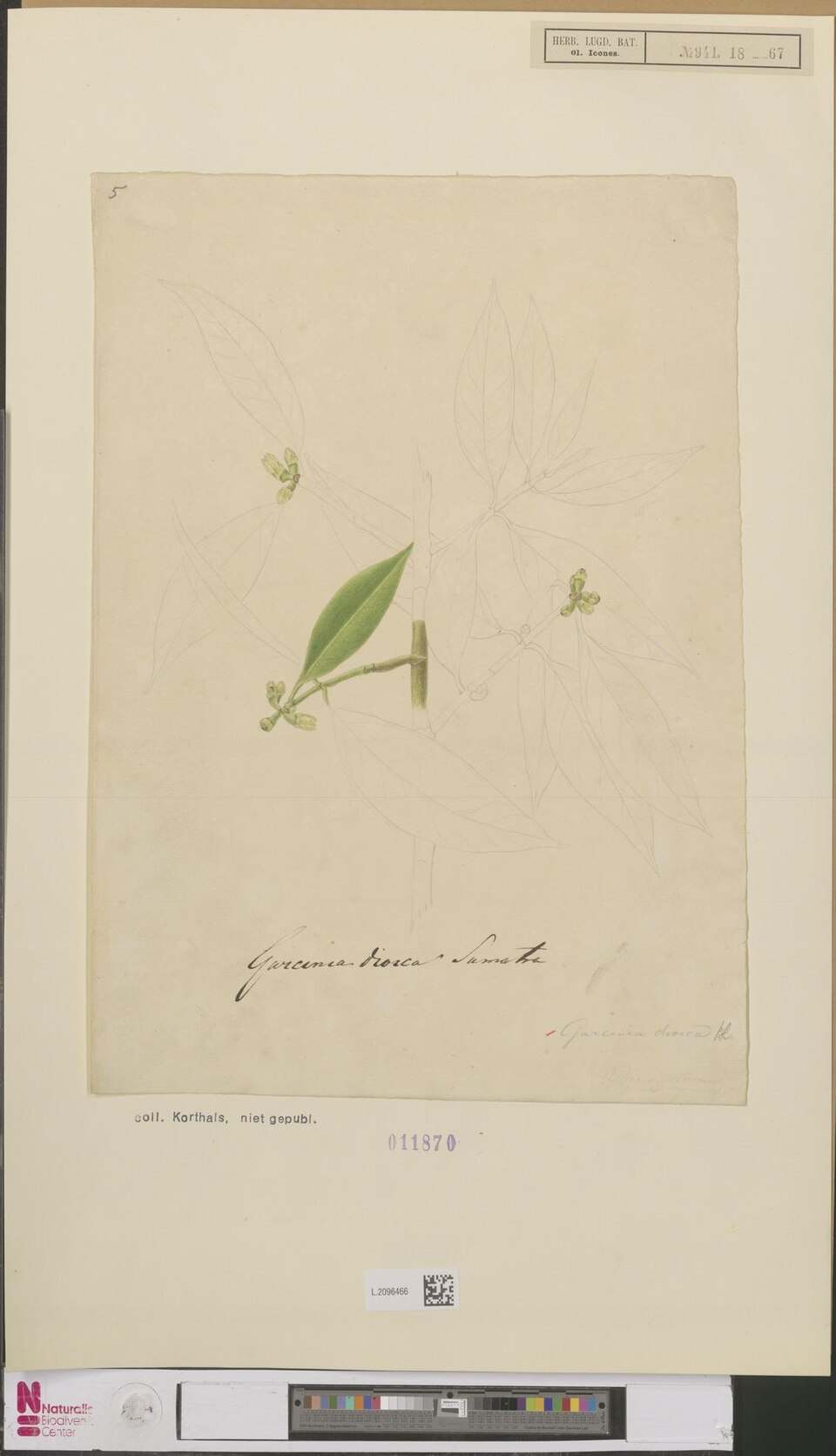
Wikimedia Commons - Unknown artistUnknown artist
What to Eat
Edible parts: Leaves, Fruit
The sour young leaves are eaten raw, and the ripe fruit are eaten for their sour taste.
Where to Find It
A tropical plant. In Java it grows in the lowlands and up to 1,200 m above sea level.
Asia, Indonesia, SE Asia,
How to Identify
A tree. It grows 5-25 m tall. The trunk is black. The branches are almost in rings. The leaves are opposite and have short stalks. They are sword shaped. They are dark green and shiny above and yellowish green underneath. The flowers are pale yellow. They can be of separate sexes or of both sexes. The fruit is a flattened round shape. It has the sunken remains of the flower on top. They are orange when ripe. They can be 4 cm across. There are 5-8 seeds.
How to Grow
Propagation: Seed - we have no specific information on this species, but the seed of most members of the genus can be slow to germinate, even if sown fresh, often taking 6 months or more.
Medicinal Uses
Young leaves are used as a food, suggesting traditional culinary/medicinal value.
Other Uses
The plant is used as a rootstock for the mangosteen (Garcinia mangostana).
Notes
There are about 300 Garcinia species.
Names & Synonyms
Kemendjing, Kicheri, Walung
References (5)
- Bijdr. 5:215. 1825
- Giesen, W., 2013, Paludiculture: sustainable alternatives on degraded peat land in Indonesia (revised draft)
- Martin, F.W. & Ruberte, R.M., 1979, Edible Leaves of the Tropics. Antillian College Press, Mayaguez, Puerto Rico. p 194
- Ochse, J.J. et al, 1931, Vegetables of the Dutch East Indies. Asher reprint. p 345
- Terra, G.J.A., 1973, Tropical Vegetables. Communication 54e Royal Tropical Institute, Amsterdam, p 49


