Garcinia griffithii
T. Anderson
Kandis gajah
(c) airgel, some rights reserved (CC BY-NC), uploaded by airgel
(c) Gavin, some rights reserved (CC BY-NC), uploaded by Gavin
(c) Pizzas fear me, some rights reserved (CC BY-NC), uploaded by Pizzas fear me
What to Eat
Edible parts: Fruit
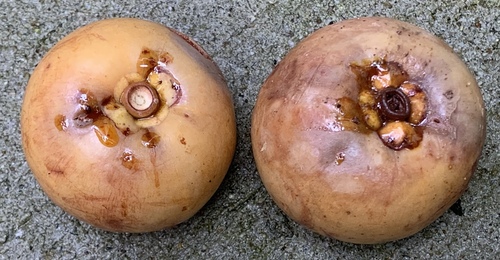
Fruit - raw or cooked. An acid flavour, they are more commonly cooked.The brown-yellow fruit is a globose berry, 5 - 8cm in diameter.
Where to Find It
A tropical plant. It grows in lowland forest.
Asia, India, Malaysia, SE Asia, Singapore,
How to Identify
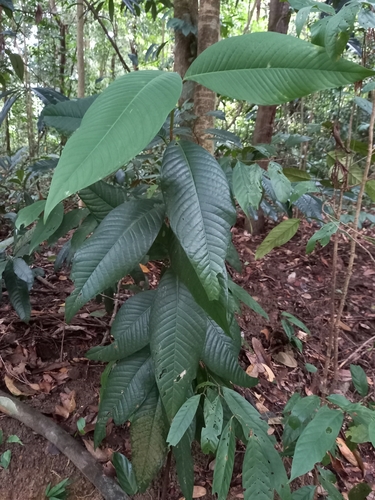
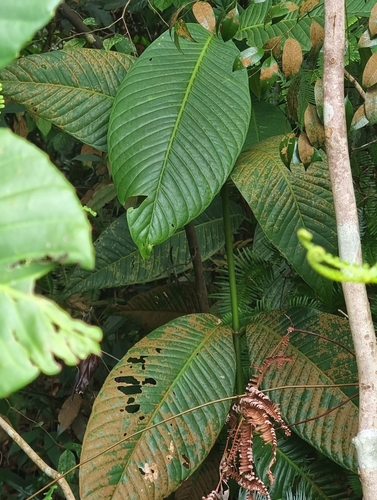
A tree. It grows 12-18 m tall. The leaves are broadly oval and 22-40 cm long by 10-20 cm wide. The flowers are of separate sexes. They are yellow but the petals are reddish at the base. The fruit is a round berry. It is 5-8 cm across. They are green but turn a yellowish-brown.
How to Grow
Propagation: Seed - we have no specific information on this species, but the seed of most members of the genus can be slow to germinate, even if sown fresh, often taking 6 months or more.
Notes
There are about 300 Garcinia species.
Names & Synonyms
Apple-kandis
References (7)
- Burkill, I.H., 1966, A Dictionary of the Economic Products of the Malay Peninsula. Ministry of Agriculture and Cooperatives, Kuala Lumpur, Malaysia. Vol 1 (A-H) p 1067
- Heyne, K., 1927, p 1089
- J. D. Hooker, Fl. British India 1:266. 1874
- Milow, P., et al, 2013, Malaysian species of plants with edible fruits or seeds and their evaluation. International Journal of Fruit Science. 14:1, 1-27
- PROSEA (Plant Resources of South East Asia) handbook, Volume 2, 1991, Edible fruits and nuts.
- Saw, L.G., LaFrankie, J. V. Kochummen, K. M., Yap S. K., 1991, Fruit Trees in a Malaysian Rain Forest. Economic Botany, Vol. 45, No. 1, pp. 120-136
- World Checklist of Useful Plant Species 2020. Royal Botanic Gardens, Kew


