Garcinia multiflora
Champion ex Bentham
Guandong mangosteen

(c) Pankaj Kumar, some rights reserved (CC BY-NC)

(c) Pankaj Kumar, some rights reserved (CC BY-NC)
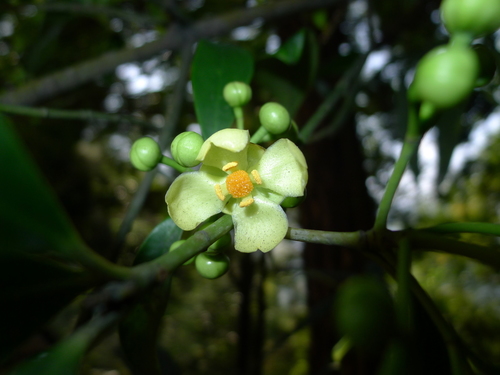
(c) 小铖/Smalltown, some rights reserved (CC BY-NC)
What to Eat
Edible parts: Fruit, Leaves
The ripe fruit is eaten raw, though it is very sour. The leaves are also edible.
Where to Find It
A tropical and subtropical plant. It grows in a range of sites usually between 400 and 1200 m altitude in China. In Taiwan in grows in the lowlands in the south. In Yunnan.
Asia, China, Hong Kong, Indochina, Laos, SE Asia, Taiwan, Vietnam,
How to Identify
A tree. It grows between 5 and 15 m tall. It has a knotty trunk and horizontal branches. The branches are slender and yellowish-brown. Trees are separately male and female. The leaves are 6-12 cm long by 3-6 cm wide. They are oval. The fruit is a round berry 5-7 cm across. There are 4 seeds 3-4 cm long.
How to Grow
A plant of the moist tropics and subtropics, where it is found at elevations up to 1,900 metres. It grows best in areas where annual daytime temperatures are within the range 21 - 28°c, but can tolerate 15 - 36°c. It prefers a mean annual rainfall in the range 1,500 - 1,800mm, but tolerates 1,100 - 2,500mm. Succeeds in full sun and in dappled shade. Succeeds in most well-drained soils of at least moderate fertility. Prefers a pH in the range 7 - 7.5, tolerating 6.5 - 8. Flowering usually occurs after a period of pronounced dry weather, and often happens twice a year.
Propagation: Seed - we have no specific information on this species, but the seed of most members of the genus can be slow to germinate, even if sown fresh, often taking 6 months or more.
Medicinal Uses
The bark is used as an external medicine to reduce inflammation.
Other Uses
The seeds yield up to 50% oil (seed pulp up to 55% oil). The oil is used for lighting, manufacturing soap or as a lubricant for machines. The timber is hard. It is used for making furniture, boats, and woodcuts. The tree is used to provide shade in tea plantations.
Wikipedia
Source ↗Garcinia multiflora is a species of tree in the family Clusiaceae. No subspecies are listed in the Catalogue of Life. It is called dọc in Vietnamese and used to flavour and colour bún riêu soup.
Other Information
It is cultivated.
Notes
There are about 300 Garcinia species.
Names & Synonyms
Bira tai, Doc, May bao, Mu zhu zi
References (13)
- Arora, R. K., 2014, Diversity in Underutilized Plant Species - An Asia-Pacific Perspective. Bioversity International. p 73
- Forest Inventory and Planning Institute, 1996, Vietnam Forest Trees. Agriculture Publishing House p 98
- Hooker's J. Bot. Kew Gard. Misc. 3:310. 1851
- Hu, Shiu-ying, 2005, Food Plants of China. The Chinese University Press. p 559
- Li Xi-wen & Li Jie; Peter F. Stevens, Clusiaceae [Draft], Flora of China
- Luo, B., et al, 2019, Wild edible plants collected by Hani from terraced rice paddy agroecosystem in Honghe Prefecture, Yunnan, China. Journal of Ethnobiology and Ethnomedicine 15:56
- Mot So Rau Dai an Duoc O Vietnam. Wild edible Vegetables. Ha Noi 1994, p 202
- Pham-Hoang Ho, 1999, An Illustrated Flora of Vietnam. Nha Xuat Ban Tre. p 454
- PROSEA (Plant Resources of South East Asia) handbook, Volume 2, 1991, Edible fruits and nut. p 177
- USDA, ARS, National Genetic Resources Program. Germplasm Resources Information Network - (GRIN). [Online Database] National Germplasm Resources Laboratory, Beltsville, Maryland. Available: www.ars-grin.gov/cgi-bin/npgs/html/econ.pl (10 April 2000)
- Van Sam, H. et al, 2008, Uses and Conservation of Plant Species in a National Park. A case study of Ben En, Vietnam. Economic Botany 62:574-593
- World Checklist of Useful Plant Species 2020. Royal Botanic Gardens, Kew
- Zeven, A. C. & de West, J. M. J., 1982, Dictionary of cultivated plants and their regions of diversity. Wageningen. p 56


