Geranium bicknellii
Britton
Bicknell's Cranesbill, Northern Crane's-bill

(c) Superior National Forest, some rights reserved (CC BY)
(c) mycomoon, some rights reserved (CC BY-NC)
What to Eat
Edible parts: Flowers, Leaves
The leaves can be eaten raw or cooked, though they are not considered choice. The flowers can be eaten raw.
Where to Find It
It is a temperate plant. It grows near the tree line in the Rocky Mountains. It grows in clearings and open woods and in disturbed soil. It needs a sunny location.
Alaska, Canada, Colombia, North America, USA, Venezuela,
How to Identify
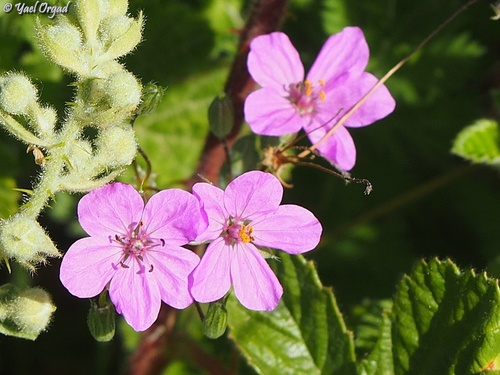
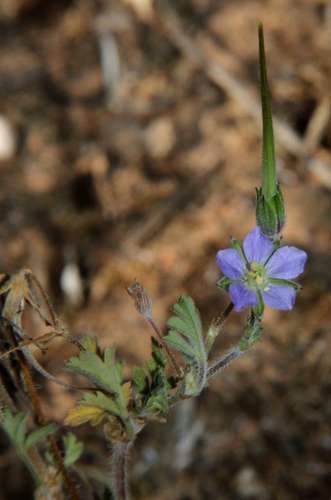
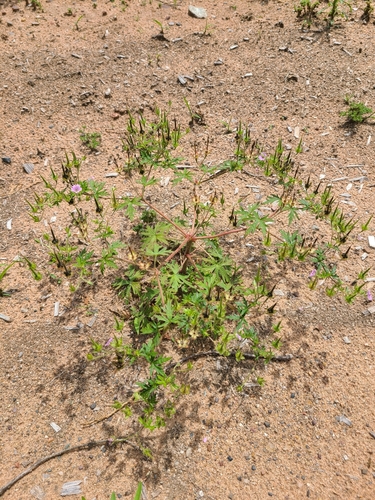
A herb. It grows for one or two years. It grows 12-40 cm high. The leaves are divided into narrow segments. The leaves are 18-60 mm wide. The flowers are in pairs and are red. They are 8-12 mm wide. The fruit is a dry capsule with a long beak. It splits lengthwise into 5 divisions.
How to Grow
We have very little information on this species and do not know if it will be hardy in Britain, though judging by its native range it should succeed outdoors in most parts of this country. The following notes are based on the general needs of the genus. Succeeds in any moderately fertile retentive soil in a sunny position. Tolerates a range of soil types. Members of this genus are rarely if ever troubled by browsing deer or rabbits.
Propagation: Sow seed in spring or autumn in a cold frame. Once seedlings are large enough to handle, prick them out into individual pots and plant out during summer.
Medicinal Uses
The whole plant, but especially the roots, is astringent, salve, and styptic. It can be used as a gargle for sore throats.
Other Uses
None known.
Wikipedia
Source ↗Geranium bicknellii is a species of geranium known by the common names Bicknell's cranesbill and northern cranesbill. It is native to much of the northern half of North America, where it can be found in a number of forest and woodland habitats. This is an annual or biennial herb which grows hairy stems up to about half a meter long. It may be erect or lie near the ground. Each leaf is several centimeters long and wide and is divided into several lobes, each of which may have smaller lobes or teeth. Flowers grow singly or in pairs and have pointed sepals and small lavender petals, each with a notch in the tip. The fruit has a rounded body with a long, straight style about 2 centimeters in length and tipped with a small beak. Geranium bicknellii is a fire-adapted species, occurring most abundantly in recently burned forests. The seeds remain dormant while buried in the forest floor, sometimes for centuries, until a fire removes the organic litter and exposes the seeds to sunlight. The geraniums will germinate, bloom, and set seed profusely for several years after the fire, until other plants grow large enough to shade them out. The new seeds will then lie dormant in the soil, waiting for the next fire. The leaves of this species and some related species are somewhat difficult to distinguish from those of some plants in the family Ranunculaceae, particularly members of the genera Aconitum and Delphinium. They have also been confused with members of the genus Ranunculus, which is also part of that family, such as the meadow buttercup, Ranunculus acris. As the species from this family with a similar leaf shape are toxic to ingest or sometimes even touch, especially in the case of Aconitum species, it is possible that this is an example of mimicry selectively favored by reducing herbivory. However, it may simply be coincidental convergent evolution. As the family Ranunculaceae is especially ancient, other families have had quite a lot of time to mimic their characteristics via selection by herbivory.
Notes
There are about 300-400 Geranium species. They are mostly temperate.
Names & Synonyms
References (6)
- Bull. Torrey Bot. Club 24:92. 1897
- Cormack, R. G. H., 1967, Wild Flowers of Alberta. Commercial Printers Edmonton, Canada. p 190
- Kew Plants of the World On line
- MacKinnon, A., et al, 2009, Edible & Medicinal Plants of Canada. Lone Pine. p 222
- Plants for a Future database, The Field, Penpol, Lostwithiel, Cornwall, PL22 0NG, UK. http://www.pfaf.org
- Porsild, A.E., 1974, Rocky Mountain Wild Flowers. Natural History Series No. 2 National Museums of Canada. p 270