Geranium dissectum
L.
Cut-leafed cranesbill
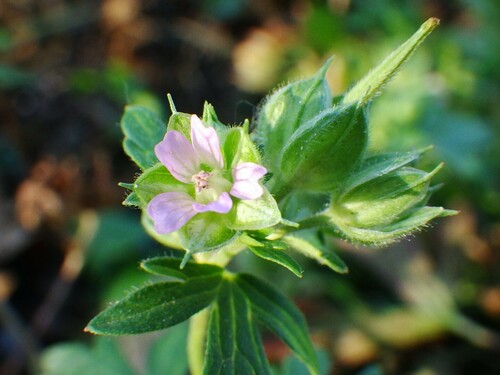
(c) Matthias Buck, some rights reserved (CC BY-NC)
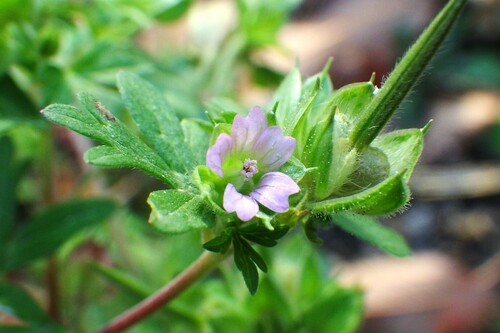
(c) Matthias Buck, some rights reserved (CC BY-NC)
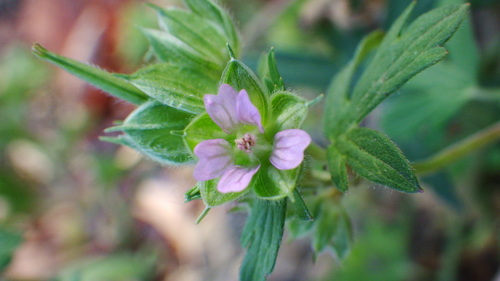
(c) Matthias Buck, some rights reserved (CC BY-NC)
What to Eat
Edible parts: Root, Leaves
The root can be eaten cooked, but is considered a famine food, used only when nothing else is available.
Where to Find It
It grows in temperate places. It usually grows in fields and waste spaces along roadsides. It is mostly on moist soils. Tasmania Herbarium.
Argentina, Australia, Brazil, Britain, Central Asia, Chile, Dominican Republic, Europe, France, Haiti, Italy, Luxembourg, Mediterranean, New Zealand, Norfolk Island, Portugal, Slovenia, South America, Spain, Tajikistan, Tasmania, Turkey, Türkiye, Uruguay, West Indies,
How to Identify
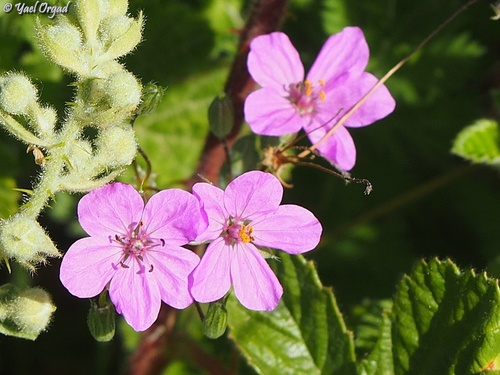
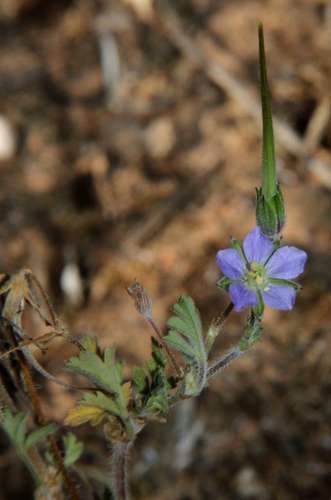
An annual herb plant. It grows 50 cm high. The stems have some hairs. The leaves at the base are in a ring. They are 3-5 cm long and 3.5-9 cm wide. The leaves are divided like fingers on a hand. The lobes are also divided. The lower leaves have longer stalks than the upper leaves. The flowers are usually in pairs. The stalk of the flower group is 1-1.5 cm long then the stalks of the individual flowers is 0.5-1 cm long. The flowers petals are almost equal in length. They are purple. There are 5 petals and 10 stamen. The seeds have awns. They roll upwards and remain attached.
How to Grow
Succeeds in any moderately fertile retentive soil in a sunny position. Tolerates a range of soil types. Members of this genus are rarely if ever troubled by browsing deer or rabbits.
Propagation: Sow seed in spring in a cold frame. Once seedlings are large enough to handle, prick them out into individual pots and plant out during summer.
Medicinal Uses
The whole plant, especially the roots, is rich in tannin and is antiseptic, highly astringent, styptic, and tonic. An infusion of the whole plant or roots alone is used to treat diarrhoea (particularly in children and the elderly), dysentery, cholera, gastro-enteritis, internal bleeding, and excessive menstruation. Externally, it is applied to purulent wounds, haemorrhoids, thrush, vaginal discharges, and inflammations of the mouth. Roots are best harvested as the plant comes into flower, when medicinal potency is at its peak. Leaves should be collected before the plant sets seed. Both roots and leaves are dried for later use.
Other Uses
A brown dye is obtained from the dry flowers. The leaves and roots are rich in tannin.
Wikipedia
Source ↗Geranium dissectum or cut-leaved crane's-bill is a plant species of the genus Geranium. It is native to Europe. It can be found on other continents as well, in some instances as an introduced species. It can be found in North America, where it is known as the cutleaf geranium. Extracts of Geranium dissectum are reported to improve germination rates of Hemp seeds.
Notes
There are about 300-400 Geranium species. They are mostly temperate.
Names & Synonyms
Agujas, Alfilerillo, Dilimli itir, Nacepljenolistna krvomočnica, Turnagagasi
References (13)
- Blamey, M and Grey-Wilson, C., 2005, Wild flowers of the Mediterranean. A & C Black London. p 112
- Cent. pl. I:21. 1755 (Amoen. acad. 4:282. 1759)
- Dogan, Y., 2012, Traditionally used wild edible greens in the Aegean Region of Turkey. Acta Societatis Botanicorum Poloniae 81(4): 329-342
- Ertug, F, Yenen Bitkiler. Resimli Türkiye Florası -I- Flora of Turkey - Ethnobotany supplement
- Flora of Australia Volume 49, Oceanic Islands 1, Australian Government Publishing Service, Canberra. (1994) p 259
- Hedrick, U.P., 1919, (Ed.), Sturtevant's edible plants of the world. p 328
- Hussey, B.M.J., Keighery, G.J., Cousens, R.D., Dodd, J., Lloyd, S.G., 1997, Western Weeds. A guide to the weeds of Western Australia. Plant Protection Society of Western Australia. p 166
- Hyde-Wyatt, B.H. & Morris D.I., 1975, Tasmanian Weed Handbook. Dept of Ag Tasmania. p 68
- Lamp, C & Collet F., 1989, Field Guide to Weeds in Australia. Inkata Press. p 128
- Paczkowska, G. & Chapman, A.R., 2000, The Western Australian Flora. A Descriptive Catalogue. Western Australian Herbarium. p 252
- Plants for a Future database, The Field, Penpol, Lostwithiel, Cornwall, PL22 0NG, UK. http://www.scs.leeds.ac.uk/pfaf/
- Plants of Haiti Smithsonian Institute http://botany.si.edu/antilles/West Indies
- Tasmanian Herbarium Vascular Plants list p 34