Geranium potentilloides
L’Her ex DC.
Crane’s bill, Mountain cranesbill
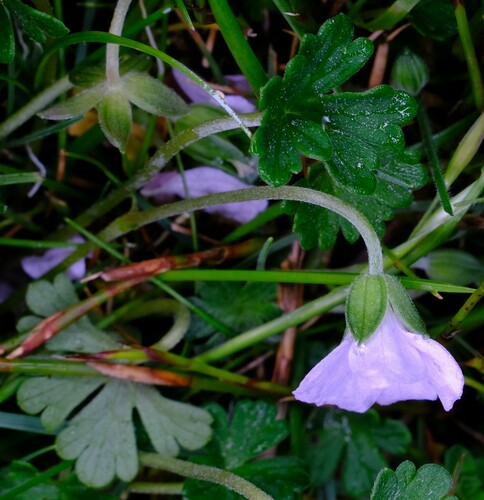
(c) Peter Crowcroft, some rights reserved (CC BY), uploaded by Peter Crowcroft
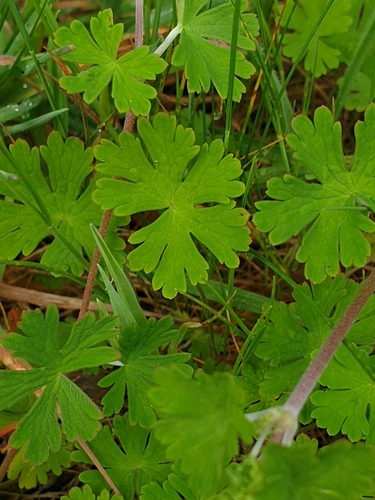
(c) Clem, some rights reserved (CC BY-NC), uploaded by Clem

(c) Ivan Margitta, some rights reserved (CC BY-NC), uploaded by Ivan Margitta
What to Eat
Edible parts: Tuber, Roots, Leaves, Flowers
The carrot-shaped root can be eaten raw or cooked, though it is starchy, astringent, and generally unpleasant in flavour. Younger roots are likely less bitter and more palatable than older ones.
Where to Find It
It is a temperate plant. It usually grows in shaded sites often near rocks. It often grows in mountain places. It needs well drained moist soils. It can tolerate part shade. Tasmania Herbarium.
Antarctic Islands, Australia, New Guinea, New Zealand, Tasmania*,
How to Identify
A herb. It keeps growing from year to year. It lies along the ground and spreads 0.5-1.5 m wide. The stems are long, leafy and scrambling. They sometimes root at the nodes. The leaves occur in a ring near the base. These are larger than those on the stem and usually fall off. The leaves are rounded in outline and deeply divided into 3-7 lobes. These are widened above. The stem leaves are 7 cm long by 5 cm wide. The leaf stalks are slender and 4 cm long. The leaves are purplish underneath. The flowers are creamy pink. They are 10 mm across. They are open petalled. They are pink and usually occur singly. They are on slender stalks 5 cm long. The fruit has a beak 1 cm long. The seeds are dark brown.
How to Grow
We have almost no information on this species and do not know if it will be hardy in Britain, though judging by its native range it could succeed outdoors at least in the milder areas of this country. The following comments are based on the general needs of the species. Succeeds in any moderately fertile retentive soil in a sunny position. Tolerates a wide range of soil types. Members of this genus are rarely if ever troubled by browsing deer or rabbits.
Propagation: Sow seed in spring in a cold frame. Once seedlings are large enough to handle, prick them out into individual pots and plant out during summer. Divide clumps in spring or autumn — larger clumps can go directly into permanent positions, but smaller ones are best potted up and grown on in a cold frame until well rooted, then planted out in spring.
Medicinal Uses
None known
Other Uses
None known
Wikipedia
Source ↗Geranium potentilloides, belongs to the family Geraniaceae, and is a small prostrate perennial herb that can grow up to 60cm high. The species is commonly referred to as Soft Cranesbill or Cinquefoil geranium.
Notes
There are about 300-400 Geranium species. They are mostly temperate.
Names & Synonyms
Kawurn-kallumbarrat, Kullumkulkeeteech, Terrat
References (15)
- Cherikoff V. & Isaacs, J., The Bush Food Handbook. How to gather, grow, process and cook Australian Wild Foods. Ti Tree Press, Australia p 195
- Dashorst, G.R.M., and Jessop, J.P., 1998, Plants of the Adelaide Plains & Hills. Botanic Gardens of Adelaide and State Herbarium. p 92
- Elliot, W.R., & Jones, D.L., 1992, Encyclopedia of Australian Plants suitable for cultivation. Vol 4. Lothian. p 358
- Gilfedder, L et al, 2003, The Nature of the Midlands. Midlands Bushweb. PO Box 156 Longford, Tasmania. p 110
- Harris, S., Buchanan, A., Connolly, A., 2001, One Hundred Islands: The Flora of the Outer Furneaux. Tas Govt. p 159
- Hibbert, M., 2002, The Aussie Plant Finder 2002, Florilegium. p 110
- Hastings Advance Community College, 2017, Uses for Native Plants of the Mornington Peninsula. 86pp. p 46
- Hope, G.S., & Coutts, P.J.F., 1971, Mankind. 8:104-14.
- Kirkpatrick, J., 1997, Alpine Tasmania, An Illustrated guide to the flora and vegetation. Oxford, p 86
- Low, T., 1991, Wild Food Plants of Australia. Australian Nature FieldGuide, Angus & Robertson. p 110
- Morley, B.D., & Toelken, H.R., (Eds), 1983, Flowering Plants in Australia. Rigby. p 211
- Plants for a Future database, The Field, Penpol, Lostwithiel, Cornwall, PL22 0NG, UK. http://www.scs.leeds.ac.uk/pfaf/
- Prodr. 1:639. 1824
- Tasmanian Herbarium Vascular Plants list p 34
- Whiting, J. et al, 2004, Tasmania's Natural Flora. Tasmania's Natural Flora Editorial Committee PO Box 194, Ulverstone, Tasmania, Australia 7315 p 185