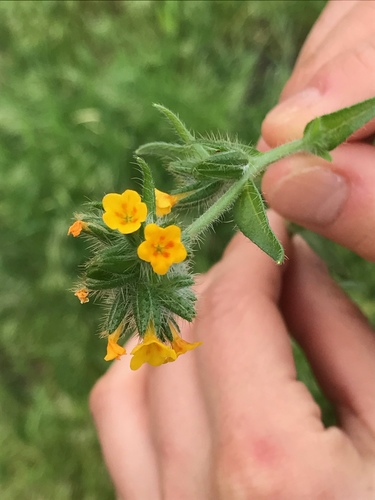
Alkanna lehmannii
(L.) Taush.
Alkanet, Spanish Bugloss, Dyer's Bugloss

Wikimedia Commons

Wikimedia Commons - Unknown authorUnknown author
What to Eat
Edible parts: Leaves, Vegetable
The leaves are eaten as a vegetable. A red coloring extracted from the roots is used as a food dye, particularly for cheeses and some wines.
Where to Find It
It grows on soils near the seaside and calcareous soils. It prefers a well drained loamy soil. It dislikes acid soils. Once established it is very drought tolerant and can survive in hot dry places. Plants can survive temperatures down to about -10°C.
Australia, Europe, France, Greece, Mediterranean, Portugal, Spain, Turkey, Türkiye,
How to Identify
A perennial plant. It grows 20 cm high and 25 cm across. It is spreading and almost lies along the ground. It has a woody base and many leaves near the base. It has rather prickly hairy leaves. The leaves are narrow or sword shaped. The lower leaves have stalks but the upper leaves do not have stalks and clasp the stem. These have heart shaped bases. The flowers are bright blue. They are 6-8 mm across and produced on branched stalks. The lower flowers have large leaf-like bracts.
How to Grow
It can be grown from seed, division or cuttings.
Notes
There are about 30 Alkanna species. A red dye is extracted from its roots.
Names & Synonyms
References (8)
- Blamey, M and Grey-Wilson, C., 2005, Wild flowers of the Mediterranean. A & C Black London. p 189
- Bodkin, F., 1991, Encyclopedia Botanica. Cornstalk publishing, p 64 (As Alkanna tinctoria)
- Brown, D., 2002, The Royal Horticultural Society encyclopedia of Herbs and their uses. DK Books. p 110 (As Alkanna tinctoria)
- Hepper, E.N., 1993, Illustrated Encyclopedia of Bible Plants, IVP, England. p 171
- Kiple, K.F. & Ornelas, K.C., (eds), 2000, The Cambridge World History of Food. CUP p 1716
- Morley, B. & Everard, B., 1970, Wild Flowers of the World. Ebury press. Plate 37
- Plants for a Future database, The Field, Penpol, Lostwithiel, Cornwall, PL22 0NG, UK. http://www.scs.leeds.ac.uk/pfaf/
- Prodr. 10:588. 1846