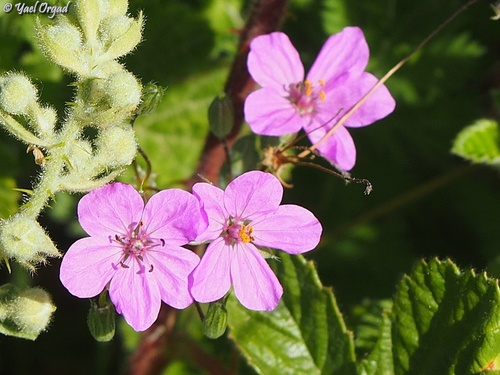
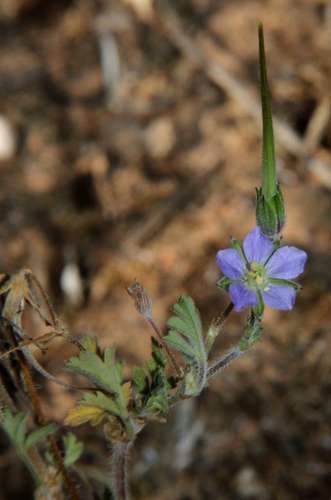
Geranium retrorsum
L’Her ex DC.
Common Cranesbill, Grassland cranesbill

(c) Nathan Odgers, some rights reserved (CC BY), uploaded by Nathan Odgers
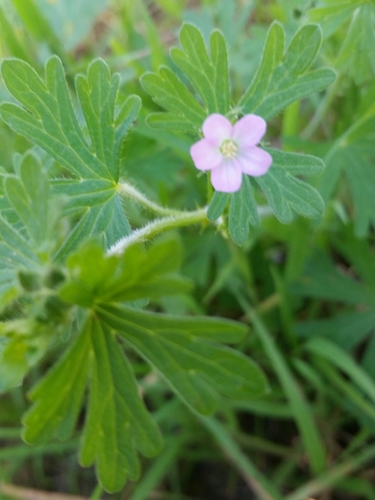
(c) econiko, some rights reserved (CC BY-NC), uploaded by econiko
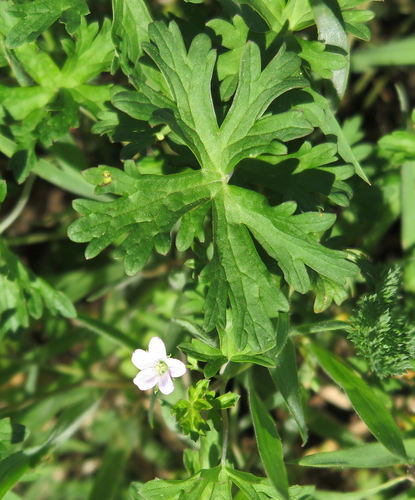
(c) Alice Shanks, some rights reserved (CC BY-NC), uploaded by Alice Shanks
What to Eat
Edible parts: Taproot
The taproot is edible.
Where to Find It
It grows in temperate places. It grows in grassland and woodland. Tasmania Herbarium.
Australia, Hawaii, New Zealand, Tasmania, USA,
How to Identify
A creeping herb plant which keeps growing from year to year. The stems lie along the ground. They are covered with soft hairs. The leaves near the base are in a ring. The leaves near the base are larger and have deeper lobes than the leaves on the stems. The leaves on the stem are 9 cm long by 3 cm wide. They are opposite. The leaf stalks are slender and 7 cm long. The hairs are short and point backwards. Leaves are round or kidney shaped with 3-7 lobes. They are green and hairy. The flower have open petals and are 2 cm across. They are pink with yellow veins. The flowers occur in pairs. They have long slender hairy stalks. There are long hairs around the edges of the sepals. The fruit has a beak 1.5 cm long. The seeds are dark brown.
How to Grow
Plants can be grown from seeds or cuttings.
Wikipedia
Source ↗Geranium retrorsum is a species of Geranium known by the common name New Zealand geranium in the United States and common cranesbill in Australia. It is native to Australia and New Zealand but can be found on other continents as an introduced species which is often a noxious weed as well. This is a perennial herb growing generally erect to a maximum height approaching half a meter. The stems are green to reddish and have stiff hairs. The leaves are a few centimeters wide and divided into several segments which are further divided into small lobes. The small flowers are fuchsia to purple in color. The fruit has a straight style about a centimeter in length. In New Zealand this species has been classified by the Department of Conservation as Threatened - Nationally Vulnerable.
Notes
There are about 300-400 Geranium species. They are mostly temperate.
References (8)
- Dashorst, G.R.M., and Jessop, J.P., 1998, Plants of the Adelaide Plains & Hills. Botanic Gardens of Adelaide and State Herbarium. p 92
- Gilfedder, L et al, 2003, The Nature of the Midlands. Midlands Bushweb. PO Box 156 Longford, Tasmania. p 110
- Gott, B & Conran, J., 1991, Victorian Koorie Plants. PO Box 666 Hamilton, Victoria 3300, Australia. p 23
- Lazarides, M. & Hince, B., 1993, Handbook of Economic Plants of Australia, CSIRO. p 120
- Paczkowska, G. & Chapman, A.R., 2000, The Western Australian Flora. A Descriptive Catalogue. Western Australian Herbarium. p 252
- Prodr. 1:644. 1824
- Tasmanian Herbarium Vascular Plants list p 34
- World Checklist of Useful Plant Species 2020. Royal Botanic Gardens, Kew