Geranium tuberosum
L.
Tuberous cranesbill

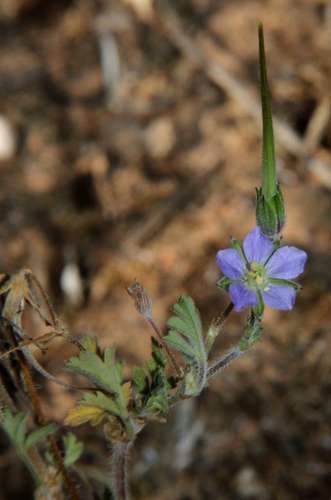
(c) Zeynel Cebeci, some rights reserved (CC BY-SA)
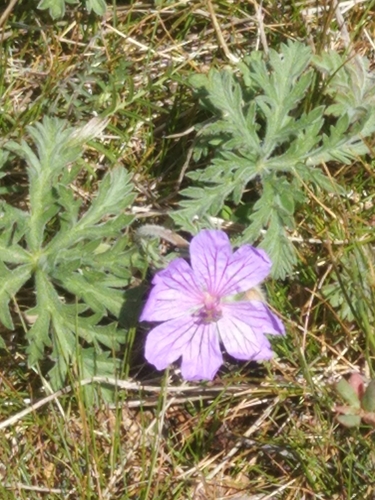
(c) cypke, some rights reserved (CC BY-NC)
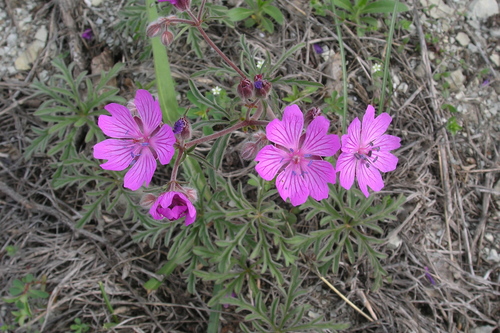
(c) Krylenko VV, some rights reserved (CC BY-NC), uploaded by Krylenko VV
What to Eat
Edible parts: Root, Tubers, Leaves
The tubers are edible and grow up to 15mm wide.
Where to Find It
It is a Mediterranean plant. It suits hardiness zones 8-10.
Africa, Australia, Europe, France, Iran, Jordan, Libya, Mediterranean, Middle East, North Africa, Spain, Tasmania, Turkey, Türkiye,
How to Identify
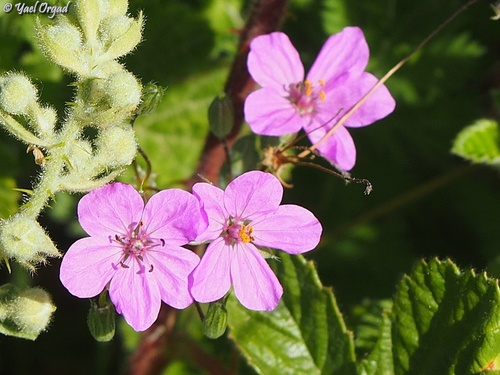
It has a round tuber. The branched stem grows from this. The stem grows 40 cm high. It has fine hairs. There are leaves near the base and these are 7.5 cm across. These are divided into 6 deeply cut lobes. The flowers have purple-pink petals. They are 12 mm long. The veins are a deep purple. The petals are notched at the tip.
How to Grow
Succeeds in any moderately fertile retentive soil in a sunny position. Tolerates a wide range of soil types. Established plants are drought resistant. This species is not hardy in all parts of Britain, it tolerates temperatures down to between -5 and -10°c. Plants come into growth in the autumn and die down in mid-summer. Plants spread by means of underground tubers and can be invasive. Members of this genus are rarely if ever troubled by browsing deer or rabbits. At least one named variety has been selected for its ornamental value. 'Charlesii' has a low spreading habit.
Propagation: Sow seed in spring in a cold frame, or as soon as it is ripe in summer. Divide clumps in late summer or early autumn — larger clumps can go directly into permanent positions, but smaller ones are best potted up and grown on in a cold frame until well rooted, then planted out in spring.
Medicinal Uses
None known
Other Uses
None known
Wikipedia
Source ↗Geranium tuberosum, the tuberous-rooted cranesbill, is a species of flowering plant in the family Geraniaceae. It is native to the Mediterranean region, the Caucasus, and western Asia. The Royal Horticultural Society considers it a good plant to attract pollinators, and it is widely available from commercial suppliers. There are a number of cultivars available, including 'Rosie's Mauve' and 'Richard Hobbs'.
Notes
There are about 300-400 Geranium species. They are mostly temperate.
Names & Synonyms
Cakmuz, Furki'shishan, Guza bin erd, Guza ereba, Hillok, Hilok, Karn al ghazal, Tavsantopu
References (16)
- Al-Qura'n, S. A., 2010, Ethnobotanical and Ecological Studies of Wild Edible Plants in Jordan. Libyan Agriculture Research Center Journal International 1(4):231-243
- Baktır, I., Yılmaz, G., Göktürk, R.S. and Karagüzel, O. (2013). EDIBLE FLOWERING GEOPHYTES OF TURKEY. Acta Hortic. 1002, 297-300
- Blamey, M and Grey-Wilson, C., 2005, Wild flowers of the Mediterranean. A & C Black London. p 112
- Cakir, E. A., 2017, Traditional knowledge of wild edible plants of Iğdır Province (East Anatolia, Turkey). Acta Soc Bot Pol. 2017;86(4):3568.
- Cundall, P., (ed.), 2004, Gardening Australia: flora: the gardener's bible. ABC Books. p 636
- Demir, I. & Ayaz, N., 2022, Wild edible plants contributing to the traditional foods of Mardin (Turkey) Province. Indian Journal of Traditional Knowledge Vol 21(3), July 2022, pp 569-582
- Dogan, A. & Tuzlaci, E., 2015, Wild Edible Plants of Pertek (Tunceli-Turkey). Marmara Pharmaceutical Journal 19: 126-135 (As Geranium stepporum)
- Ertug, F., 2000, An Ethnobotanical Study in Central Anatolia (Turkey). Economic Botany Vol. 54. No. 2. pp. 155-182
- Ertug, F, Yenen Bitkiler. Resimli Türkiye Florası -I- Flora of Turkey - Ethnobotany supplement
- Hibbert, M., 2002, The Aussie Plant Finder 2002, Florilegium. p 110
- Kargioglu, M. et al, 2010, Traditional Uses of Wild Plants in the Middle Aegean Region. Human Ecology 38:429-450
- Mahklouf, M. H., 2019, Ethnobotanical Study of Edible Wild Plants in Libya. European Journal of Ecology. 5(2): 30-40
- Morley, B. & Everard, B., 1970, Wild Flowers of the World. Ebury press. Plate 32
- Plants for a Future database, The Field, Penpol, Lostwithiel, Cornwall, PL22 0NG, UK. http://www.scs.leeds.ac.uk/pfaf/
- Sp. pl. 2:680. 1753
- Tukan, S. K., et al, 1998, The use of wild edible plants in the Jordanian diet. International Journal of Food Sciences and Nutrition. 49:225-235