Gladiolus communis
L.
Byzantine gladiolus
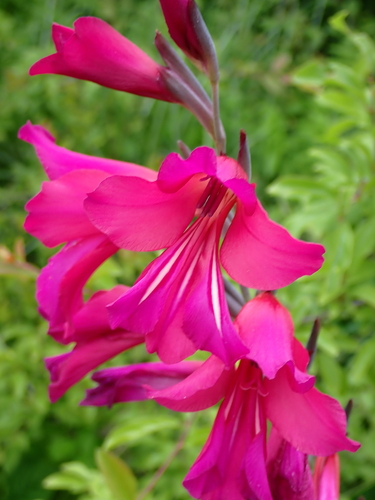
no rights reserved, uploaded by Robert H. Wardell

(c) Wild.Rice, some rights reserved (CC BY-NC)

(c) Wild.Rice, some rights reserved (CC BY-NC)
What to Eat
Edible parts: Root-starch
The starch from the corm is edible and has been used as a famine food for extending bread flour after the bitter element is removed.
Where to Find It
It is a temperate plant. It is frost hardy. It is naturalised in Tasmania. It suits hardiness zones 6-10.
Australia, Europe, France, Italy, Mediterranean, Sicily, Spain, Tasmania,
How to Identify
A plant with a corm. It grows 50-75 cm high and 8-10 cm wide. The leaves are grey. The leaves sheath the stem. There are 3-5 leaves and they are sword shaped. they have several prominent veins. The flowers are purple or red. There are 5-10 on a stem in 2 alternating ranks.
Wikipedia
Source ↗Gladiolus communis, the eastern gladiolus, or common corn-flag, is a species of flowering plant in the family Iridaceae, native to temperate northern Africa, western Asia and southern Europe, from the Mediterranean to the Caucasus, and widely naturalised in frost-free locations elsewhere – such as coastal parts of the southwestern British Isles. It is a vigorous cormous herbaceous perennial growing to 1 m (3 ft 3 in) tall with linear leaves and bright pink flowers in spring. Two subspecies are identified: G. communis subsp. communis G. communis subsp. byzantinus (Mill.) A. P. Ham. In cultivation the latter has gained the Royal Horticultural Society's Award of Garden Merit.
Other Information
It is a famine food.
Notes
There are about 180 Gladiolus species.
Names & Synonyms
Spatuliddra
References (13)
- Bodkin, F., 1991, Encyclopedia Botanica. Cornstalk publishing, p 496
- Bodkin, F., 1991, Encyclopedia Botanica. Cornstalk publishing, p 497 (As Gladiolus communis)
- Bot. J. Linn. Soc. 76:358. 1978
- Brickell, C. (Ed.), 1999, The Royal Horticultural Society A-Z Encyclopedia of Garden Plants. Convent Garden Books. p 472 (As Gladiolus communis)
- Cundall, P., (ed.), 2004, Gardening Australia: flora: the gardener's bible. ABC Books. p 639
- Geraci, A., et al, 2018, The wild taxa utilized as vegetables in Sicily (Italy): a traditional component of the Mediterranean diet. Journal of Ethnobiology and Ethnomedicine (2018) 14:14
- Harris, S., Buchanan, A., Connolly, A., 2001, One Hundred Islands: The Flora of the Outer Furneaux. Tas Govt. p 160 (As Gladiolus communis)
- Hibbert, M., 2002, The Aussie Plant Finder 2002, Florilegium. p 111
- Lazarides, M. & Hince, B., 1993, Handbook of Economic Plants of Australia, CSIRO. p 120 (As Gladiolus communis)
- Paczkowska, G. & Chapman, A.R., 2000, The Western Australian Flora. A Descriptive Catalogue. Western Australian Herbarium. p 70
- PARMENTIER,
- Joyce, D., 1998, The Garden Plant Selector. Ryland, Peters and Small. p 294
- Tasmanian Herbarium Vascular Plants list p 66


