Glaux maritima
L.
Black saltwort, Sea Milkwort

(c) l4voie, some rights reserved (CC BY-NC)

(c) l4voie, some rights reserved (CC BY-NC)
(c) Bernd Bäumler, some rights reserved (CC BY-NC)
What to Eat
Edible parts: Leaves, Root
Young shoots can be eaten raw or pickled. The roots, which belong to the subspecies G. maritima obtusifolia, are edible cooked and can be harvested at almost any time of year. North American Indians boiled the roots for a long time before eating them. Even after thorough cooking, eating the roots was considered to cause drowsiness, and consuming too many was said to cause nausea.
Known Hazards
Where to Find It
It is a temperate plant. It also grows in Arctic regions. It grows in rock crevices, salt marshes and sandy places near the sea. It also grows along rivers. It grows in wetlands. It grows between 2,000-4,600 m altitude in Pakistan. In Sichuan.
Afghanistan, Arctic, Britain, Canada, Central Asia, China, Europe, France, Himalayas, Japan, Kazakhstan, Kyrgyzstan, Mediterranean, Mongolia, North America, Pakistan, Portugal, Russia, Spain, Tajikistan, Tibet, Turkmenistan, USA, Uzbekistan,
How to Identify
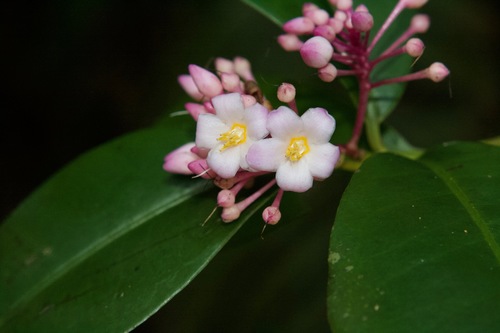
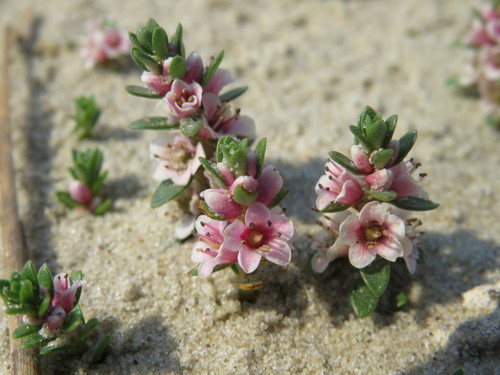
A low fleshy herb. It lies along the ground. It keeps growing from year to year and roots at some of the nodes. The leaves are narrowly oval and mostly opposite. The leaves do not have stalks and do not have teeth. The flowers are pale pink, purplish or white. They are 3-6 mm across. They do not have petals. They occur singly at the base of the leaves. The fruit is a 5 valved capsule.
How to Grow
Succeeds in most soils. Dislikes shade.
Propagation: Sow seed in spring in a cold frame. Prick seedlings into individual pots when large enough to handle and plant out during summer. Where seed is plentiful, a direct outdoor sowing in situ in mid-spring is worth trying. Divide clumps in spring — larger divisions can be planted directly into permanent positions, while smaller clumps are best potted up and grown on in a cold frame until well rooted, then planted out in spring.
Medicinal Uses
Some Native North American peoples ate the boiled roots to induce sleep.
Other Uses
None known.
Wikipedia
Source ↗A frost-hardy perennial reaching 0.3 m tall and wide. Produces small flowers from June to August. Thrives in light sandy to heavy clay soils, tolerating saline conditions and maritime exposure. Requires full sun and prefers moist soil. Hardy across temperate regions.
Notes
There is only one Glaux species.
References (7)
- Blamey, M and Grey-Wilson, C., 2005, Wild flowers of the Mediterranean. A & C Black London. p 167
- MacKinnon, A., et al, 2009, Edible & Medicinal Plants of Canada. Lone Pine. p 237 (ssp. obtusifolia)
- Moerman, D. F., 2010, Native American Ethnobotany. Timber Press. p 248
- Plants for a Future database, The Field, Penpol, Lostwithiel, Cornwall, PL22 0NG, UK. http://www.scs.leeds.ac.uk/pfaf/
- Turner, N., 1995, Food Plants of Coastal First Peoples. Royal BC Museum Handbook p 109 (ssp. obtusifolia)
- Wujisguleng, W., & Khasbagen. K., 2010, An integrated assessment of wild vegetable resources in Inner Mongolian Autonomous Region, China. Journal of Ethnobiology and Ethnomedicine 6:34
- Zhang, Y., et al, 2014, Diversity of wetland plants used traditionally in China: a literature review. Journal of Ethnobiology and Ethnomedicine. 10:72