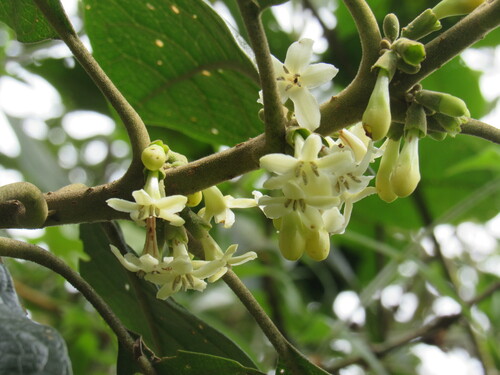
Glechoma hederacea
L.
Ground Ivy, Cat's foot, Creeping Charlie

(c) viktorie_kolouchova, some rights reserved (CC BY-NC)
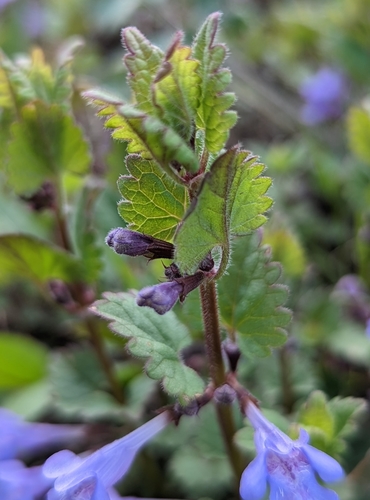
(c) Ginevra🌿, some rights reserved (CC BY-NC), uploaded by Ginevra🌿

(c) Bastiaan, some rights reserved (CC BY-NC-ND)
What to Eat
Edible parts: Leaves, Leaves - tea, Spice, Flowers
Young leaves can be eaten raw or cooked. They have a bitter flavour with a slight aromatic tang that works well mixed into salads, and they can also be cooked like spinach, added to soups, or used as a flavouring. The leaves are available very early in the year. A herb tea is made from fresh or dried leaves, often blended with verbena leaves. Historically, the herb was added to beer in much the same way as hops — to clear it and improve both flavour and keeping quality — and was the most common beer flavouring before hops came into widespread use from the 16th century onwards.
Known Hazards
Where to Find It
It is a temperate plant. It grows on heavy, damp soils. It grows in warmer temperate areas. It suits plant hardiness zones 4-9.
Asia, Argentina, Australia, Austria, Balkans, Bosnia, Britain, Canada, Chile, China, Czech Republic, Europe, Hungary, Ireland, Japan, Luxembourg, Netherlands, New Zealand, North America, Norway, Russia, Scandinavia, Serbia, Slovakia, Slovenia, South America, Spain, Switzerland, Tasmania, Turkey, Türkiye, USA,
How to Identify
A herb. It has a creeping ivy-like growth habit. It creeps along the ground. It grows 15 cm high and spreads 2 m wide. The stems are square. They root at the nodes. The leaves are greyish-green. They have a crinkly edge and are hairy. They are heart shaped. The leaves occur in pairs. The flowers are purple blue. There are 5 petals which are fused together. The 2 lower lips are covered with white dots. It has a mint like smell when the leaves are crushed.
Nutrition Score: 36/100
| Part | Moisture | kJ | kcal | Protein | Vit A | Vit C | Iron | Zinc |
|---|---|---|---|---|---|---|---|---|
| Leaves | 113 | 27 | 6.1 | 14000 | 44 | — | — | — |
How to Grow
Prefers a heavy soil and dappled shade. Prefers a moist well-drained soil, succeeding in sun or shade. A very invasive plant, spreading freely at the roots. A good bee plant. In garden design, as well as the above-ground architecture of a plant, root structure considerations help in choosing plants that work together for their optimal soil requirements including nutrients and water.
Propagation: Seed can be sown in situ as soon as ripe or in spring. Divide clumps in spring or autumn — larger divisions can go straight into permanent positions, while smaller clumps are best potted up and grown on in a cold frame until well rooted before planting out in spring.
Medicinal Uses
Ground ivy is a safe and effective herb used to treat problems involving the mucous membranes of the ear, nose, throat, and digestive system. It is well tolerated and can be given to children to clear lingering catarrh and to manage chronic conditions such as glue ear and sinusitis. Throat and chest complaints, particularly those involving excess catarrh, also respond well. The leaves and flowering stems are anodyne, antiphlogistic, appetizer, astringent, digestive, diuretic, febrifuge, pectoral, gently stimulant, tonic, and vermifuge. They are best harvested in May while still fresh and can be dried for later use. The leaves are used to treat hypersensitivity in children and are helpful for kidney disorders and indigestion. Applied externally, the expressed juice is said to speed the healing of bruises and black eyes. Use with caution.
Other Uses
Makes a good ground cover plant for shady positions, though it is quite vigorous and can overwhelm smaller plants.
Wikipedia
Source ↗Glechoma hederacea is an aromatic, perennial, evergreen creeper of the mint family Lamiaceae. It is commonly known as ground-ivy, gill-over-the-ground, creeping charlie, alehoof, tunhoof, catsfoot, field balm, and run-away-robin. It is also sometimes known as creeping jenny, but that name more commonly refers to Lysimachia nummularia. It is used as a salad green in many countries. European settlers carried it around the world, and it has become a well-established introduced and naturalized plant in a wide variety of localities. It is also considered an aggressive invasive weed of woodlands and lawns in some parts of North America. In the absence of any biological control research conducted by the USDA, herbicides are relied upon (despite their drawbacks) particularly for woodland ecosystems. The plant's extensive root system makes it difficult to eradicate by hand-pulling.
Notes
There are 10-12 Glechoma species. It is used in medicine. It has become a weed in the USA and Canada. Chemical composition: volatile oil = 1.8%. Rich in menthone and limonene.
Names & Synonyms
Alehoof, Bršljanasta grenkuljica, Dobricica, Erva de sao joao, Field balm, Gill-over-the-ground, Hierba terrestre, Hiedra terrestre, Hondsdraf, Katonapetrezselyem, Korsknapp, Nepeta, Runaway robin, Vadpetrezselyem
References (32)
- Abbet, C., et al, 2014, Ethnobotanical survey on wild alpine food plants in Lower and Central Valais (Switzerland). Journal of Ethnopharmacology 151 (2014) 624–634
- Bodkin, F., 1991, Encyclopedia Botanica. Cornstalk publishing, p 497
- Bremness, L., 1994, Herbs. Collins Eyewitness Handbooks. Harper Collins. p 175
- Brickell, C. (Ed.), 1999, The Royal Horticultural Society A-Z Encyclopedia of Garden Plants. Convent Garden Books. p 476
- Brown, D., 2002, The Royal Horticultural Society encyclopedia of Herbs and their uses. DK Books. p 224
- Cerne, M., 1992, Wild Plants from Slovenia used as Vegetables. Acta Horticulturae 318
- Chen, B. & Qiu, Z., Consumer's Attitudes towards Edible Wild Plants, Ishikawa Prefecture, Japan. p 23 www.hindawi.com/journals/ijfr/aip/872413.pdf
- Denes, A., et al, 2012, Wild plants used for food by Hungarian ethnic groups living in the Carpathian Basin. Acta Societatis Botanicorum Poloniae 81 (4): 381-396
- Facciola, S., 1998, Cornucopia 2: a Source Book of Edible Plants. Kampong Publications, p 126
- Hedrick, U.P., 1919, (Ed.), Sturtevant's edible plants of the world. p 436 (As Nepeta glechoma)
- Hibbert, M., 2002, The Aussie Plant Finder 2002, Florilegium. p 112
- Irving, M., 2009, The Forager Handbook, A Guide to the Edible Plants of Britain. Ebury Press p 201
- Janaćković, P. et al, 2019, Traditional knowledge on plant use from Negotin Krajina (Eastern Serbia): An ethnobotanical study. Indian Journal of Traditional Knowledge Vol 18 (1), pp 25-33
- Kiple, K.F. & Ornelas, K.C., (eds), 2000, The Cambridge World History of Food. CUP p 433, 1782
- Lawton, B.P., 2002, Mints. A Family of Herbs and Ornamentals. Timber Press, Portland, Oregon. p 100, 132
- Luczaj, L., 2012, Ethnobotanical review of wild edible plants of Slovakia. Acta Societatis Botanicorum Poloniae 81(4):245-255
- Łukasz Łuczaj and Wojciech M Szymański, 2007, Wild vascular plants gathered for consumption in the Polish countryside: a review. J Ethnobiol Ethnomedicine. 3: 17
- Mabey, R., 1973, Food for Free. A Guide to the edible wild plants of Britain, Collins. p 141
- MacKinnon, A., et al, 2009, Edible & Medicinal Plants of Canada. Lone Pine. p 277
- Malezas Comestibles del Cono Sur, INTA, 2009, Buernos Aires
- Michael, P., 2007, Edible Wild Plants and Herbs. Grub Street. London. p 110
- Plants for a Future database, The Field, Penpol, Lostwithiel, Cornwall, PL22 0NG, UK. http://www.scs.leeds.ac.uk/pfaf/
- Redzic, S. J., 2006, Wild Edible Plants and their Traditional Use in the Human Nutrition in Bosnia-Herzegovina. Ecology of Food and Nutrition, 45:189-232
- Redzic, S., 2010, Use of Wild and Semi-Wild Edible Plants in Nutrition and Survival of People in 1430 Days of Siege of Sarajevo during the War in Bosnia and Herzegovina (1992–1995). Coll. Antropol 34 (2010) 2:551-570
- READ, (As Nepeta glechoma)
- Schunko, C., et al, 2010, Organic farmers use of wild food plants and fungi in a hilly area in Styria (Austria). Journal of Ethnobiology and Ethnomedicine 6:17
- Seidemann J., 2005, World Spice Plants. Economic Usage, Botany, Taxonomy. Springer. p 167
- Sp. pl. 1:578. 1753
- Stern, G., 1986, Australian Weeds. A Source of Food and Medicine. Harper & Row. p 108
- Vorstenbosch, T., et al, 2017, Famine food of vegetal origin consumed in the Netherlands during World War II. Journal of Ethnobiology and Ethnomedicine (2017) 13:63
- www.ediblewildfood.com
- Zennie, T.M. and Ogzewalla, C.D., 1974, Ascorbic Acid and Vitamin A content of Edible Wild Plants of Ohio and Kentucky.