Glossodia major
R.Br.
Common Waxlip, Blue Cockies, Parson-in-the-Pulpit, Wax-lip orchid

(c) Connor Margetts, some rights reserved (CC BY), uploaded by Connor Margetts
(c) Ralph Foster, some rights reserved (CC BY-NC)

(c) Toby Eccles, some rights reserved (CC BY-NC)
What to Eat
Edible parts: Tuber, Root, Bulb
The tuber is traditionally roasted and eaten, though this harvesting method kills the plant.
Where to Find It
It is a temperate plant. It is normally in coastal heath and light forest. They grow up to 800 m altitude.
Australia*, Tasmania*,
How to Identify
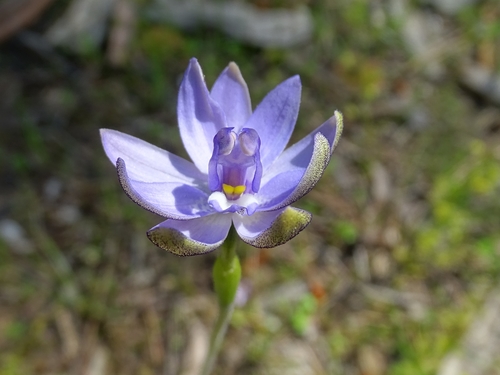
A ground orchid with a thin wiry stem. It grows to about 30 cm tall. It has one hairy sword shaped leaf. This is 10 cm long by 2 cm wide. It is hairy on both surfaces and is often hugging the ground. The flower stalk is 30 cm long. There are 1-2 star shaped flowers. The flowers are purple and 4.5 cm across. They are white near the base and have two white patches.
How to Grow
Plants are grown from tubers. They can also be grown from seed. The seed are scattered around adult plants. Plants are very sensitive to overwatering. Plants flower more after fires.
Wikipedia
Source ↗Glossodia major, commonly known as the waxlip orchid, parson-in-the-pulpit, or purple cockatoo is a plant in the orchid family Orchidaceae, and is endemic to Australia. It is a ground orchid with a single hairy leaf and one or two purple to mauve flowers.
Notes
There are about 3 Glossodia species.
References (19)
- Bodkin, F., 1991, Encyclopedia Botanica. Cornstalk publishing, p 500
- Caton, J.M. & Hardwick, R. J., 2016, Field Guide to Useful Native Plants from Temperate Australia. Harbour Publishing House. p 292
- Clarke, P. A., 2013, The Aboriginal Ethnobotany of the Adelaide Region, South Australia. Transactions of the Royal Society of South Australia. (2013), 137(1): 97-126
- Collier, P., 1993, Orchids of Tasmania. Plant Identikit. Society for growing Australian Plants. Tasmania. p 79
- Cronin, L., 1989, The Concise Australian Flora. Reed. p 75
- Dashorst, G.R.M., and Jessop, J.P., 1998, Plants of the Adelaide Plains & Hills. Botanic Gardens of Adelaide and State Herbarium. p 204
- Elliot, W.R., & Jones, D.L., 1992, Encyclopedia of Australian Plants suitable for cultivation. Vol 4. Lothian. p 369
- Gilfedder, L et al, 2003, The Nature of the Midlands. Midlands Bushweb. PO Box 156 Longford, Tasmania. p 70
- Grieg, D., 2002, A photographic guide to Wildflowers of South-eastern Australia. New Holland. p 93
- Harris, S., Buchanan, A., Connolly, A., 2001, One Hundred Islands: The Flora of the Outer Furneaux. Tas Govt. p 161
- Holliman, J., (Ed.), 2002, Orchids. Botanica's Pocket. Random House, Australia. p 287
- Jones, D., Wapstra, H., Tonelli, P., and Harris S., 1999, The Orchids of Tasmania. Miegunyah Press, MUP, Victoria, Australia. p 163
- Hunter, J. T. & Sheringham, P., 2006, Vegetation and Floristics of Melville Range Nature Reserve. A Report to the New South Wales Parks and Wildlife Service. p 174
- Lim, T. K., 2015, Edible Medicinal and Non Medicinal Plants. Volume 9, Modified Stems, Roots, Bulbs. Springer p 44
- Low, T., 1992, Bush Tucker. Australia’s Wild Food Harvest. Angus & Robertson. p 120
- Minchin, R.F., Tasmanian Wildflowers. A Field Guide. Volume one. Regal Publications, Launceston p 44
- Pearson, S. & A., 1992, Rainforest Plants of Eastern Australia. Kangaroo Press p 116
- Tasmanian Herbarium Vascular Plants list p 74
- Woolmore, E et al, 2002, King Island Flora: A Field Guide. p 96