Grevillea heliosperma
R. Br.
Rock Grevillea

(c) johneichler, some rights reserved (CC BY-NC), uploaded by johneichler
(c) Josh Magro, some rights reserved (CC BY-NC)
What to Eat
Edible parts: Seeds, Gum, Flowers - nectar
The seeds are eaten raw. The flowers provide edible nectar, and gum is also used.
Where to Find It
A tropical plant. It can grow in the tropics. It grows in sandstone country on rocky slopes. They need a sunny location and well drained soil. It suits hardiness zones 9-12.
Australia*,
How to Identify
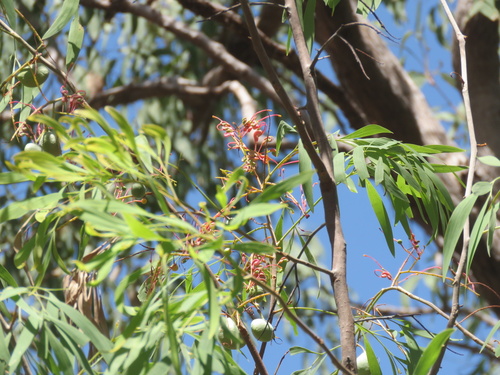
A slender tree. It grows 5-10 m tall. The whole leaf is 15-35 cm long and it is deeply divided into lobes. Sometimes the lobes are divided again. The flowers are red with a style which sticks out. They are 2-3.5 cm long. There are many flowers arranged along a stalk 5-15 cm long. These occur near the ends of branches. The fruit is smooth and round. It is woody and 2.5-3.5 cm across. It is brown when ripe with 2 papery winged seeds.
How to Grow
Plants are grown from seed. The seed should be fresh. Seed can be soaked in hot water for 24 hours.
Wikipedia
Source ↗Grevillea heliosperma, commonly known as rock grevillea, is a shrub native to northern Australia, generally growing around 3 to 5 m (9.8 to 16.4 ft) tall, rarely to 8 m (26 ft). It has red flowers.
Notes
There are 250 Grevillea species.
Names & Synonyms
Djamudu, Yalyana, Yilingbirradangwa
References (19)
- Bindon, P., 1996, Useful Bush Plants. Western Australian Museum. p 148
- Bodkin, F., 1991, Encyclopedia Botanica. Cornstalk publishing, p 511
- Brock, J., 1993, Native Plants of Northern Australia, Reed. p 203
- Cherikoff V. & Isaacs, J., The Bush Food Handbook. How to gather, grow, process and cook Australian Wild Foods. Ti Tree Press, Australia p 200
- Dunlop, C.R., Leach, G.J. & Cowie, I.D., 1995, Flora of the Darwin Region. Vol 2. Northern Territory Botanical Bulletin No 20. p 123
- Elliot, W.R., & Jones, D.L., 1990, Encyclopedia of Australian Plants suitable for cultivation. Vol 5. Lothian. p 61
- Etherington, K., & Imwold, D., (Eds), 2001, Botanica's Trees & Shrubs. The illustrated A-Z of over 8500 trees and shrubs. Random House, Australia. p 354
- Hibbert, M., 2002, The Aussie Plant Finder 2002, Florilegium. p 114
- Kenneally, K.E., Edinger, D. C., and Willing T., 1996, Broome and Beyond, Plants and People of the Dampier Peninsula, Kimberley, Western Australia. Department of Conservation and Land Management. p 169
- Lazarides, M. & Hince, B., 1993, Handbook of Economic Plants of Australia, CSIRO. p 124
- Milson, J., 2000, Trees and Shrubs of north-west Queensland. DPI p 254
- Olde, P & Marriott, N., 1995, The Grevillea Book. Kangaroo Press. Vol 2. p 192
- Paczkowska, G . & Chapman, A.R., 2000, The Western Australian Flora. A Descriptive Calatogue. Western Australian Herbarium. p 483
- Petheram, R.J. and Kok, B., 2003, Plants of the Kimberley Region of Western Australia. UWA Press p 329
- Smith, M & Kalotas, A. C., 1985, Bardi Plants: An Annotated List of Plants and Their Use by the Bardi Aborigines of Dampierland, in North-western Australia. Rec. West Aust. Mus. 1985, 12(3): 317-359
- Townsend, K., 1994, Across the Top. Gardening with Australian Plants in the tropics. Society for Growing Australian Plants, Townsville Branch Inc. p 234
- Trans. Linn. Soc. London 10:176. 1810
- Vigilante, T., et al, 2013, Island country: Aboriginal connections, values and knowledge of the Western Kimberley islands in the context of an island biological survey. Records of the Western Australian Museum Supplement 81: 145-182
- Wheeler, J.R.(ed.), 1992, Flora of the Kimberley Region. CALM, Western Australian Herbarium, p 470
More from Proteaceae


