Grevillea robusta
A.Cunn. ex R. Br.
Silky oak
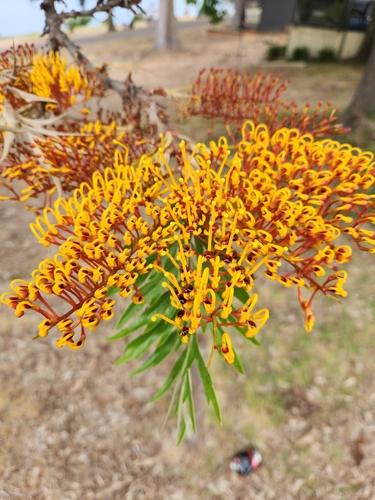
(c) keljack, some rights reserved (CC BY-NC), uploaded by keljack

(c) Geoff Fox, some rights reserved (CC BY-NC), uploaded by Geoff Fox

(c) Jean-Philippe BASUYAUX, some rights reserved (CC BY-NC), uploaded by Jean-Philippe BASUYAUX
What to Eat
Edible parts: Nectar
The flowers are one of the richest sources of nectar, which can be sucked directly from the flowers, shaken into a bowl, or washed out in a small quantity of water. The nectar falls in showers when the flowers are shaken.
Known Hazards
Where to Find It
A subtropical plant. It can grow in temperate and tropical places. It is native to E Australia. It is moderately frost hardy. It can grow in fairly dry conditions. It needs well drained soil. It can grow in full sun or light shade. In China it is cultivated as an ornamental along roadsides at low altitudes. In India it is used as a shade in coffee at elevations of 1200-2300 m altitude. It cannot tolerate lime and does best in acid soils. Once fully established in can tolerate temperatures down to 10°C. It suits hardiness zones 8-12. National Arboretum Canberra.
Africa, Argentina, Asia, Australia, Caribbean, Central Africa, Central America, China, Congo DR, Dominican Republic, East Africa, Easter Island, Eswatini, Ethiopia, Haiti, Hawaii, India, Indonesia, Jamaica, Kenya, Marquesas, Mozambique, Myanmar, Nepal, Norfolk Island, North Africa, Pacific, Pakistan, Sao Tome and Principe, SE Asia, South Africa, Southern Africa, South America, Sri Lanka, St Helena, Swaziland, Tanzania, Tasmania, USA, West Indies, Zambia, Zimbabwe,
How to Identify
A small to large evergreen tree. It grows to 30 m high. It can spread to 4-10 m wide. It is cone shaped. The branches have a brown rusty covering. The leaf stalk is 1.5-7 cm long. The leaves are feather like. There are 7-15 segments and these segments are sword like and 15 mm wide. The leaf blade is 15-25 cm long by 7-15 cm wide. The edges can be curved back. They are silvery on the underside. The flowers occur as masses of long golden yellow blooms. The flower stalk is slender and 1-1.4 cm long. The fruit are boat shaped and 1.5 cm long by 7 mm wide. There are 2 seeds. The seeds are black. They have wings.
How to Grow
It prefers a rich moist soil, but it also succeeds in dry soils. Dislikes limey soils. Established plants are drought resistant. This species is not very hardy when grown outdoors in Britain. In its native range it does experience frosts, though these are normally light and short-lived. Plants tolerate temperatures down to -7°c in Australian gardens though this cannot be translated directly to British gardens because of our cooler summers and longer, colder and wetter winters. It is usually grown as a pot plant in Britain, though it rarely flowers here. A very ornamental plant, it is often grown as a street tree in suitable climates. Hybridizes freely with other members of this genus. The flowers are very attractive to bees. Plants in this genus are notably resistant to honey fungus.
Propagation: Sow seed in February in a warm greenhouse; germination is usually good. Prick seedlings out into individual pots when large enough to handle and grow on in the greenhouse for at least their first winter. Plant out into permanent positions in late spring or early summer, after the last expected frosts. Alternatively, take cuttings of half-ripe wood, 5–8cm with a heel, in June or July in a frame.
Medicinal Uses
None known.
Other Uses
The plant yields small quantities of a gum resin. The leaves contain rutin and yield intense yellow and green dyes. This tree is one of the most important reafforestation trees in Nepal. Because it is more resistant than other members of the genus to root-rotting fungus, it is sometimes used as a rootstock for more susceptible species. The wood is strong, silky-textured, light, easily split, durable but porous, and used for panelling, joinery, and cabinet making. It is also a good fuel.
Wikipedia
Source ↗Grevillea robusta, commonly known as the southern silky oak, silk oak or silky oak, silver oak or Australian silver oak, is a species of flowering plant in the family Proteaceae. Despite its common names, it is unrelated to true oaks, which belong to the family Fagaceae. Grevillea robusta is a tree, and is the largest species in its genus. It is a native of eastern coastal Australia, growing in riverine, subtropical and dry rainforest environments.
Production
It is fast growing. It can take 10 years until flowering.
Notes
There are 250 Grevillea species. It can be invasive.
Names & Synonyms
Kagiyo, Khar-daw-hmi, Koomkabang, Meresi, Mgrivea, Mukima, Pohon oakan sutra, Salamander, Silk-Oak Grevillea, Tuggan tuggan, Warra-garria, Yin hua
References (48)
- Barwick, M., 2004, Tropical and Subtropical Trees. A Worldwide Encyclopedic Guide. Thames and Hudson p 205
- Bekele-Tesemma A., Birnie, A., & Tengnas, B., 1993, Useful Trees and Shrubs for Ethiopia. Regional Soil Conservation Unit. Technical Handbook No 5. p 260
- Blomberry, A.M., 1979, Australian Native Plants. Angus and Robertson p 264
- Bodkin, F., 1991, Encyclopedia Botanica. Cornstalk publishing, p 517
- Bonney, N., 1997, Economic Native Trees and Shrubs for South Australia. Greening Australia (SA) inc. Campbelltown SA 5074 p 168
- Brickell, C. (Ed.), 1999, The Royal Horticultural Society A-Z Encyclopedia of Garden Plants. Convent Garden Books. p 481
- Cooper, W. and Cooper, W., 2004, Fruits of the Australian Tropical Rainforest. Nokomis Editions, Victoria, Australia. p 412
- Cribb, A.B. & J.W., 1976, Wild Food in Australia, Fontana. p 182
- Cronin, L., 1989, The Concise Australian Flora. Reed. p 173
- Cundall, P., (ed.), 2004, Gardening Australia: flora: the gardener's bible. ABC Books. p 652
- Doran, J.C., & Turnbull, J.W. (Eds), 1997, Australian Trees and Shrubs: species for land rehabilitation and farm plantings in the tropics. ACIAR Monograph No 24. p 298
- Elliot, W.R., & Jones, D.L., 1990, Encyclopedia of Australian Plants suitable for cultivation. Vol 5. Lothian. p 101
- Etherington, K., & Imwold, D., (Eds), 2001, Botanica's Trees & Shrubs. The illustrated A-Z of over 8500 trees and shrubs. Random House, Australia. p 357
- Facciola, S., 1998, Cornucopia 2: a Source Book of Edible Plants. Kampong Publications, p 189
- Flora of Australia Volume 49, Oceanic Islands 1, Australian Government Publishing Service, Canberra. (1994) p 198
- Fowler, D. G., 2007, Zambian Plants: Their Vernacular Names and Uses. Kew. p 83
- Greig, D., 1996, Flowering Natives for Home Gardens. Angus & Robertson. p 207
- Hall, N. et al, 1972, The Use of Trees and Shrubs in the Dry Country of Australia, AGPS, Canberra. p 252
- Haslam, S., 2004, Noosa's Native Plants. Noosa Integrated Catchment Assn. Inc. p 342
- Hibbert, M., 2002, The Aussie Plant Finder 2002, Florilegium. p 115
- Holliday, I., 1989, A Field Guide to Australian Trees. Hamlyn. p 220
- Jones D, L, 1986, Ornamental Rainforest Plants in Australia, Reed Books, p 46
- Krishen P., 2006, Trees of Delhi, A Field Guide. DK Books. p 250
- Latham, P., 2004, Useful Plants of Bas-Congo province. Salvation Army & DFID p 142
- Lazarides, M. & Hince, B., 1993, Handbook of Economic Plants of Australia, CSIRO. p 125
- Llamas, K.A., 2003, Tropical Flowering Plants. Timber Press. p 321
- Lord, E.E., & Willis, J.H., 1999, Shrubs and Trees for Australian gardens. Lothian. p 17
- Low, T., 1991, Wild Food Plants of Australia. Australian Nature FieldGuide, Angus & Robertson. p 143
- Marinelli, J. (Ed), 2004, Plant. DK. p 456
- Mbuya, L.P., Msanga, H.P., Ruffo, C.K., Birnie, A & Tengnas, B., 1994, Useful Trees and Shrubs for Tanzania. Regional Soil Conservation Unit. Technical Handbook No 6. p 286
- Nicholson, N & H., 1996, Australian Rainforest Plants, Terania Rainforest Publishing. NSW. p 35
- Olde, P & Marriott, N., 1995, The Grevillea Book. Kangaroo Press. Vol 3. p 142
- Plants of Haiti Smithsonian Institute http://botany.si.edu/antilles/West Indies
- Schuler, S., (Ed.), 1977, Simon & Schuster's Guide to Trees. Simon & Schuster. No. 123
- Self, M., 199, Phoenix Seeds catalogue. p 17
- Staples, G.W. and Herbst, D.R., 2005, A tropical Garden Flora. Bishop Museum Press, Honolulu, Hawaii. p 468
- Suppl. prodr. fl. Nov. Holl. 24. 1830
- Sukarya, D. G., (Ed.) 2013, 3,500 Plant Species of the Botanic Gardens of Indonesia. LIPI p 311
- Swaminathan, M.S., and Kochnar, S.L., 2007, An Atlas of major Flowering Trees in India. Macmillan. p 232
- Swaziland's Flora Database http://www.sntc.org.sz/flora
- Townsend, K., 1994, Across the Top. Gardening with Australian Plants in the tropics. Society for Growing Australian Plants, Townsville Branch Inc. p 239
- van Wyk, B, van Wyk, P, and van Wyk B., 2000, Photographic guide to Trees of Southern Africa. Briza. p 164
- Williams, J.B., Harden, G.J., and McDonald, W.J.F., 1984, Trees and shrubs in rainforests of New South Wales and Southern Queensland. Univ. of New England, Armidale. p 35
- Williams, K.A.W., 1999, Native Plants of Queensland Volume 4. Keith A.W. Williams North Ipswich, Australia. p 210
- World Checklist of Useful Plant Species 2020. Royal Botanic Gardens, Kew
- Yallakool Reserve Plant List July 1, 2009 Off internet
- Young, J., (Ed.), 2001, Botanica's Pocket Trees and Shrubs. Random House. p 419
- Zizka, G., 1991, Flowering Plants of Easter Island. Palmarum Hortus Francofurtensis
More from Proteaceae


