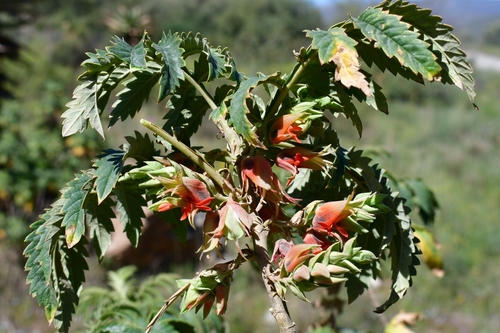
Greyia sutherlandii
Hook. & Harv.
Natal bottle brush, South African bottlebrush, Beaconwood

(c) Charles Stirton, some rights reserved (CC BY-SA), uploaded by Charles Stirton

no rights reserved, uploaded by Peter Warren

no rights reserved, uploaded by Peter Warren
What to Eat
Edible parts: Sap, Nectar
The flower nectar is used to make beer.
Where to Find It
It is native to South Africa. It grows up to 1800 m altitude in South Africa. It can tolerate some frost. They suit warm dry climates. It does well in Mediterranean climates. It will grow in the cooler subtropics. It suits hardiness zones 9-11. In Brisbane Botanical gardens.
Africa, Australia, South Africa, Southern Africa,
How to Identify
A shrub or small tree. It can be 3-11 m tall. The trunk is rough and dark. The leaves turn red and fall during the year. The leaves are simple and alternate. The leaves are almost heart-shaped and with a flat base. They are 8-13 cm across. They are green above and pale below. There are teeth along the edge. The flowers are bright red. They occur at the ends of branches. They form bottle brush like clusters of bell shaped flowers. The fruit is a cylindrical capsule. It is about 2 cm long and becomes pale grey when mature. The sections split open to release the seeds.
How to Grow
They can be grown from seed or cuttings.
Wikipedia
Source ↗Greyia sutherlandii, also known as Natal bottlebrush, is a species of flowering plant in the family Francoaceae. It is native to South Africa, Eswatini, and Lesotho.
Production
It is fairly fast growing.
Notes
There are 3 Greyia species. They were in the Greyiaceae. They grow in South Africa.
References (14)
- Barwick, M., 2004, Tropical and Subtropical Trees. A Worldwide Encyclopedic Guide. Thames and Hudson p 207
- Cundall, P., (ed.), 2004, Gardening Australia: flora: the gardener's bible. ABC Books. p 656
- Etherington, K., & Imwold, D., (Eds), 2001, Botanica's Trees & Shrubs. The illustrated A-Z of over 8500 trees and shrubs. Random House, Australia. p 360
- Heywood, V.H., Brummitt, R.K., Culham, A., and Seberg, O. 2007, Flowering Plant Families of the World. Royal Botanical Gardens, Kew. p 210
- Hibbert, M., 2002, The Aussie Plant Finder 2002, Florilegium. p 117
- Morley, B. & Everard, B., 1970, Wild Flowers of the World. Ebury press. Plate 77
- Palgrave, K.C., 1996, Trees of Southern Africa. Struik Publishers. p 548
- Palmer, E and Pitman, N., 1972, Trees of Southern Africa. Vol. 2. A.A. Balkema, Cape Town p 1387
- Proc. Dubl. Univ. Zool. Bot. Assoc. 1: 138. T. 13. 1859
- Ruiters-Welcome, A. K., 2019, Food plants of southern Africa. Ph.D. thesis. Univ. of Johannesburg p 78
- Ryan, S., 2008, Dicksonia. Rare Plants Manual. Hyland House. p 28
- van Wyk, B, van Wyk, P, and van Wyk B., 2000, Photographic guide to Trees of Southern Africa. Briza. p 169
- Welcome, A. K. & Van Wyk, B.-E., 2019, An inventory and analysis of the food plants of southern Africa. South African Journal of Botany 122 (2019) 136–179
- Young, J., (Ed.), 2001, Botanica's Pocket Trees and Shrubs. Random House. p 420