Hakea divaricata
L. Johnson
Fork-leafed Corkwood, Corkbark, Needlewood
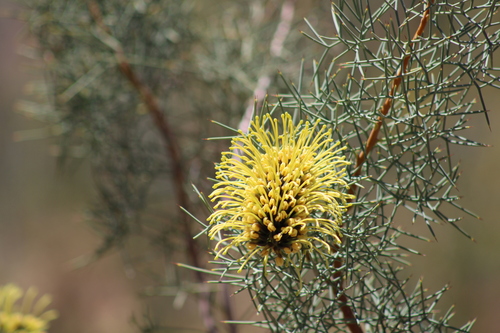
no rights reserved, uploaded by Jess Miller-Camp
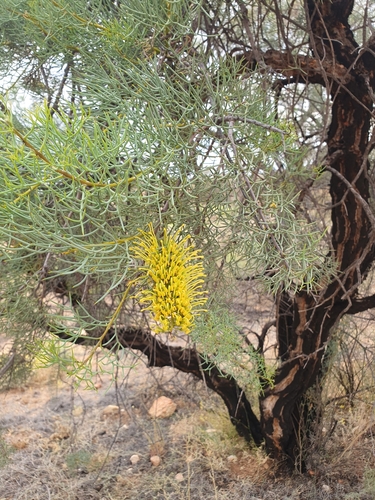
(c) maxark, some rights reserved (CC BY)
What to Eat
Edible parts: Seeds, Nectar
The seeds are eaten without any preparation. The nectar from the flowers is soaked in water to make a drink that is slightly intoxicating.
Where to Find It
It grows in Central Australia. It grows in open woodland and in rocky sites near water. It suits semiarid regions. It needs an open sunny site and a well-drained soil. It can tolerate heavy frosts. It can grow in arid places.
Australia*,
How to Identify
A small gnarled tree. It is like Hakea lorea but has shorter, forked leaves. It grows 6-10 m tall and spreads 3-5 m wide. The crown is open and sparse. The trunk is crooked. The bark is grey and deeply cracked. The small branches are red and smooth. The leaves are 7-20 cm long by 0.2 cm wide. They can be simple but are often divided into up to 16 stiff segments. These are 9 cm long. The flowering racemes are 5-14 cm long. They occur in the axils of leaves and are made up of 65-120 flowers. The flowers are yellow. The fruit is 2.3-4 cm long by 1-1.4 cm wide. It has a long curved beak.
How to Grow
Plants are grown from seed.
Medicinal Uses
The plant is used medicinally, though specific applications are not detailed in available sources.
Wikipedia
Source ↗Hakea divaricata, commonly known as needlewood, corkbark tree or fork-leaved corkwood, is a tree or shrub in the family Proteaceae native to an area in central Australia. A slow growing species with up to 120 showy cream to greenish-yellow flowers in long racemes from June to November. The Alyawarr peoples know the plant as ntywey-arrengk, the Eastern Arrernte as untyeye and the Western Arrernteas ntyweye. The Kaytetye know it as ntyarleyarle or ntyeye, the Pintupi Luritja as piruwa, the Pitjantjatjara as piruwa or ularama and the Warlpiri as kumpalpa, piriwa or yarrkampi.
Production
Plants are slow growing.
Notes
There are about 130 Hakea species.
Names & Synonyms
Witjinti
References (6)
- Boomsma, C.D., 1972, Native Tree of South Australia. Woods & Forests Department South Australia, Bulletin No.19. p 197
- Elliot, W.R., & Jones, D.L., 1990, Encyclopedia of Australian Plants suitable for cultivation. Vol 5. Lothian. p 201
- Hall, N. et al, 1972, The Use of Trees and Shrubs in the Dry Country of Australia, AGPS, Canberra. p 385
- Lang, P. J., et al, 1986, Anangu Pitjantjatjara Lands Biological Survey. p 43
- Latz, P.K., 1996, Bushfires and Bushtucker: Aboriginal plant use in Central Australia. IAD Press Alice Springs p 207
- Paczkowska, G . & Chapman, A.R., 2000, The Western Australian Flora. A Descriptive Calatogue. Western Australian Herbarium. p 492
More from Proteaceae


