Hakea ivoryi
Bailey
Corkbark Tree, Corkwood, Ivory's Hakea
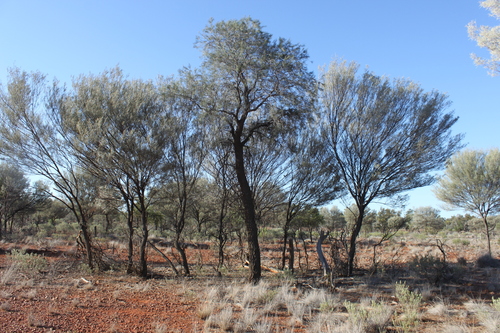
(c) Darren Fielder, some rights reserved (CC BY-NC)
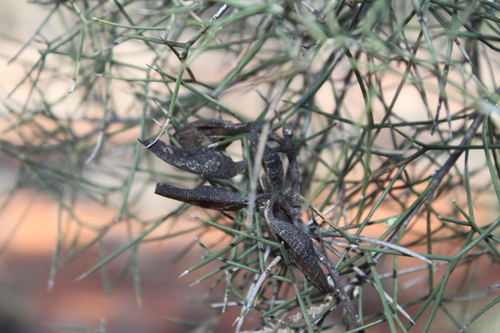
(c) Darren Fielder, some rights reserved (CC BY-NC)
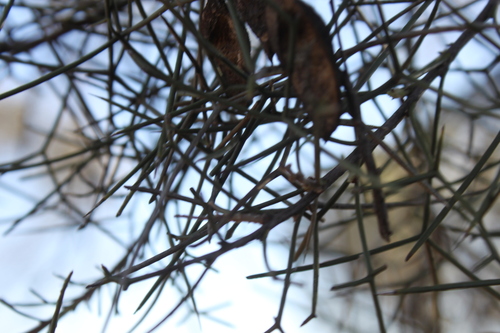
(c) Darren Fielder, some rights reserved (CC BY-NC)
Where to Find It
It is a warm temperate plant. It grows on sandy or rocky soils in SW Queensland and NW New South Wales in Australia. It needs good drainage and a sunny position. It can tolerate moderate frosts. It suits hardiness zones 9-11.
Australia*,
How to Identify
A small tree. It grows 5-15 m high and spreads 4-6 m across. The trunk is crooked. It often has suckers. The crown is dense. The bark is dark brown and thick and corky. The small branches are dark and covered with hairs. The leaves are 4-15 cm long by 0.2 cm wide. They are grey green. The leaves can be entire or divided. When divided, the segments are slender. They have sharp points. The flowering stalk is 3-9 cm long. It is densely crowded with flowers. The flowers are 0.6-0.8 cm long and greenish white. The fruit is 2.5-3.5 cm long by 1.2 cm wide.
How to Grow
Plants are grown from seed.
Wikipedia
Source ↗Hakea ivoryi, commonly known as Ivory's hakea, corkwood or the corkbark tree, is a shrub or small tree in the family Proteaceae and is endemic to an area in the South West region of Queensland and the north west of New South Wales.
Notes
There are about 130 Hakea species.
References (5)
- Boomsma, C.D., 1972, Native Tree of South Australia. Woods & Forests Department South Australia, Bulletin No.19. p 200
- Elliot, W.R., & Jones, D.L., 1990, Encyclopedia of Australian Plants suitable for cultivation. Vol 5. Lothian. p 210
- Etherington, K., & Imwold, D., (Eds), 2001, Botanica's Trees & Shrubs. The illustrated A-Z of over 8500 trees and shrubs. Random House, Australia. p 365
- Lazarides, M. & Hince, B., 1993, Handbook of Economic Plants of Australia, CSIRO. p 127
- Williams, K.A.W., 1999, Native Plants of Queensland Volume 4. Keith A.W. Williams North Ipswich, Australia. p 214
More from Proteaceae


