Hakea leucoptera
R. Br.
Needlebush, Silver Needlewood

(c) mikew65, some rights reserved (CC BY-NC)
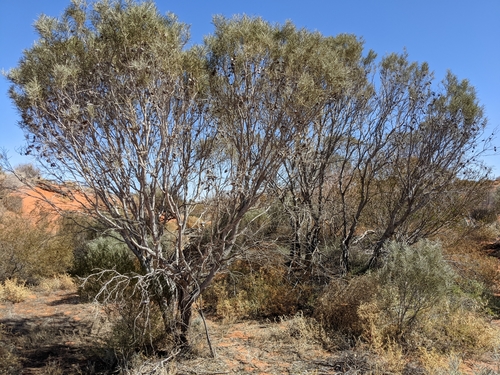
(c) andamooka, some rights reserved (CC BY-NC)
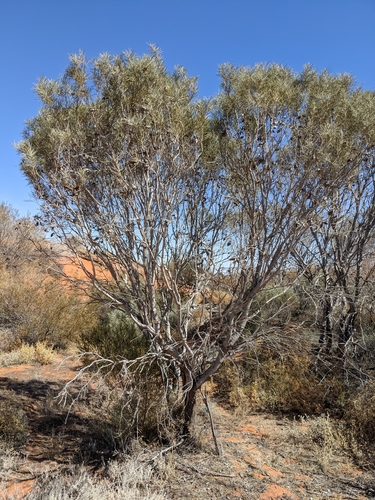
(c) andamooka, some rights reserved (CC BY-NC)
What to Eat
Edible parts: Roots - sap, Nectar
Shrubby forms are palatable to stock but only in times of acute feed shortage. Smoking pipes have been manufactured from the roots and in 1895 the Australian Needle-wood Pipe Company was formed in Sydney. This plant was important to the Indigenous people and inland explorers as they sourced water from the roots. The tree was burnt which forced the water into the root system, then the roots were dug up. They were stripped, one end placed over a slow fire while the other over a container to force the water out. This feature also enabled the plant to quickly regenerate after fire. A sweet nutritious drink was made by dipping heavily laden blossom into a cup of water or by sucking the flowers directly. Hakea leucoptera flowers produce a high quality honey favoured by bees. The Indigenous people of inland Australia used corkwoods as a medicinal agent. Burns and open sores were directly applied with the burnt bark of the Hakea tree or the burnt bark mixture was combined with animal fat to make a healing ointment. The seed pods were also used for decoration by Indigenous people. The timber polishes up well and haves a very showy grain and was also used for small tannery articles.
Where to Find It
It grows in warm temperate places and suits arid or semiarid locations. It needs well drained soil. It needs full sun. It can stand heavy frosts. It grows in areas with an annual rainfall between 230-460 mm. It can grow in arid places. It suits hardiness zones 9-11.
Africa, Australia, Southern Africa,
How to Identify
A medium to large shrub. It grows 2-5 m high and spreads 2-3 m wide. It can be spreading or upright. The leaves are narrow. They are 4-8 cm long and 2 mm wide. They are very sharp. The flowers are white and in showy clusters. The fruit are hard woody follicles. They are 2.5-3 cm long by 1.5 cm wide. They are broad and swollen in the lower half. The seed has a light brown wing. The seed is black.
How to Grow
Plants form root suckers and could be grown from these. Plants can be grown from seed.
Wikipedia
Source ↗Hakea leucoptera, commonly known as silver needlewood, needle hakea, pin bush or water tree and as booldoobah in the Koori language, is a shrub or small tree with rigid, cylindrical, sharply pointed leaves and white, cream-coloured or yellow flowers in late spring and early summer. It is widespread and common in central parts of the Australian mainland.
Notes
There are about 130 Hakea species.
Names & Synonyms
Bin.gawin.gal, Kulua
References (19)
- Bodkin, F., 1991, Encyclopedia Botanica. Cornstalk publishing, p 530
- Boomsma, C.D., 1972, Native Tree of South Australia. Woods & Forests Department South Australia, Bulletin No.19. p 202
- Elliot, W.R., & Jones, D.L., 1990, Encyclopedia of Australian Plants suitable for cultivation. Vol 5. Lothian. p 212
- Etherington, K., & Imwold, D., (Eds), 2001, Botanica's Trees & Shrubs. The illustrated A-Z of over 8500 trees and shrubs. Random House, Australia. p 365
- Hall, N. et al, 1972, The Use of Trees and Shrubs in the Dry Country of Australia, AGPS, Canberra. p 385
- Hibbert, M., 2002, The Aussie Plant Finder 2002, Florilegium. p 118
- Holliday, I., 1979, A Field Guide to Australian Native Shrubs. Rigby. p 106
- Hunter, J. T. et al, Budjiti traditional use of plants on Naree Station. p 8
- Hunter, J.T., 2017, Is there a relationship between contemporary high Aboriginal plant resource locations and mapped vegetation communities? Cunninghamia 17:27-34. The Royal Botanic Garden Sydney. ISSN 2200 - 405X (Possibly also as Hakea tephrosperma)
- Lazarides, M. & Hince, B., 1993, Handbook of Economic Plants of Australia, CSIRO. p 127
- Lord, E.E., & Willis, J.H., 1999, Shrubs and Trees for Australian gardens. Lothian. p 169
- Low, T., 1991, Wild Food Plants of Australia. Australian Nature FieldGuide, Angus & Robertson. p 184
- McKerney, M. & White, H., 2011, Bush Tucker, Boomerangs & Bandages. Border River-Gwyder Catchment Management Authority p 107
- Molyneux, B. and Forrester, S., 1997, The Austraflora A-Z of Australian Plants. Reed. p 117
- Paczkowska, G . & Chapman, A.R., 2000, The Western Australian Flora. A Descriptive Calatogue. Western Australian Herbarium. p 493
- Royal Botanic Gardens, Kew (1999). Survey of Economic Plants for Arid and Semi-Arid Lands (SEPASAL) database. Published on the Internet; http://www.rbgkew.org.uk/ceb/sepasal/internet [Accessed 6th June 2011]
- Smith, K & I., 1999, Grow your own bushfoods. New Holland. Australia. p 116
- Trans. Linn. Soc. London 10:180. 1810
- Williams, K.A.W., 1999, Native Plants of Queensland Volume 4. Keith A.W. Williams North Ipswich, Australia. p 214
More from Proteaceae


