Hakea lorea
(R.Br.) R.Br.
Cork Bark, Bootlace Oak, Corkwood oak, Western cork tree
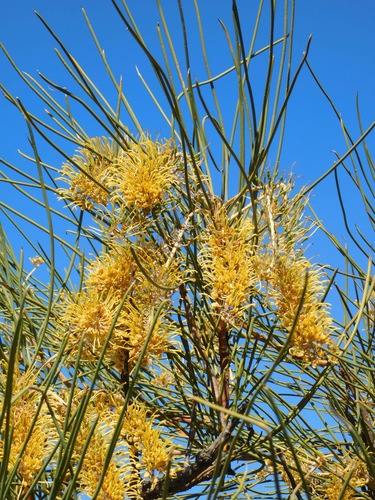
(c) desertnaturalist, some rights reserved (CC BY), uploaded by desertnaturalist
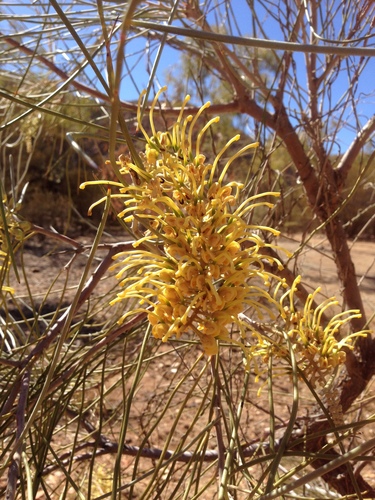
(c) linger, some rights reserved (CC BY-NC)

(c) Dougal Townsend, some rights reserved (CC BY-NC)
What to Eat
Edible parts: Flowers - nectar, Drink
A sweet drink can be made from the crushed nectar-rich flowers. The flowers can yield a considerable quantity of sweet nectar that can be sipped with a straw or mixed with water to make a sweet beverage.
Where to Find It
A tropical plant. It grows in sandy loams on plains. It grows on rocky soils. It can tolerate frosts. It needs a warm sunny position and a well-drained soil. It suits hardiness zones 10-12.
Australia*,
How to Identify
A small gnarled tree. It grows 4-5 m high. The bark is thick, corky and furrowed. The leaves are needle like and 30 cm long and have a sharp point. The flowers are in yellow clusters. The fruits are in clusters. They are woody. These woody capsules have beaks. They contain 2 winged seeds. These are released when the capsule splits open.
How to Grow
Plants are grown from seed.
Wikipedia
Source ↗Hakea lorea, commonly known as bootlace oak or cork tree, is a species of shrub or small tree in the family Proteaceae found in central and northern Australia. It has needle-shaped leaves, yellow, white or green flowers and hard corky bark.
Production
Plants are slow growing.
Notes
There are about 130 Hakea species.
Names & Synonyms
Kartanpa, Witjinti
References (10)
- Bodkin, F., 1991, Encyclopedia Botanica. Cornstalk publishing, p 530
- Cancilla, D., 2018, Ethnobotanical and Ethnozoological Values Desktop Assessment - Eliwana Project. p 13
- Elliot, W.R., & Jones, D.L., 1990, Encyclopedia of Australian Plants suitable for cultivation. Vol 5. Lothian. p 214
- Etherington, K., & Imwold, D., (Eds), 2001, Botanica's Trees & Shrubs. The illustrated A-Z of over 8500 trees and shrubs. Random House, Australia. p 365
- Goddard, C. & Kalotas A. (Eds.), Punu, 2002, Yankunytjatjara plant use. Jukurrpa books. p 38
- Lang, P. J., et al, 1986, Anangu Pitjantjatjara Lands Biological Survey. p 43
- Lazarides, M. & Hince, B., 1993, Handbook of Economic Plants of Australia, CSIRO. p 127
- Paczkowska, G . & Chapman, A.R., 2000, The Western Australian Flora. A Descriptive Calatogue. Western Australian Herbarium. p 494
- Petheram, R.J. and Kok, B., 2003, Plants of the Kimberley Region of Western Australia. UWA Press p 487
- Townsend, K., 1994, Across the Top. Gardening with Australian Plants in the tropics. Society for Growing Australian Plants, Townsville Branch Inc. p 245
More from Proteaceae


