Hakea macrocarpa
A. Cunn. ex R. Br.
Corkwood Tree

(c) geoffbyrne, some rights reserved (CC BY-NC)
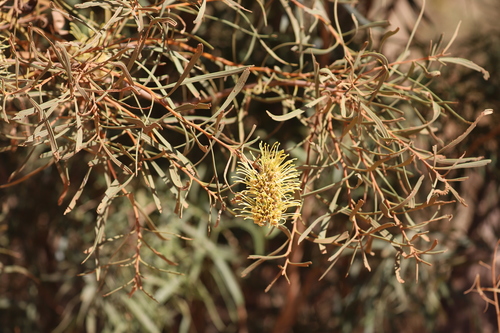
(c) Arthur Chapman, some rights reserved (CC BY-NC-SA)
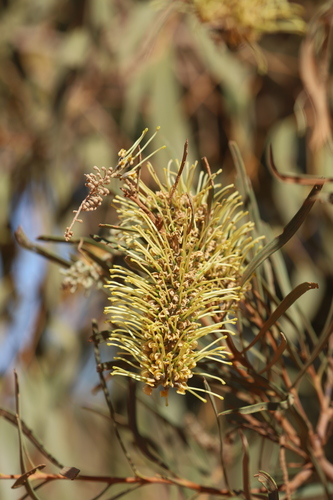
(c) Arthur Chapman, some rights reserved (CC BY-NC-SA)
What to Eat
Edible parts: Gum, Nectar
The gum and nectar are edible.
Where to Find It
A tropical plant. It grows in northern Australia. It grows in woodland near the coast. It suits tropical, seasonally dry climates. It requires an open sunny position and a well-drained soil. It can grow in arid places.
Australia*,
How to Identify
A tall shrub or small tree. It grows 5-7 m high and 3-6 m wide. The crown can be round or straggly. The bark has deep cracks. The leaves are 15-20 cm long by 0.4-1 cm wide. They are narrowly sword shaped. They are dull and leathery. They taper to the base. The flowering stalks are 7-15 cm long and in the axils of leaves. The flowers are greenish-white and have a scent. The fruit is 3-4 cm long by 1.5-2 cm wide. It is oval.
How to Grow
Plants are grown from seed.
Wikipedia
Source ↗Hakea macrocarpa, commonly known as flat-leaved hakea, is a species of flowering plant in the family Proteaceae and is endemic to northern Australia. It is a tree or shrub with furrowed bark, woolly-hairy branchlets, narrowly linear leaves and cream-coloured to greenish-yellow flowers.
Notes
There are about 130 Hakea species.
Names & Synonyms
Dyaridany
References (10)
- Bodkin, F., 1991, Encyclopedia Botanica. Cornstalk publishing, p 530
- Cherikoff V. & Isaacs, J., The Bush Food Handbook. How to gather, grow, process and cook Australian Wild Foods. Ti Tree Press, Australia p 190
- Elliot, W.R., & Jones, D.L., 1990, Encyclopedia of Australian Plants suitable for cultivation. Vol 5. Lothian. p 215
- Kenneally, K.E., Edinger, D. C., and Willing T., 1996, Broome and Beyond, Plants and People of the Dampier Peninsula, Kimberley, Western Australia. Department of Conservation and Land Management. p 171
- Latz, P.K., 1996, Bushfires and Bushtucker: Aboriginal plant use in Central Australia. IAD Press Alice Springs p 210
- Lazarides, M. & Hince, B., 1993, Handbook of Economic Plants of Australia, CSIRO. p 127
- Low, T., 1991, Wild Food Plants of Australia. Australian Nature FieldGuide, Angus & Robertson. p 184
- Paczkowska, G . & Chapman, A.R., 2000, The Western Australian Flora. A Descriptive Calatogue. Western Australian Herbarium. p 494
- Townsend, K., 1994, Across the Top. Gardening with Australian Plants in the tropics. Society for Growing Australian Plants, Townsville Branch Inc. p 245
- Wheeler, J.R.(ed.), 1992, Flora of the Kimberley Region. CALM, Western Australian Herbarium, p 476
More from Proteaceae


