Hemiscolopia trimera
(Boerl.) Slooten
SalicaceaeFruit

wikimedia · cc-by
Wikimedia Commons - Muséum National d'Histoire Naturelle
Wikimedia Commons - Muséum National d'Histoire Naturelle

gbif · cc0
President and Fellows of Harvard College
President and Fellows of Harvard College
What to Eat
Edible parts: Fruit
The fruit is eaten.
Where to Find It
A tropical plant. It occurs on rocky soil in dense forests. It occurs about 850 m altitude. It is usually in mixed rainforests between 20-700 m above
Asia, Indochina, Indonesia, SE Asia, Thailand, Vietnam,
Countries: United Arab Emirates, Afghanistan, Armenia, Azerbaijan, Bangladesh, Bahrain, Brunei, Bhutan, China, Georgia, Indonesia, Israel, India, Iraq, Iran, Jordan, Japan, Kyrgyzstan, Cambodia, North Korea, South Korea, Kuwait, Kazakhstan, Laos, Lebanon, Sri Lanka, Myanmar, Mongolia, Maldives, Malaysia, Nepal, Oman, Philippines, Pakistan, Qatar, Saudi Arabia, Singapore, Syria, Thailand, Tajikistan, Timor-Leste, Turkmenistan, Turkey, Taiwan, Uzbekistan, Vietnam, Yemen
How to Identify
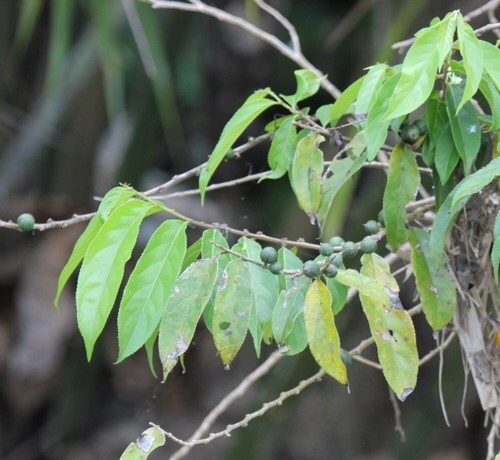
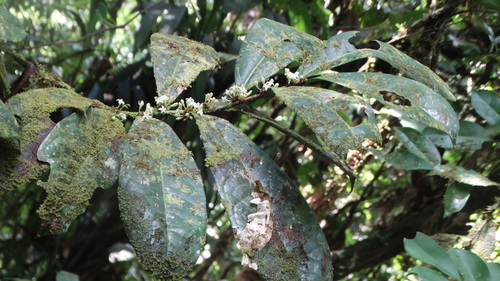
A medium sized tree. It grows 10-12 m tall. It can have simple spines 2-3 cm long. The leaves are large and oblong. Young leaves are purplish. Flowers are in groups of 4-8 in the axils of leaves. The fruit is an oval berry. It is 2 cm high. It contains 20 seeds which are angular and 6-8 mm long.
How to Grow
Plants can be grown from seeds.
Notes
Also put in the Flacourtiaceae family. Probably now Scolopia trimera.
Names & Synonyms
Moc huong tam phan, Mochuong tam-phan, Pohon rukem gunung
References (3)
- Forest Inventory and Planning Institute, 1996, Vietnam Forest Trees. Agriculture Publishing House p 312
- Sleumer, H., 1954, Flacourtiaceae in Flora Malesiana, Ser 1 Vol 5(1) p 65
- Sukarya, D. G., (Ed.) 2013, 3,500 Plant Species of the Botanic Gardens of Indonesia. LIPI p 319