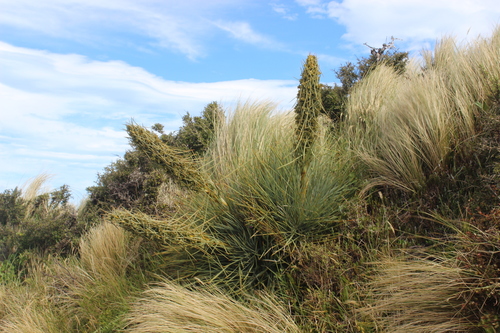
Heracleum pubescens
(Hoffm.) Bieb.
Downy cow-parsnip

Wikimedia Commons - Dietmar Rabich

Wikimedia Commons - Dietmar Rabich
What to Eat
Edible parts: Leaves, Stem
The young shoots are filled with a sweet, aromatic juice and are eaten raw.
Where to Find It
It is a temperate plant.
Asia, Caucasus, Europe, France, Georgia,
How to Identify
A biennial or perennial herb growing to 0.8 m (2ft 6in). Hermaphroditic and insect-pollinated; self-fertile. Adapts to light sandy, medium loamy, and heavy clay soils across mildly acid to basic pH ranges. Grows in full shade, semi-shade, or full sun and prefers moist soil.
How to Grow
Propagation: Sow seed mid to late spring or early autumn directly in situ. Divide plants in autumn.
Medicinal Uses
None known.
Other Uses
None known.
Wikipedia
A biennial or perennial herb growing to 0.8 m (2ft 6in). Hermaphroditic and insect-pollinated; self-fertile. Adapts to light sandy, medium loamy, and heavy clay soils across mildly acid to basic pH ranges. Grows in full shade, semi-shade, or full sun and prefers moist soil.
Names & Synonyms
References (5)
- Bussman, R. W. et al, 2017, Ethnobotany of Samtskhe-Javakheti, Sakartvelo (Republic of Georgia), Caucasus. Indian Journal of Traditional Knowledge Vol. 16(1) pp 7-24 (As Heracleum wilhelmsii)
- Facciola, S., 1998, Cornucopia 2: a Source Book of Edible Plants. Kampong Publications, 19
- Fl. taur.-caucas. 3:225. 1819
- Hedrick, U.P., 1919, (Ed.), Sturtevant's edible plants of the world. p 341
- Plants for a Future database, The Field, Penpol, Lostwithiel, Cornwall, PL22 0NG, UK. http://www.scs.leeds.ac.uk/pfaf/