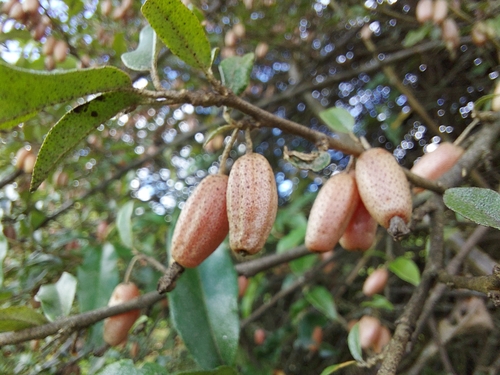
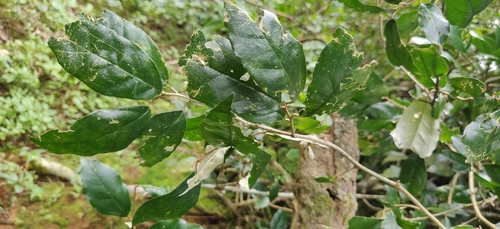
Hippophae sinensis
(Rousi.) Y. S. Lian & X. L. Chen
Chinese sea buckthorn

(c) Jane Charlen, some rights reserved (CC BY-NC), uploaded by Jane Charlen

(c) khola, some rights reserved (CC BY-NC)
What to Eat
Edible parts: Fruit
The fruit can be eaten raw or cooked, though its strongly acidic, lemon-like flavour makes it too sharp for most people when raw. Some species and cultivars (not specified) yield fruit containing up to 9.2% oil. The fruit is suitable for preserves and is increasingly used in mixed fruit juice blends for its reputed health benefits. It is ripe from late September and generally hangs on the plant all winter unless taken by birds. The fruit becomes less acid after a frost or when cooked, though the taste and quality of frosted berries deteriorates quickly, so it is best harvested before frosts occur.
Where to Find It
It grows in temperate places. It suits hardiness zones 3-9.
Asia, Australia, China*,
How to Identify
A deciduous tree. It grows about 4.5 m high. It can be 12 m high. Male and female flowers are on separate trees. The fruit are edible.
How to Grow
Propagation: Sow seed in spring in a sunny position in a cold frame. Germination is usually quick and reliable, though 3 months of cold stratification may improve the rate. Alternatively, sow in a cold frame as soon as seed ripens in autumn. Prick seedlings into individual pots when large enough to handle and grow on in a greenhouse through their first winter. Plant out in late spring. In spring, male seedlings have very prominent axillary buds, while females are smooth and clear at this time. Cuttings of half-ripe wood taken in June/July in a frame are possible but difficult, and represent the easiest method of vegetative propagation. Cuttings of mature wood in autumn are also difficult — take them at the end of autumn or in early spring before buds burst, store in sand and peat until April, cut into 7–9cm lengths, and root in a plastic tent with bottom heat; rooting should occur within 2 months. Division of suckers in winter can be planted directly into permanent positions and usually establishes well. Layering in autumn is also possible.
Medicinal Uses
An oil produced from the tender branches and leaves — distinct from the fruit oil — is used as an ointment for burns. A high-quality medicinal oil from the fruit treats cardiac disorders and is said to be particularly effective on the skin for burns, eczema, and radiation injury; it is also taken internally for stomach and intestinal diseases. The fruit is exceptionally rich in vitamins A, C, and E, flavonoids, other bio-active compounds, and essential fatty acids — the last being unusual for a fruit. It is being investigated for its potential to reduce cancer incidence and halt or reverse tumour growth.
Other Uses
The wood is used for fuel.
Wikipedia
Source ↗Fast-growing deciduous tree reaching 15m tall. Flowers appear in April with seeds ripening September to October. Dioecious species requiring both male and female plants for seed production; wind-pollinated and not self-fertile. Nitrogen-fixing. Tolerates light sandy, medium loamy, and heavy clay soils, including poor soils. Grows in mildly acidic, neutral, and mildly alkaline pH. Requires full sun and prefers dry to wet conditions. Handles strong winds but not maritime exposure.
Production
It grows quickly.
Notes
There are about 8 Hippophae species. The fruit are rich in Vitamin C. An unresolved name in The Plant List