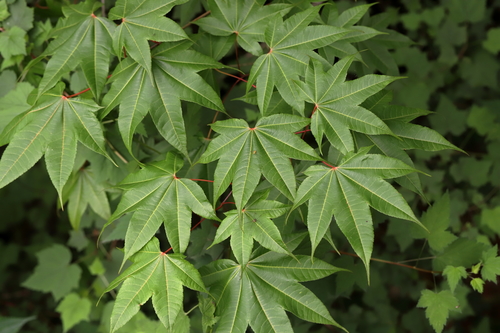
Allophylus macrostachys
Radlk.

President and Fellows of Harvard College

President and Fellows of Harvard College

President and Fellows of Harvard College
What to Eat
Edible parts: Fruit
The fruit are edible and recorded as eaten in traditional use.
Where to Find It
It is a tropical plant. They are found in the under shrub of the lower forested areas of the Philippines.
Asia, India, Pacific, Philippines*, SE Asia,
How to Identify
A small tree or shrub. The branches are 3 times branched and slender and smooth. The leaves have 3 leaflets. They are fairly thin and smooth and paler beneath. The leaflets are oblong and tapering with the end one wedge shaped at the base. The side ones are blunt. The flower spikes are on their own, in the axils of leaves and fine and delicate. The flowers are usually more than the leaves. The flowers are whitish. The fruit are round and with a smooth stalk.
Notes
There are 190-200 Allophyllus species. Some say there is just one widely variable species.
Names & Synonyms
Barotangol, Bignai-baker, Bignai-gubat, Lingo-lingo
References (2)
- Monsalud, M.R., Tongacan, A.L., Lopez, F.R., & Lagrimas, M.Q., 1966, Edible Wild Plants in Philippine Forests. Philippine Journal of Science. p 541
- Verheij, E. W. M. and Coronel, R.E., (Eds.), 1991, Plant Resources of South-East Asia. PROSEA No 2. Edible fruits and nuts. Pudoc Wageningen. p 313