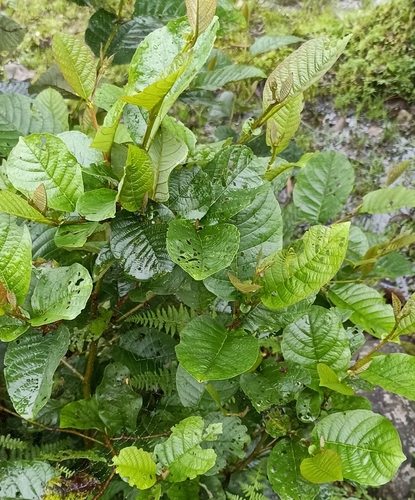
Alnus rubra
Bongard
Oregon alder, Red alder

(c) Neil Gilham, some rights reserved (CC BY-NC), uploaded by Neil Gilham

(c) Neil Gilham, some rights reserved (CC BY-NC), uploaded by Neil Gilham

(c) dshell, some rights reserved (CC BY-NC)
What to Eat
Edible parts: Wood - flavour, Bark, Buds, Catkins, Sap
Catkins can be eaten raw or cooked; they are rich in protein but have a bitter flavour and are not very palatable. The inner bark is edible but must be dried first, as it is emetic when fresh. It is typically dried, ground into a powder and used as a thickening agent in soups or mixed with cereals when making bread. The sap can be consumed raw and is harvested in late winter; flow is best on a warm, sunny day following a cold frosty night. It has a sweet flavour and was often used to sweeten other foods. Buds are also noted as edible, though no further detail is given and it is unclear whether this refers to flower buds or leaf buds.
Known Hazards
Where to Find It
It is a temperate plant. It is native to North America. It can tolerate reasonable frost. It often grows on flood plains and along streams. It can grow in wet soils. It cannot tolerate shade. It suits hardiness zones 4-9. Arboretum Tasmania.
Alaska, Australia, Britain, Canada, Europe, North America*, Tasmania, USA,
How to Identify
A deciduous tree. It grows 12-15 m high. It usually branches into several trunks. The lower branches hang downwards. The bark is thin and pale grey. The leaves are large and have coarse teeth around the edge. They are dark green above and paler grey-green underneath. There is often fine orange hairs underneath. The male flowers are catkins borne at the tips of the branches. They are yellow. The fruit are woody and cone like. They are 2.5 cm long.
How to Grow
Prefers a heavy soil and a damp situation. Grows well in heavy clay soils. Tolerates very infertile sites. A very wind resistant tree with excellent establishment in severely exposed sites, it tolerates severe maritime exposure. The red alder is a very fast growing tree, even when planted in severe exposure, but it is short-lived, dying when 60 - 80 years old. Trees that are 5 years old from seed have reached 6 metres in height on a very exposed site in Cornwall, they are showing no signs of wind-shaping. This is an important pioneer tree, quickly invading logged or burnt over sites, and providing ideal conditions for other trees to become established. A very ornamental tree. This species has a symbiotic relationship with certain soil micro-organisms, these form nodules on the roots of the plants and fix atmospheric nitrogen. Some of this nitrogen is utilized by the growing plant but some can also be used by other plants growing nearby. Red alder has been estimated to fix as much as 300 kg of nitrogen per hectare. In garden design, as well as the above-ground architecture of a plant, root structure considerations help in choosing plants that work together for their optimal soil requirements including nutrients and water.
Propagation: Seed is best sown in a cold frame as soon as it is ripe, only just covered. Spring-sown seed also germinates successfully provided it is not covered. Germination occurs as temperatures rise in spring. Seedlings should be pricked out into individual pots when large enough to handle, then planted into permanent positions in summer if growth is sufficient, or overwintered in pots and planted out the following spring. With sufficient seed, sow thinly in an outdoor seed bed in spring; seedlings can be planted into permanent positions in autumn or winter, or grown on for a further season before planting. Cuttings of mature wood can be taken as soon as the leaves fall in autumn and rooted outdoors in sandy soil.
Medicinal Uses
Red alder was widely used medicinally by native North American Indians, primarily through preparations of the bark, and the plant sees little use in modern herbalism. The bark is appetiser, astringent, cathartic, cytostatic, emetic, stomachic and tonic. It contains salicin, which likely breaks down into salicylic acid (closely related to aspirin) in the body and acts as an anodyne and febrifuge. An infusion of the bark has been used to treat headaches, rheumatic pains, internal injuries and diarrhoea. A poultice of the bark is applied externally to eczema, sores and aches. The sap is applied externally to cuts. The catkins and young cones are astringent and have been chewed to treat diarrhoea.
Other Uses
A fast-growing and very wind-resistant tree, red alder is excellent for establishing shelterbelts quickly. Its extensive root system makes it suitable for controlling erosion along riverbanks. It is a valuable pioneer species for re-establishing woodland on disused farmland and difficult sites, rapidly creating sheltered conditions for more permanent woodland trees. Root bacteria fix atmospheric nitrogen, enabling growth on poor soils while benefiting neighbouring plants. The heavy leaf canopy contributes to humus build-up when leaves fall in autumn. Alder seedlings do not compete well in shade and gradually die out as other trees establish. Tannin is obtained from the bark and strobils. Both roots and young shoots have been used in basket making. A red to brown dye is obtained from the bark. The wood is soft, brittle, not strong, light, close and straight-grained, and very durable in water; it is an important lumber tree that makes a good imitation mahogany and is used for furniture. It burns well without sparking, making it suitable for open fires, and produces high-grade charcoal.
Wikipedia
Source ↗Alnus rubra, the red alder, is a deciduous broadleaf tree native to western North America (Alaska, Yukon, British Columbia, Washington, Oregon, California, Idaho and Montana).
Production
It is a fast growing tree. Trees live for 75 years.
Notes
There are 25-35 Alnus species.
Names & Synonyms
References (15)
- Beckstrom-Sternberg, Stephen M., and James A. Duke. "The Foodplant Database." http://probe.nalusda.gov:8300/cgi-bin/browse/foodplantdb.(ACEDB version 4.0 - data version July 1994) (As Alnus oregona)
- Bodkin, F., 1991, Encyclopedia Botanica. Cornstalk publishing, p 67
- Brickell, C. (Ed.), 1999, The Royal Horticultural Society A-Z Encyclopedia of Garden Plants. Convent Garden Books. p 99
- Coombes, A.J., 2000, Trees. Dorling Kindersley Handbooks. p 117
- Cundall, P., (ed.), 2004, Gardening Australia: flora: the gardener's bible. ABC Books. p 132
- Etherington, K., & Imwold, D., (Eds), 2001, Botanica's Trees & Shrubs. The illustrated A-Z of over 8500 trees and shrubs. Random House, Australia. p 88
- Facciola, S., 1998, Cornucopia 2: a Source Book of Edible Plants. Kampong Publications, p 49
- Farrar, J.L., 1995, Trees of the Northern United States and Canada. Iowa State University press/Ames p 298
- Heywood, V.H., Brummitt, R.K., Culham, A., and Seberg, O. 2007, Flowering Plant Families of the World. Royal Botanical Gardens, Kew. p 61
- Kermath, B. M., et al, 2014, Food Plants in the Americas: A survey of the domesticated, cultivated and wild plants used for Human food in North, Central and South America and the Caribbean. On line draft. p 35
- MacKinnon, A., et al, 2009, Edible & Medicinal Plants of Canada. Lone Pine. p 54
- Mem. Acad. Imp. Sci. St.-Petersbourg, Ser. 6, Sci. Math. 2(2):162. 1832
- Slocum, P.D. & Robinson, P., 1999, Water Gardening. Water Lilies and Lotuses. Timber Press. p 107
- Turner, N., 1995, Food Plants of Coastal First Peoples. Royal BC Museum Handbook p 64
- Young, J., (Ed.), 2001, Botanica's Pocket Trees and Shrubs. Random House. p 86