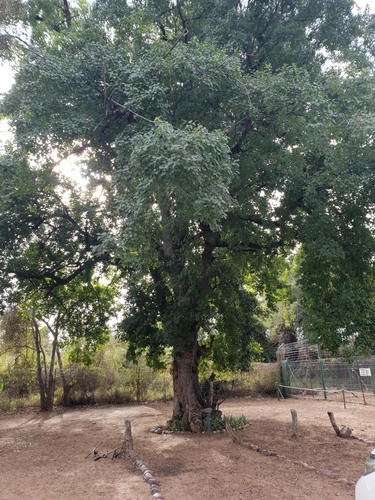
Alphitonia excelsa
(Fenzl) Reissek ex Benth.
Soap tree, Red Ash, Red Almond, Leather jacket

(c) Margaret Donald, some rights reserved (CC BY-NC-ND)

(c) Lana Waller, some rights reserved (CC BY-NC)
What to Eat
Edible parts: Fruit, Leaves
Trees are quick growing in cultivation. This is an Australian ornamental tree, with some specimens of high visual appeal. It may be used in amenity planting as a street tree providing shelter. It has also been used in boat-building and cabinet making, its tough timber a light red or brown in colour. It can be a fodder plant for sheep and cattle, and is a useful pioneer species in bush regeneration. Indigenous Australians used the leaves as a soap due to the plant’s high saponin content.
Where to Find It
A tropical and subtropical plant. It grows best on medium well drained soils. It needs a sheltered position and in shade. It is drought and frost resistant. It will grow on a range of soils. It will grow in the tropical lowlands as well as in frosty places in Central Australia. It is a very hardy plant. It suits hardiness zones 9-10.
Asia, Australia, Brunei, Fiji, Indonesia, Malaysia, Pacific, Papua New Guinea, PNG, Philippines, Samoa, SE Asia,
How to Identify
A tree which may or may not lose its leaves during the year. It loses its leaves in cooler climates. It grows to 12-18 m tall and spreads to 5-10 m across. It can be 30 m tall. The stem is erect. The bark is grey and smooth in young plants but cracked along its length in older plants. The branches come out in layers. Young parts of the plant are covered with rusty hairs. The leaves are dark green above and glossy. They are paler underneath. They are broadly oval, smooth and 7-15 cm long by 4-6 cm wide. The leaf stalk is 2 cm long and generally softly hairy. The flowers are cream and very small. They occur in dense clusters near the ends of branches. The flowers are about 0.5 cm across and have a scent. The fruit are dull black berries. They are 1 cm across and corky or mealy in texture. They contain 3-5 glossy brown seeds. These are 5 mm long by 4 mm wide.
How to Grow
The plants can be grown from seed. Fresh seed should be used. The seed need to be treated before sowing. They germinate poorly. Plants can also be grown from cuttings.
Wikipedia
Source ↗Alphitonia excelsa, commonly known as the red ash or soap tree, is a species of tree in the family Rhamnaceae. It is endemic to Australia, being found in New South Wales, Queensland, Northern Territory and the northeastern tip of Western Australia. It is used in bush regeneration as a pioneer species and for amenity planting.
Production
It is a quick growing plant. Fruit are ripe from October to January. (May to July). Ripe fruit can persist on the tree for a few months.
Other Information
It is not known if it is used for food in Papua New Guinea.
Notes
There are (6) 20 Alphitonia species. The fruit are used as a fish poison.
Names & Synonyms
Wilirda
References (27)
- Argent, G et al, nd, Manual of the Larger and More important non Dipterocarp Trees of Central Kalimantan Indonesia. Volume 2 Forest Research Institute, Samarinda, Indonesia. p 518
- Bodkin, F., 1991, Encyclopedia Botanica. Cornstalk publishing, p 70
- Borrell, O.W., 1989, An Annotated Checklist of the Flora of Kairiru Island, New Guinea. Marcellin College, Victoria Australia. p 121
- Cooper, W. and Cooper, W., 2004, Fruits of the Australian Tropical Rainforest. Nokomis Editions, Victoria, Australia. p 423
- Cronin, L., 1989, The Concise Australian Flora. Reed. p 137
- Cundall, P., (ed.), 2004, Gardening Australia: flora: the gardener's bible. ABC Books. p 138
- Doran, J.C., & Turnbull, J.W. (Eds), 1997, Australian Trees and Shrubs: species for land rehabilitation and farm plantings in the tropics. ACIAR Monograph No 24. p 243
- Elevitch, C.R.(ed.), 2006, Traditional Trees of the Pacific Islands: Their Culture, Environment and Use. Permanent Agriculture Resources, Holualoa, Hawaii. p 59
- Elliot, W.R., & Jones, D.L., 1982, Encyclopedia of Australian Plants suitable for cultivation. Vol 2. Lothian. p 176
- Fl. austral 1:414. 1863
- Haslam, S., 2004, Noosa's Native Plants. Noosa Integrated Catchment Assn. Inc. p 222
- Jackes, B.R., 2001, Plants of the Tropics. Rainforest to Heath. An Identification Guide. James Cook University. p 76
- Jones D, L, 1986, Ornamental Rainforest Plants in Australia, Reed Books, p 189
- Lamberton, K (Ed.), 2004, The Australian gardening encyclodepia. Murdoch Books, NSW Australia. p 160
- Lazarides, M. & Hince, B., 1993, Handbook of Economic Plants of Australia, CSIRO. p 15
- Lord, E.E., & Willis, J.H., 1999, Shrubs and Trees for Australian gardens. Lothian. p 12
- Melzer, R. & Plumb, J., 2011, Plants of Capricornia. Belgamba, Rockhampton. p 284
- Nicholson, N & H., 1994, Australian Rainforest Plants 4, Terania Rainforest Publishing. NSW. p 8
- Peekel, P.G., 1984, (Translation E.E.Henty), Flora of the Bismarck Archipelago for Naturalists, Division of Botany, Lae, PNG. p 345, 344
- Recher, P, 2001, Fruit Spirit Botanical Gardens Plant Index. www.nrg.com.au/~recher/ seedlist.html p 4
- Slik, F., www.asianplant.net
- Townsend, K., 1994, Across the Top. Gardening with Australian Plants in the tropics. Society for Growing Australian Plants, Townsville Branch Inc. p 77
- Townsend, K., 1999, Field Guide to Plants of the Dry Tropics. Society for Growing Australian Plants, Townsville Branch Inc. p 23
- Wheeler, J.R.(ed.), 1992, Flora of the Kimberley Region. CALM, Western Australian Herbarium, p 630
- Wightman, Glenn et al. 1992. Mudburra Ethnobotany: Aboriginal Plant Use from Kulumindini (Elliott) Northern Australia. Northern Territory Botanical Bulletin No 14. Parks and Wildlife Commission of the Northern Territory. p 10, 7
- Wightman, G. M. & Andrews, M.R., 1989, Plants of Northern Territory Monsoon Vine Forests (Vol 1). Conservation Commission of Northern Territory. p 18
- Williams, J.B., Harden, G.J., and McDonald, W.J.F., 1984, Trees and shrubs in rainforests of New South Wales and Southern Queensland. Univ. of New England, Armidale. p 90